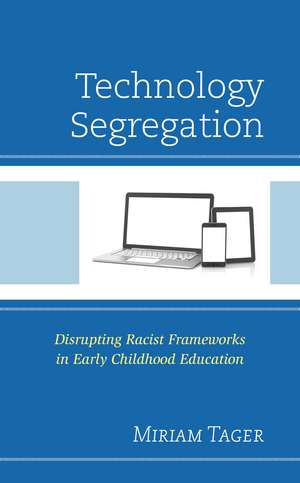
Technology Segregation: Disrupting Racist Frameworks in Early Childhood Education: Race and Education in the Twenty-First Century
Autor Miriam Tageren Limba Engleză Hardback – 8 noi 2019
Din seria Race and Education in the Twenty-First Century
- 33%
 Preț: 542.27 lei
 - 27%
 Preț: 264.02 lei
 - 31%
 Preț: 529.87 lei
 - 33%
 Preț: 550.36 lei
 - 23%
 Preț: 329.17 lei
 - 23%
 Preț: 322.16 lei
 - 33%
 Preț: 546.41 lei
 - 27%
 Preț: 263.04 lei
 - 27%
 Preț: 254.02 lei
 - 27%
 Preț: 271.02 lei
 - 28%
 Preț: 220.15 lei
 - 28%
 Preț: 219.66 lei
 - 28%
 Preț: 222.03 lei
 - 27%
 Preț: 260.93 lei
 - 31%
 Preț: 498.26 lei
 - 26%
 Preț: 279.94 lei
 - 28%
 Preț: 220.06 lei
 - 28%
 Preț: 219.54 lei
 - 27%
 Preț: 268.35 lei
 - 37%
 Preț: 501.74 lei
 - 32%
 Preț: 489.94 lei
 - 33%
 Preț: 516.80 lei
 - 31%
 Preț: 463.70 lei
 - 32%
 Preț: 491.31 lei
 - 28%
 Preț: 385.70 lei
 - 33%
 Preț: 545.52 lei
 - 32%
 Preț: 489.39 lei
 - 28%
 Preț: 220.15 lei
 - 28%
 Preț: 222.63 lei
 - 30%
 Preț: 502.83 lei
Preț: 535.67 lei
Preț vechi: 767.83 lei
-30%
Puncte Express: 804
Carte tipărită la comandă
Livrare economică 27 noiembrie-11 decembrie
Livrare prin curier în România Termenul estimat este afișat lângă disponibilitate.
Transport gratuit pentru acest produs Plată online sau ramburs, în funcție de opțiunile comenzii.
Retur gratuit în 14 zile Comandă securizată și suport în română.
Specificații
ISBN-13: 9781498584432
ISBN-10: 1498584438
Pagini: 158
Ilustrații: 1 tables;
Dimensiuni: 159 x 232 x 18 mm
Greutate: 0.4 kg
Editura: Bloomsbury Publishing
Colecția Lexington Books
Seria Race and Education in the Twenty-First Century
Locul publicării:New York, United States
ISBN-10: 1498584438
Pagini: 158
Ilustrații: 1 tables;
Dimensiuni: 159 x 232 x 18 mm
Greutate: 0.4 kg
Editura: Bloomsbury Publishing
Colecția Lexington Books
Seria Race and Education in the Twenty-First Century
Locul publicării:New York, United States
Cuprins
Chapter One: Introduction to Two Different Worlds
Chapter Two: Residential Segregation = School Segregation
Chapter Three: Segregated Schooling: Separate and Still Unequal
Chapter Four: Technology Infrastructure and the Digital Divide
Chapter Five: Technology and Whiteness
Chapter Six: Money Matters: All about School Funding
Chapter Seven: Oppressive Policies
Chapter Eight: Methods of Disruption
Chapter Two: Residential Segregation = School Segregation
Chapter Three: Segregated Schooling: Separate and Still Unequal
Chapter Four: Technology Infrastructure and the Digital Divide
Chapter Five: Technology and Whiteness
Chapter Six: Money Matters: All about School Funding
Chapter Seven: Oppressive Policies
Chapter Eight: Methods of Disruption
Recenzii
The author's experience working in early childhood education is evident from the numerous vignettes and sample conversations she recounts-elements that give face to students of color affected by the segregative practices she details. Tager (Westfield State Univ.) presents numerous citations and statistics illustrating the level of inequity and the inaccurate assumptions regarding many young students' access to technology. Beyond the discussion of technology segregation, the book explores deeper issues of racism in schools and the historical development of the modern segregated school and segregated neighborhood as they grew out of economic and political events. The economic aspect of technology segregation, and of racism on the whole, is a central topic and the subject of much reflection throughout the book. The work culminates in suggestions for disrupting systemic racism as it currently manifests in school systems using a multifaceted approach. Technology Segregation does a wonderful job of drawing attention to issues of racism in early childhood education, and is certainly a worthwhile read even for those without a strong technology focus in their classrooms. Summing Up: Highly recommended. Lower-division undergraduates through faculty; professionals.
This engaging and accessible book draws from rich classroom observation and histories of segregation in housing, education and broader society to confront technology apartheid in US communities. Detailing the persistent digital divide in children's daily lives, Miriam Tager sheds needed light on "technology racism" and systematically documents ways in which children's lack of access to taken for granted technologies has material consequences for their school and life success and contributes to overrepresentation in special education. Moving from systematic critique to engaging strategies for change, readers are challenged to disrupt racism in technology access and other arenas and engage in restorative justice.
This ground-breaking book uses the framework of critical race theory to unpack the issue of technology segregation and how it disenfranchises young citizens of color in the United States. Drawing from qualitative data collected in early childhood classrooms in the Northern United States, this book clearly shows how teachers of young children can unconsciously perpetuate systems of inequity and inequality through their technology choices. But most powerfully this book offers concrete suggestions as to how such racist frameworks and actions can be disrupted and upended. This book will be of interest to any and all early childhood educators at any level particularly those with an interest in technology and social justice.
This engaging and accessible book draws from rich classroom observation and histories of segregation in housing, education and broader society to confront technology apartheid in US communities. Detailing the persistent digital divide in children's daily lives, Miriam Tager sheds needed light on "technology racism" and systematically documents ways in which children's lack of access to taken for granted technologies has material consequences for their school and life success and contributes to overrepresentation in special education. Moving from systematic critique to engaging strategies for change, readers are challenged to disrupt racism in technology access and other arenas and engage in restorative justice.
This ground-breaking book uses the framework of critical race theory to unpack the issue of technology segregation and how it disenfranchises young citizens of color in the United States. Drawing from qualitative data collected in early childhood classrooms in the Northern United States, this book clearly shows how teachers of young children can unconsciously perpetuate systems of inequity and inequality through their technology choices. But most powerfully this book offers concrete suggestions as to how such racist frameworks and actions can be disrupted and upended. This book will be of interest to any and all early childhood educators at any level particularly those with an interest in technology and social justice.
Notă biografică
Miriam Tager is associate professor of Early Childhood Education at Westfield State University in Massachusetts.