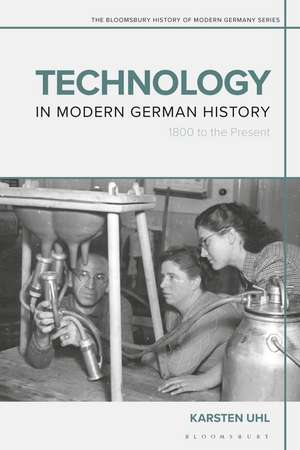
Technology in Modern German History: 1800 to the Present: The Bloomsbury History of Modern Germany Series
Autor Dr Karsten Uhlen Limba Engleză Paperback – 24 aug 2023
The book investigates the role technology played in transforming Germany's culture, society and politics during the 19th and 20th centuries. Key topics covered include the different stages of industrialization, the growth of networked cities, and the triumph of a teleological narrative of technology as progress. Moreover, it provides a critical revision of the history of high technology which reveals how high-tech euphoria determined certain paths in history regardless of whether the respective technology proved to be successful.
In its second part, the volume introduces new avenues in scholarship. Karsten Uhl examines neglected areas, such as rural technologies or the often-overlooked importance of everyday technologies: How did consumers or workers use new technologies? How did they appropriate and modify them? Lastly, the book considers the final decades of the 20th century and asks if they provided a significant new quality of technological change: To what degree and effects did computerization transform professional and private life in Germany? In culture and politics, reinforced by the German variety of environmentalism, the idea of progress was challenged, as the once prevailing vision of progress gave way to new apprehensions of uncertainty evident to this day.
Technology in Modern German History brings fascinating insight into a much neglected area of German history for students and scholars alike.


Preț: 199.22 lei
Preț vechi: 280.37 lei
-29%
Puncte Express: 299
Carte tipărită la comandă
Livrare economică 24 octombrie-07 noiembrie
Livrare prin curier în România Termenul estimat este afișat lângă disponibilitate.
Transport gratuit de la 400.00 lei Plată online sau ramburs, în funcție de opțiunile comenzii.
Retur gratuit în 14 zile Comandă securizată și suport în română.
Specificații
ISBN-13: 9781350289949
ISBN-10: 1350289949
Pagini: 290
Ilustrații: 22 bw illus
Dimensiuni: 150 x 229 x 15 mm
Greutate: 0.45 kg
Editura: Bloomsbury Publishing
Colecția Bloomsbury Academic
Seria The Bloomsbury History of Modern Germany Series
Locul publicării:London, United Kingdom
ISBN-10: 1350289949
Pagini: 290
Ilustrații: 22 bw illus
Dimensiuni: 150 x 229 x 15 mm
Greutate: 0.45 kg
Editura: Bloomsbury Publishing
Colecția Bloomsbury Academic
Seria The Bloomsbury History of Modern Germany Series
Locul publicării:London, United Kingdom
Cuprins
List of Images
Introduction
Part I - Tracing the History
1. Industrialization and Beyond
2. Urban Technologies
3. High Technology
4. Visions of Progress
Part II - New Directions
5. The Human Body in a Highly 'Technified' Environment
6. Rural Technologies
7. Everyday Technologies
8. Apprehensions of Uncertainty
Conclusion
Appendix: Sources and Annotated Bibliography
Index
Introduction
Part I - Tracing the History
1. Industrialization and Beyond
2. Urban Technologies
3. High Technology
4. Visions of Progress
Part II - New Directions
5. The Human Body in a Highly 'Technified' Environment
6. Rural Technologies
7. Everyday Technologies
8. Apprehensions of Uncertainty
Conclusion
Appendix: Sources and Annotated Bibliography
Index
Recenzii
Technology has been fundamental to German political, economic, social, and cultural development. Karsten Uhl provides the first systematic overview of its central role since the 19th century, incorporating classic studies of key technologies with findings and emerging themes from the most recent literature.
Technology in Modern German History is the first comprehensive study to explore the profound significance of technology in modern German history. This study is insightful, interesting, and eminently readable and will be of interest both to scholars and students.
Karsten Uhl's Technology in Modern German History serves as an excellent introduction to the history of technology in Germany. The book's secondary source materials explicitly build on foundational texts within the field of history of technology, thereby reenforcing the book's position as an overview resource, one that serves to introduce students not only to German history of technology but also to the history of technology as a whole.
Technology in Modern German History is an excellent and stimulating overview of essential themes in the history of German technology with a helpful bibliography of English-language sources.
This is a highly readable and informative survey that succeeds in covering many important features of the history of technology in Germany and convincingly integrates recent methodological developments.
A critical and comprehensive work that is indeed essential reading for anyone who wants to understand the profound impact of technology on Germany's development. The work not only gives the reader access to classic works in the field, but also provides new insights and stimulates the reader's interest in exploring the field of academic research in depth.
Karsten Uhl has written a valuable book that will help readers grasp both the complexity and richness of the German technological heritage.
Technology in Modern German History is the first comprehensive study to explore the profound significance of technology in modern German history. This study is insightful, interesting, and eminently readable and will be of interest both to scholars and students.
Karsten Uhl's Technology in Modern German History serves as an excellent introduction to the history of technology in Germany. The book's secondary source materials explicitly build on foundational texts within the field of history of technology, thereby reenforcing the book's position as an overview resource, one that serves to introduce students not only to German history of technology but also to the history of technology as a whole.
Technology in Modern German History is an excellent and stimulating overview of essential themes in the history of German technology with a helpful bibliography of English-language sources.
This is a highly readable and informative survey that succeeds in covering many important features of the history of technology in Germany and convincingly integrates recent methodological developments.
A critical and comprehensive work that is indeed essential reading for anyone who wants to understand the profound impact of technology on Germany's development. The work not only gives the reader access to classic works in the field, but also provides new insights and stimulates the reader's interest in exploring the field of academic research in depth.
Karsten Uhl has written a valuable book that will help readers grasp both the complexity and richness of the German technological heritage.