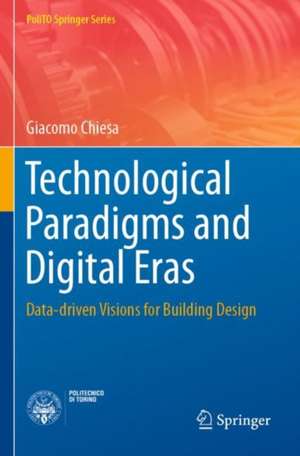
Technological Paradigms and Digital Eras: PoliTO Springer Series
Autor Giacomo Chiesaen Limba Engleză Paperback – 15 aug 2020
Din seria PoliTO Springer Series
- 15%
 Preț: 660.76 lei
 - 20%
 Preț: 670.48 lei
 - 20%
 Preț: 632.54 lei
 - 20%
 Preț: 624.53 lei
 - 18%
 Preț: 1124.84 lei
 - 23%
 Preț: 692.25 lei
 - 24%
 Preț: 625.15 lei
 - 20%
 Preț: 673.91 lei
 - 18%
 Preț: 755.00 lei
 - 15%
 Preț: 662.81 lei
 - 18%
 Preț: 1225.26 lei
 - 18%
 Preț: 1006.04 lei
 - 18%
 Preț: 729.30 lei
 -
 Preț: 484.83 lei
 -
 Preț: 371.20 lei
 -
 Preț: 368.59 lei
 - 15%
 Preț: 613.80 lei
 - 18%
 Preț: 852.21 lei
 - 24%
 Preț: 772.44 lei
Preț: 624.04 lei
Preț vechi: 780.05 lei
-20%
Puncte Express: 936
Carte tipărită la comandă
Livrare economică 30 noiembrie-07 decembrie
Livrare prin curier în România Termenul estimat este afișat lângă disponibilitate.
Transport gratuit pentru acest produs Plată online sau ramburs, în funcție de opțiunile comenzii.
Retur gratuit în 14 zile Comandă securizată și suport în română.
Specificații
ISBN-13: 9783030262013
ISBN-10: 3030262014
Pagini: 212
Ilustrații: XVII, 192 p. 88 illus., 31 illus. in color.
Dimensiuni: 155 x 235 x 11 mm
Greutate: 0.37 kg
Ediția:1st ed. 2020
Editura: Springer
Colecția PoliTO Springer Series
Seria PoliTO Springer Series
Locul publicării:Cham, Switzerland
ISBN-10: 3030262014
Pagini: 212
Ilustrații: XVII, 192 p. 88 illus., 31 illus. in color.
Dimensiuni: 155 x 235 x 11 mm
Greutate: 0.37 kg
Ediția:1st ed. 2020
Editura: Springer
Colecția PoliTO Springer Series
Seria PoliTO Springer Series
Locul publicării:Cham, Switzerland
V-ar putea interesa
-
 Autogenous Shrinkage of ConcreteEi-ichi Tazawa-15%Preț: 575.76 lei677.37 lei
 -
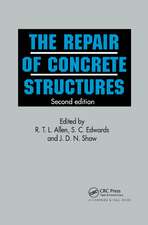 Repair of Concrete StructuresR T L Allen-15%Preț: 529.28 lei622.69 lei
 -
 Application of Admixtures in ConcreteA.M. Paillere-15%Preț: 530.47 lei624.09 lei
 -
 -15%Preț: 530.47 lei624.09 lei
 -
 -15%Preț: 585.78 lei689.15 lei
 -
 Mechanisms of Chemical Degradation of Cement-based SystemsK.L. Scrivener-15%Preț: 558.77 lei657.38 lei
 -
 Self-Consolidating Concrete: Applying what we knowJoseph DaczkoPreț: 488.80 lei
 -
 Special Inorganic CementsIvan Odler-15%Preț: 570.23 lei670.86 lei
 -
 -15%Preț: 530.47 lei624.09 lei
 -
 -18%Preț: 1242.71 lei1515.51 lei
 -
 Case Studies in Building RehabilitationJ. M. P. Q. Delgado-15%Preț: 612.76 lei720.90 lei
 -
 Hygrothermal Behaviour and Building PathologiesJ. M. P. Q. Delgado-15%Preț: 612.60 lei720.70 lei
 -
 -24%Preț: 1827.65 lei2404.80 lei
 -
 Operations and Basic Processes in IronmakingJosé Ignacio Verdeja GonzálezPreț: 403.80 lei
 -
 Innovations and Technologies in ConstructionSergey Vasil'yevich Klyuev-18%Preț: 1436.22 lei1751.48 lei
 -
 -18%Preț: 1244.24 lei1517.37 lei
 -
 Bioclimatic Approaches in Urban and Building DesignGiacomo Chiesa-18%Preț: 1124.84 lei1371.76 lei
 -
 Innovations in Ventilative CoolingGiacomo Chiesa-18%Preț: 1225.26 lei1494.23 lei
 -
 Coupled System Pavement - Tire - VehicleMichael Kaliske-18%Preț: 1267.46 lei1545.69 lei
 -
 Preț: 249.55 lei
 -
 Akustik und RaumklimaArmin RaabePreț: 124.58 lei
 -
 Sustainable Civil Engineering PracticesVarinder S. Kanwar-18%Preț: 1593.99 lei1943.89 lei
 -
 -18%Preț: 1218.32 lei1485.76 lei
 -
 Recent Developments in Sustainable InfrastructureBibhuti Bhusan Das-24%Preț: 1708.56 lei2248.09 lei
 -
 Icscea 2019J. N. Reddy-20%Preț: 1015.42 lei1269.27 lei
 -
 Structural Health Monitoring and Engineering StructuresTinh Quoc Bui-18%Preț: 1905.28 lei2323.51 lei
 -
 Preț: 412.10 lei
Cuprins
Introduction.- ICT, data and design issues.- Modelling reality, modelling virtuality.- Scripting and parametric CAD modelling for performance-driven design.- Real time monitoring.- Platform – A space for project design and an interface between reality and virtuality.- Data, properties, smart city.- Conclusions.
Textul de pe ultima copertă
The book connects the ICT and the architectural worlds, analyzing modeling, materialization and data-driven visions for design issues at different scales. Furthermore, using sample modeling and materialization tools, it explores the links between performance-driven design approaches and the application of new digital technologies. Intended for architects and urbanists, it provides a theoretical framework to address the implications of the digital revolution in building design and operation. Furthermore, combining insights from IT and ICT with architectural and urban design know-how, it offers engineering professionals a technology-driven interpretation of the building design field.
Caracteristici
Explores the theories and methodologies on which elaboration and management of data for urban and building design are based Demonstrates the need to rethink current methods and tools by re-designing operations taking into consideration the effects of ICT on human activities Includes easy-to-understand practical examples that can be replicated by readers