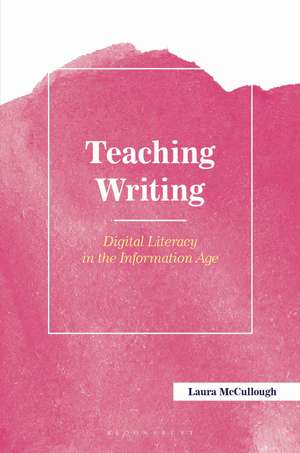
Teaching Writing: Digital Literacy in the Information Age: Teaching Writing Series
Autor Laura McCulloughen Limba Engleză Paperback – 8 mai 2027


Preț: 182.51 lei
Preț vechi: 201.34 lei
-9% Precomandă
Puncte Express: 274
Carte nepublicată încă
Livrare prin curier în România Precomanda se expediază când titlul devine disponibil.
Transport gratuit de la 400.00 lei Plată online sau ramburs, în funcție de opțiunile comenzii.
Retur gratuit în 14 zile Comandă securizată și suport în română.
Doresc să fiu notificat când acest titlu va fi disponibil:
Se trimite...
Specificații
ISBN-13: 9798216482062
Pagini: 128
Dimensiuni: 152 x 229 mm
Editura: Bloomsbury Publishing
Colecția Bloomsbury Academic
Seria Teaching Writing Series
Locul publicării:New York, United States
Pagini: 128
Dimensiuni: 152 x 229 mm
Editura: Bloomsbury Publishing
Colecția Bloomsbury Academic
Seria Teaching Writing Series
Locul publicării:New York, United States
Cuprins
Chapter 1. Digital and Information Literacy in the age of technology
Sample syllabus and introduction
Chapter 2. WHO ARE WE AND WHERE ARE WE FROM? Intersectionality and locating ourselves as citizens
Identity and the lenses we see the world through. We all have identity variables and roles that overlap and shape how we see the world (and sometimes how the world sees us).
Chapter 3. Exploring Truth: opinion vs an assertion.
Not all opinions are equal. How to frame and assertion. How to assess an opinion.
Chapter 4. Understanding DiQerent types of bias
Bias comes in many shapes and forms including our own tendency to look for confirmation bias. How to recognize and understand bias.
Chapter 5. Trust and information: Authority and credibility
Fake news. Fun news. Comedy and entertainment. Lateral research is a survival skill in the digital age!
Chapter 6. Not your grandparents' research: skills for the times we are in
Research documentation: just a bread crumb trail in the woods of the digital world: Understanding research protocol: the basics aren't hard!
Chapter 7. Integration and synthesis: why you matter
A paper is a combination of heart, mind, and information.
Chapter 8: Becoming reflective: thinking and telling
Reflection is a soft skill in a culture of "urgency": slow down and consider the roses!
Chapter 9: Story matters: narrative theory and humanity
Why narrative matters and the importance of story in our lives
Chapter 10: Conflict is part of life, but why is everybody fighting?
Slowing down, cultivating curiosity, and learning to fight fairly
Chapter 11: Ethos, logos, and pathos: a rhetoric of love
Civil discourse is just a fancy way of saying we need to listen to each other even when we disagree, and how to bring this all close to home?
Chapter 12: Practicing civil discourse: how to ask good questions
The gift of a listening face: communication basics and making it easy for even the shy ones
Chapter 13: Making it personal: thinking deeply and communicating truly
Becoming a "meaning maker" in times of uncertainty
Chapter 14: Research and our lived experience: relationality and ancestry
Research and document a specific aspects of family, culture, personal history, ancestry, or the ancestry of an ethnic group or culture. What does it mean to be human? What does it mean to be an American?
Chapter 15: Research and ideas: what we need to know and how
Exploring the divergence between conflict resolution and conflict transformation, Non-violent communication (NVC), Attachment theory, Relational health, interpersonal communication skills, the break down in civil engagement, narrative theory and the importance of story, or any number of related ideas: students become creators who apply ideas to their own lives.