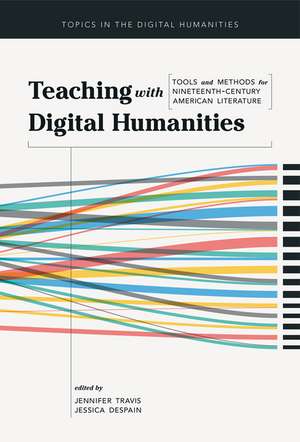
Teaching with Digital Humanities: Tools and Methods for Nineteenth-Century American Literature: Topics in the Digital Humanities
Editat de Jennifer Travis, Jessica DeSpain Contribuţii de Nicole N Aljoe, Elizabeth Argentieri, Blair Best, Tisha M Brooks, Madeleine (Maddie) G Cella, Benjamin J Doyle, Amy E Earhart, Duncan Faherty, Eric Gardner, Ella L Gill, Clayton Grimm, Cynthia L Hallen, Molly O'Hagan Hardy, Elizabeth Hopwood, Teagan Rabuano, Ashley Reed, Lawrence G Richardson, Augusta Rohrbach, Victoria K Sprowls, Catherine Waitinas, Ed Whiteen Limba Engleză Hardback – 15 noi 2018
A supplemental companion website with substantial appendixes of syllabi and assignments is now available for readers of Teaching with Digital Humanities.
Din seria Topics in the Digital Humanities
-
 Preț: 210.15 lei
 -
 Preț: 217.57 lei
 -
 Preț: 173.05 lei
 - 20%
 Preț: 663.49 lei
 -
 Preț: 173.05 lei
 -
 Preț: 157.04 lei
 -
 Preț: 218.96 lei
Preț: 700.44 lei
Preț vechi: 808.26 lei
-13%
123.87€ • 146.87$ • 107.85£
Carte indisponibilă temporar
Specificații
ISBN-10: 0252042239
Pagini: 298
Ilustrații: 2 black & white photographs, 3 tables
Dimensiuni: 156 x 235 x 25 mm
Greutate: 0.57 kg
Editura: University of Illinois Press
Colecția University of Illinois Press
Seria Topics in the Digital Humanities
V-ar putea interesa
-
 Wounded HeartsJennifer TravisPreț: 268.31 lei
 -
 -18%Preț: 1198.21 lei1461.24 lei
 -
 Poetry Says SomethingMargaret WolfordPreț: 60.44 lei
 -
 An Adaptation of William Shakespeare's MacbethDavid AndaloraPreț: 52.46 lei
 -
 Teaching Creativity in Marketing and Business EducationStephen P. Ramocki Ph. D.Preț: 189.04 lei
 -
 Keys to MeaningCarmen Y. ReyesPreț: 74.30 lei
 -
 Literature Circle Assessment ProjectsJohn D. MorgantiPreț: 68.92 lei
 -
 Lapbooking Through American GovernmentMrs Catherine McGrew JaimePreț: 51.63 lei
 -
 Litwits Workshops Sensory Enrichment GuideLitwits WorkshopsPreț: 91.11 lei
 -
 Douggie's Super Science AdventuresMichael BrumagePreț: 57.45 lei
 -
 Preț: 137.92 lei
 -
 Common Core Language Synonyms and Antonyms Elementary WorkbookTest Master Press, Common Core DivisionPreț: 110.54 lei
 -
 -34%Preț: 525.65 lei791.72 lei
 -
 Tutor Your ChildrenTaran JonesPreț: 261.92 lei
 -
 Great Math TricksSribatsa DasPreț: 42.00 lei
 -
 Peter the Speed ReaderPatrick G. EspositoPreț: 95.14 lei
 -
 Preț: 100.69 lei
 -
 Cry of the Earth - Cry of the PoorMR Ovide BastienPreț: 78.52 lei
Recenzii
"Relevant not only to practitioners and theorists of digital humanities but also to students and scholars of 19th-century American literature. . . . Highly recommended." --Choice
"In this compelling collection of essays, Travis and DeSpain explore the many ways in which digital humanities scholarship is remaking the pedagogy of nineteenth-century American literature. Teaching with Digital Humanities highlights the virtues of estrangement--how we can better see books, manuscripts, and newspapers once they've been tagged, aggregated, or otherwise reconfigured. Both the material forms of texts and the contents they convey are ripe for fresh analysis in a digital environment. This book is an invaluable guide to teaching within a new horizon of possibility introduced by digital methods."--Kenneth M. Price, coeditor of The Walt Whitman Archive
Notă biografică
Descriere
Jennifer Travis and Jessica DeSpain present a long-overdue collection of theoretical perspectives and case studies aimed at teaching nineteenth-century American literature using digital humanities tools and methods. Scholars foundational to the development of digital humanities join educators who have made digital methods central to their practices. Together they discuss and illustrate how digital pedagogies deepen student learning. The collection's innovative approach allows the works to be read in any order. Travis and DeSpain curate conversations on the value of project-based, collaborative learning; examples of real-world assignments where students combine close, collaborative, and computational reading; how digital humanities aids in the consideration of marginal texts; the ways in which an ethics of care can help students organize artifacts; and how an activist approach affects debates central to the study of difference in the nineteenth century.
A supplemental companion website with substantial appendixes of syllabi and assignments is now available for readers of Teaching with Digital Humanities.