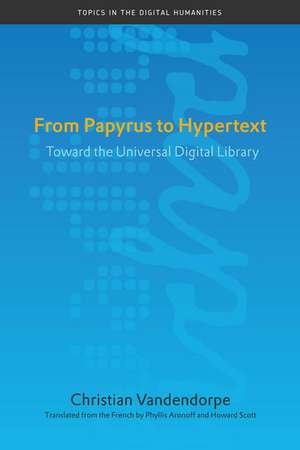
From Papyrus to Hypertext: Toward the Universal Digital Library: Topics in the Digital Humanities
Autor Christian Vandendorpe Traducere de Phyllis Aronoff, Howard Scotten Limba Engleză Paperback – 23 mar 2009
Subliniem natura profund interdisciplinară a lucrării From Papyrus to Hypertext, un studiu care intersectează istoria cărții, psihologia cognitivă și informatica pentru a cartografia transformarea lecturii în era digitală. Christian Vandendorpe nu se limitează la o analiză tehnologică, ci investighează modul în care mediile digitale și internetul au alterat procesele de cercetare, ipotezele despre public și teoriile memoriei. Ne-a atras atenția modul în care autorul reflectă asupra întregii istorii a cuvântului scris, demonstrând cum materialitatea suportului influențează direct interpretarea textelor.
Observăm o organizare riguroasă în 27 de secțiuni tematice care ghidează cititorul printr-o progresie logică: de la fixarea gândirii prin scris și standardele de lizibilitate, până la conceptele complexe de liniaritate și tabularitate. Cartea analizează elemente inovatoare ale textului digital, cum ar fi hyperlink-urile și emoticoanele, dar și genuri colaborative emergente precum blogurile, care estompează distincția tradițională dintre autor și cititor. Lucrarea acoperă aceeași arie ca Text and Genre in Reconstruction, dar cu o abordare mai orientată spre evoluția istorică a formelor textuale și spre impactul cognitiv al tranziției de la pagină la ecran.
Spre deosebire de alte titluri care tratează digitalizarea doar ca pe o schimbare de format, Christian Vandendorpe oferă o perspectivă critică asupra modului în care „hiperficțiunea” și noile stiluri de adnotare redefinesc experiența umană de asimilare a informației. Este o resursă esențială pentru înțelegerea modului în care accesibilitatea universală și digitalizarea continuă să modeleze viitorul alfabetizării.
Din seria Topics in the Digital Humanities
- 20%
 Preț: 245.96 lei
 -
 Preț: 233.16 lei
 -
 Preț: 189.80 lei
 -
 Preț: 219.08 lei
 -
 Preț: 193.83 lei
 -
 Preț: 228.67 lei
Preț: 219.35 lei
Carte disponibilă
Livrare economică 13-27 noiembrie
Specificații
ISBN-10: 0252076257
Pagini: 208
Ilustrații: 10 black & white photographs; 1 line drawing; 1 table
Dimensiuni: 152 x 229 x 15 mm
Greutate: 0.29 kg
Ediția:1st Edition
Editura: University of Illinois Press
Colecția University of Illinois Press
Seria Topics in the Digital Humanities
V-ar putea interesa
-
 Octavia E. ButlerGerry CanavanPreț: 158.03 lei
 -
 World Greatest Short StoriesJerry AyersPreț: 59.12 lei
 -
 El Famoso MillenniumCerintoPreț: 103.88 lei
 -
 The Old Lady and the Meadow MouseMargaret HarbourPreț: 93.88 lei
 -
 The TruceJuanita Noyola TobiasPreț: 137.33 lei
 -
 Scars, Water, and ItaliansSara ErlichmanPreț: 136.25 lei
 -
 The Collected Pulp Era Volume 1Lynn HickmanPreț: 183.14 lei
 -
 FantasyAlain PelosatoPreț: 34.24 lei
 -
 The GiftSheldon CohenPreț: 135.69 lei
 -
 “I Hate Feminists!”: December 6, 1989 and its AftermathMelissa Blais-19%Preț: 97.14 lei119.87 lei
De ce să citești această carte
Această carte se adresează cercetătorilor din domeniul științelor umaniste digitale și profesioniștilor din biblioteconomie sau editare. Cititorul câștigă o perspectivă istorică clară asupra modului în care suportul fizic — de la papirus la ecran — ne modelează gândirea. Este un instrument teoretic valoros care explică de ce modul în care citim astăzi pe internet este fundamental diferit de lectura tradițională, oferind argumente solide despre viitorul bibliotecilor universale.
Despre autor
Christian Vandendorpe este un distins profesor și teoretician, recunoscut pentru contribuțiile sale în domeniul semioticii și al științelor umaniste digitale. Interesul său academic se concentrează pe istoria lecturii și pe impactul tehnologiilor informaționale asupra proceselor cognitive și culturale. În From Papyrus to Hypertext, tradusă în limba engleză de Phyllis Aronoff și Howard Scott, Vandendorpe își folosește expertiza pentru a demonstra că tranziția către digital nu este doar o schimbare tehnică, ci o mutație culturală majoră care redefinește relația dintre text și societate.
Descriere scurtă
Recenzii
"In forty pithy essays, the author considers technological innovations that have transformed writing, altering the activity of reading and the processing of texts, individually and collectively. . . . The book's fragmentary organization--the adroit syntheses can be read in any order--makes it exceptionally accessible ... for the born-digital generation. . . . Essential."--Choice
Notă biografică
Cuprins
1. Introduction 1
2. In the Beginning Was the Ear 5
3. Writing and the Fixation of Thought 8
4. The Power of the Written Sign 10
5. Writing and Orality 12
6. Standards of Readability 15
7. Linearity and Tabularity 22
8. Toward the Tabular Text 28
9. Meaning and Effect 40
10. Filters in Reading 49
11. Textuality: Form and Substance 52
12. Textual Connections 56
13. Instances of Utterance 59
14. From Interactivity to the Pseudo-Text 63
15. Varieties of Hypertext 70
16. Context and Hypertext 77
17. The Limitations of Lists 80
18. Aporias of Hyperfiction 82
19. Reading Images 87
20. The Writer and Images 94
21. The Rise of the Visual 97
22. The Period, the Pause, and the Emoticon 102
23. Op. cit. 105
24. The Reader: User or Consumer of Signs/ 108
25. Intensive and Extensive Reading, or the Rights of the Reader 112
26. Metaphors for Reading 116
27. Representations of the Book 119
28. The Role of the Publisher 121
29. The CD-ROM and Nostalgia for teh Papyrus Scroll 123
30. Giving the Reader Control 125
31. Text and Interactivity 129
32. Managing Hyperlinks 131
33. I Click, Therefore I Read 133
34. The End of the Page? 136
35. On the Fragment 143
36. The Body of the Text 146
37. The Decline of the Novel 149
38. The Rise of the Blog 152
39. A Culture of Participation and Sharing 155
40. Toward the Universal Digital Library 159
Notes 167
References 177
Index 187