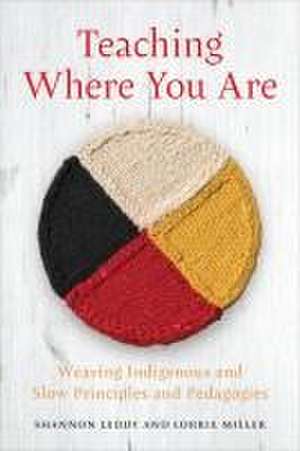
Teaching Where You Are
Autor Shannon Leddy, Lorrie Milleren Limba Engleză Paperback – 17 noi 2023
Using the holistic framework of the Medicine Wheel, Shannon Leddy and Lorrie Miller illustrate the ways in which interdisciplinary thinking, a focus on experiential learning, and the thoughtful application of the 4Rs - Respect, Relevance, Reciprocity, and Responsibility - can bring us back to the principle of teaching people, not subjects. Bringing forth the ways in which colonialism and cognitive imperialism have shaped Canadian curriculum and consciousness, the book offers avenues for the development of decolonial literacy to support the work of Indigenizing education. In considering the importance of engaging in decolonizing and Indigenizing approaches to education through Slow and Indigenous pedagogies using the lens of place-based and land-based education, Teaching Where You Are presents a text useful for teachers and educators grappling with the ongoing impacts of colonialism and the soul-work of how to decolonize and rehumanize education in meaningful ways.
Preț: 201.37 lei
Puncte Express: 302
Carte disponibilă
Livrare economică 07-21 decembrie
Livrare express 21-27 noiembrie pentru 22.72 lei
Livrare prin curier în România Termenul estimat este afișat lângă disponibilitate.
Transport gratuit de la 400.00 lei Plată online sau ramburs, în funcție de opțiunile comenzii.
Retur gratuit în 14 zile Comandă securizată și suport în română.
Specificații
ISBN-13: 9781487554019
ISBN-10: 148755401X
Pagini: 192
Ilustrații: 15 colour illustrations and 2 b&w figures; 15 Illustrations, unspecified
Dimensiuni: 146 x 226 x 13 mm
Greutate: 0.33 kg
Editura: University of Toronto Press
ISBN-10: 148755401X
Pagini: 192
Ilustrații: 15 colour illustrations and 2 b&w figures; 15 Illustrations, unspecified
Dimensiuni: 146 x 226 x 13 mm
Greutate: 0.33 kg
Editura: University of Toronto Press
Notă biografică
Shannon Leddy is an associate professor of Art Education at the University of British Columbia.
Cuprins
List of Illustrations
Abbreviations
Foreword: Weaving and Reweaving Indigenous Education in New Ways through the Timelessness of Transformative Thought, Teaching, and Learning xvii
Herman Michell
Preface
Acknowledgements
1. Tawâw
Bringing Indigenous Knowledge and Pedagogies into the Class
Indigenous Ways and Reconciliation
The Medicine Wheel Framework, Our Loom
Warp and Weft: Connecting Slow to Indigenous Ways
2. Building Decolonial Literacy for Indigenous Education
Historically Rooted Thought: We Are All Colonized People
It Is Not about the Lesson Plans
Ontologies
Identity
Place
Relationship
Weaving
Sourcing and Preparing Materials
3. Slow Ways and Indigenous Ways
Disconnecting from the Clock and Caring Deeply
Experiential
Land Conscious/Place Conscious
Deeply Relational
Internal Connection
Spinning
4. East - Spiritual - Respect
August on the Salish Sea: Tucked into a Bay
Dyeing the Yarn before the Weave
5. South - Emotional - Relevance
Why Emotion Matters
Decolonizing Is a Slow and Careful Business
Taking Trauma into Account
Developing Effective Practices
Circle Pedagogy
Winding the Wool
6. West - Physical - Reciprocity
The Unseen
The Visible, Physical, Material World
In the Classroom
Pedagogy that Nurtures
Relational Place-Conscious Pedagogy
Setting up the Loom
7. North - Intellectual - Responsibility
What Counts as Knowledge? How Much Knowledge Counts?
It Really Isn’t about the Lesson Plans
Adding an Indigenous Lens
Developing Effective Practices
Kendomang Zhagodenamonon Lodge
Button Blankets and Starblankets
Tiny Orange Sweater Project
Summing Up
Weaving and Finishing
8. Pimoteh (Walking)
References
Index
Descriere
Drawing on First Peoples Principles of Education, this book highlights the ways in which Indigenous learning and pedagogies parallel the western notion of Slow pedagogy.