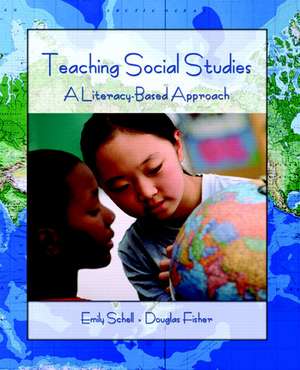
Teaching Social Studies: A Literacy-Based Approach
Autor Emily Schell, Douglas R. Fisheren Limba Engleză Paperback – 30 sep 2006
Preț: 744.75 lei
Preț vechi: 967.21 lei
-23%
Puncte Express: 1117
Carte tipărită la comandă
Livrare economică 26 noiembrie-10 decembrie
Livrare prin curier în România Termenul estimat este afișat lângă disponibilitate.
Transport gratuit pentru acest produs Plată online sau ramburs, în funcție de opțiunile comenzii.
Retur gratuit în 14 zile Comandă securizată și suport în română.
Specificații
ISBN-13: 9780131700178
ISBN-10: 0131700170
Pagini: 276
Dimensiuni: 192 x 232 x 12 mm
Greutate: 0.46 kg
Ediția:1
Editura: PEARSON MERRILL PRENTICE HALL
Locul publicării:Boston, United States
ISBN-10: 0131700170
Pagini: 276
Dimensiuni: 192 x 232 x 12 mm
Greutate: 0.46 kg
Ediția:1
Editura: PEARSON MERRILL PRENTICE HALL
Locul publicării:Boston, United States
V-ar putea interesa
-
 AQA A Level Sociology Student Book 1Dave AikenPreț: 262.20 lei
 -
 How to Teach Your Children ShakespeareKen Ludwig-18%Preț: 95.95 lei116.49 lei
 -
 Preț: 192.94 lei
 -
 Outside the box 9-11Molly Potter-41%Preț: 100.93 lei172.41 lei
 -
 Preț: 288.73 lei
 -
 Spelling for Literacy for ages 8-9Andrew Brodie-41%Preț: 99.54 lei169.05 lei
 -
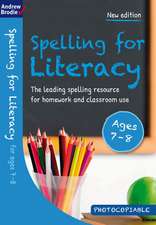 Spelling for Literacy for ages 7-8Andrew Brodie-40%Preț: 104.60 lei174.91 lei
 -
 -42%Preț: 75.08 lei129.13 lei
 -
 -8%Preț: 546.66 lei594.21 lei
 -
 -27%Preț: 86.90 lei119.42 lei
 -
 -19%Preț: 157.58 lei194.29 lei
 -
 Operation Order!: Black Ops - Gitmo GetawayJohn EnockPreț: 93.54 lei
Cuprins
1. What IS Social Studies?
2. Why Teach Social Studies?
3. What Do We Teach in Social Studies?
4. Teaching Social Studies for Understanding
5. Using Texts for Teaching and Learning Social Studies
6. Effective Uses of Literature to Teach Social Studies
7. Putting the Pieces Together: Curriculum Planning and Organization
8. Real-World Teaching and Learning
9. Student Achievement and Assessments
10. How Do We Share What We've Learned in Social Studies
2. Why Teach Social Studies?
3. What Do We Teach in Social Studies?
4. Teaching Social Studies for Understanding
5. Using Texts for Teaching and Learning Social Studies
6. Effective Uses of Literature to Teach Social Studies
7. Putting the Pieces Together: Curriculum Planning and Organization
8. Real-World Teaching and Learning
9. Student Achievement and Assessments
10. How Do We Share What We've Learned in Social Studies
Textul de pe ultima copertă
Dealing with the crucial classroom factors of national standards and legislation, as well as limited teaching time, Teaching Social Studies: A Literacy-Based Approach clearly guides new and established teachers through the planning, teaching, and assessing of social studies as it integrates powerful literacy strategies that will motivate students, deepen their understanding of social studies concepts, and strengthen their comprehension.
Teaching social studies has always been a challenge for educators. Doing it effectively requires commitment, organization, creativity, energy, and patience. The realities of today’s classroom limit the amount of time teachers can spend teaching social studies, but there has never been a time when social studies content has been more valuable, because it is through social studies that students learn to make sense of the world. They learn to become committed citizens of this global community; about the events, people, communications, advancements and conflicts of the past and their consequences on the present; and how to find their own place in history.
Integrating Literacy and Social Studies
This text is the best I have ever seen in the Social Studies field for content and strategies on how to develop a good literacy program for the Social Studies. Steven Thorpe, Southern OregonUniversity
Addressing the Realities of Today’s Classroom
The text clearly makes connections between social studies and the real world. It develops topics that are often barely mentioned, such as connections to real-world learning and combining reading and social studies. It focuses on the essential topics and develops them well. I think a student reading this book would come away with a good idea of how to teach social studies. Carolyn F. Riley, Northern IllinoisUniversity
Providing Tools for the Classroom
The specific literacy strategies are excellent. I found myself learning some new-to-me strategies that I’m excited to implement. This is a real strength. I can see my students marking these strategies with sticky notes for easy reference when they are in-service teachers. Sara W. Fry. BucknellUniversity
Teaching social studies has always been a challenge for educators. Doing it effectively requires commitment, organization, creativity, energy, and patience. The realities of today’s classroom limit the amount of time teachers can spend teaching social studies, but there has never been a time when social studies content has been more valuable, because it is through social studies that students learn to make sense of the world. They learn to become committed citizens of this global community; about the events, people, communications, advancements and conflicts of the past and their consequences on the present; and how to find their own place in history.
Integrating Literacy and Social Studies
- Information about teaching history, economy, geography, and the social sciences ensures students’ understanding of the content as well as their development of literacy skills.
- Book Links provide specific guidance for linking social studies content to motivating, enriching literature.
- History’s Finer Points features engage you in historical thinking that will enliven your teaching.
This text is the best I have ever seen in the Social Studies field for content and strategies on how to develop a good literacy program for the Social Studies. Steven Thorpe, Southern OregonUniversity
Addressing the Realities of Today’s Classroom
- Vignettes in every chapter reflect masterful, integrated teaching found in the real classrooms of committed, successful social studies teachers.
- Special attention is paid to assessment and Standards alignment when preparing strategies for teaching social studies content and literacy integration.
The text clearly makes connections between social studies and the real world. It develops topics that are often barely mentioned, such as connections to real-world learning and combining reading and social studies. It focuses on the essential topics and develops them well. I think a student reading this book would come away with a good idea of how to teach social studies. Carolyn F. Riley, Northern IllinoisUniversity
Providing Tools for the Classroom
- Field tested strategies throughout chapters give you the resources to begin powerful, integrated social studies teaching immediately.
- Lesson planning tools help you design responsive instruction.
The specific literacy strategies are excellent. I found myself learning some new-to-me strategies that I’m excited to implement. This is a real strength. I can see my students marking these strategies with sticky notes for easy reference when they are in-service teachers. Sara W. Fry. BucknellUniversity
Caracteristici
Book links-Throughout the book, specific literature useful in the teaching of social studies is included. As such, readers will learn to incorporate children’s literature and informational sources into their teaching of social studies.
Margin notes-Notes throughout each chapter provide readers with additional information, such as history connections, websites, teaching ideas, and such.
Lesson planning tools-The book contains a number of lesson planning tools to help readers design responsive instruction.
Document based questions-At the end of each chapter, readers will find a quote or other history connection and a thought-provoking question that they can discuss in class.
Essential questions and big ideas are featured in each chapter-These big ideas and essential questions guide students understanding of the content and provide readers with a clear road map for developing understanding.
Margin notes-Notes throughout each chapter provide readers with additional information, such as history connections, websites, teaching ideas, and such.
Lesson planning tools-The book contains a number of lesson planning tools to help readers design responsive instruction.
Document based questions-At the end of each chapter, readers will find a quote or other history connection and a thought-provoking question that they can discuss in class.
Essential questions and big ideas are featured in each chapter-These big ideas and essential questions guide students understanding of the content and provide readers with a clear road map for developing understanding.