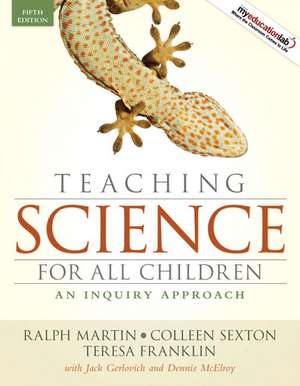
Teaching Science for All Children: An Inquiry Approach: myeducationlab (Access Codes)
Autor Ralph Martin, Colleen Sexton, Teresa Franklinen Limba Engleză Paperback – 31 ian 2008
Notăm cu interes apariția celei de-a cincea ediții a lucrării Teaching Science for All Children, un text fundamental pentru metodologia predării științelor la nivel primar. Volumul se încadrează în centrul programelor de formare a cadrelor didactice, oferind o abordare ancorată în modelul cercetării (inquiry-based learning) și în principiile constructiviste. Credem că relevanța acestei ediții derivă din modul în care integrează standardele NSE (National Science Education) cu strategii practice pentru incluziunea elevilor cu nevoi de învățare diverse. Putem afirma că autorii Ralph Martin, Colleen Sexton și Teresa Franklin reușesc să transforme teoria pedagogică în instrumente aplicabile, precum planurile de lecție bazate pe Ciclul de Învățare.
Această lucrare completează perspectiva oferită de Your Science Classroom, adăugând o structură mai detaliată privind utilizarea tehnologiei în sala de clasă și extinzând modelul celor 5E către o strategie de incluziune totală. În timp ce alte resurse precum [Methods for Teaching Elementary School Science [With CD]](book) se concentrează pe gestionarea timpului limitat la clasă, volumul de față oferă o profunzime sporită în ceea ce privește cercetarea științifică ca metodă pedagogică. Deși Ralph Martin a explorat în alte lucrări precum The Mission of the Redeemer sau Will Many Be Saved? teme de teologie și misiune, în acest manual își valorifică cei treizeci de ani de experiență în reforma educațională, concentrându-se strict pe rigoarea metodologică necesară viitorilor profesori de științe.
Preț: 1285.80 lei
Preț vechi: 1669.87 lei
-23%
Carte disponibilă
Livrare economică 05-19 noiembrie
Specificații
ISBN-10: 0205594913
Pagini: 531
Dimensiuni: 214 x 275 x 21 mm
Greutate: 1.18 kg
Ediția:5Nouă
Editura: Allyn & Bacon
Seria myeducationlab (Access Codes)
Locul publicării:Boston, United States
V-ar putea interesa
-
 -15%Preț: 535.29 lei629.75 lei
 -
 Preț: 411.68 lei
 -
 Understanding Art Education: Engaging Reflexively with PracticeNicholas AddisonPreț: 405.13 lei
 -
 Teaching with FireSam M IntratorPreț: 183.06 lei
De ce să citești această carte
Recomandăm această carte viitorilor învățători și profesori care doresc să stăpânească metoda cercetării în predarea științelor. Cititorul câștigă acces la un cadru didactic verificat, care îmbină standardele naționale cu realitatea diversității din sălile de clasă contemporane. Este un ghid practic care transformă știința dintr-o materie teoretică într-o experiență de explorare activă pentru copii.
Despre autor
Ralph Martin este o figură centrală în mișcările de reformă educațională și socială, cu o activitate ce se întinde pe parcursul a trei decenii. Expertiza sa diversă se reflectă în capacitatea de a aborda teme complexe, de la metodologii de predare a științelor în învățământul primar, până la analize teologice profunde și lucrări academice interdisciplinare. În Teaching Science for All Children, Martin își folosește experiența de lider în mișcarea de reînnoire educațională pentru a oferi soluții concrete de predare incluzivă și inovatoare.
Descriere
Cuprins
I.4-E Methods for Teaching Science
1. What is the Nature of Science?
How Do Children Perceive Science?
What Changes Have Occurred in Elementary Science?
The Nature of Science
Three Essential Features of Science
The Aims of Standards and Research-Based Education
2. How do Children Learn Science?
What Role Does Brain Development and Processing Play in Learning?
Where Do Children's Ideas Come From and How Do They Influence Learning?
What Is the Dominant Perspective About How Children Learn Science?
What Techniques and Roles Support Constructivist Learning?
3. How Can You Improve Science Learning for Diverse Learners?
Science For All
Science for Exceptional Children
How Can Parents Help Meet Children's Special Needs?
4. How Do You Plan for the Inquiry-Based Classroom?
Using the National Science Education Standards and Promoting Inquiry.
Concept Mapping
Planning Constructive Inquiry Science Lessons
5. What Inquiry Methods Help Learners to Construct Understanding?
What is Scientific Literacy?
Science as Inquiry for Literacy
Methods that Use Inquiry to Promote Student Concept Formation
Techniques for Promoting Student Cooperation
Recommendations for Enhancing Student's Learning of Science
6. How Can You Use Questions to Foster Scientific Inquiry?
Questions on Questions
What Are the Different Types of Questions?
What Are the Keys to Effective Questioning?
How Can You Improve Your Questioning?
Why Use Students' Questions
7. How Do You Develop and Use Authentic Assessment?
Evaluating Student Learning
Selecting the Tool for the Task.
8. How Does Technology Enrich Scientific Inquiry?
Why Use Educational Technology?
How Can Educational Technology Be Applied in the Context of Science Teaching?
What Is Integration?
9. How Do You Plan for and Integrate Science with Other Disciplines?
Approaches to Integration
Challenges to Integration
10. How Can You Design and Manage a Safe Inquiry-Based Science Classroom?
Recommendations for Safe Science Experiences
How Do You Plan for Safety?
What Are Your Legal Responsibilities?
Safety Equipment
Performing Safety Assessments
What Materials are Necessary for the Activities?
Storage
Room Arrangement
A Final Thought
11. What Materials and Resources Promote Inquiry-Based Science?
Lessons Learned
Selecting and Using Textbooks
Best Practices
Resources for Best Practices
II. 4-E Inquiry Lessons for Teaching Science
Life Science Lessons and Activities
Physical Science Lessons and Activities
Earth and Space Science Activities
Appendix: National Science Education Standards: Contents Standards for Grades K-4 and 5-8.
References
Index
Notă biografică
Dr. Colleen Sexton is an Associate Professor of Science Education at Governors State University, University Park, IL. She is the Academic Director of the South Suburban Consortium for Grow Your Own Illinois Teachers. This initiative is designed to provide a college degree to teacher candidates committed to teaching in traditionally hard-to-staff school districts. She has a special interest in Environmental Education and effective Integration of Educational Technology in the classroom. She has traveled to Turkey and Cyprus to deliver professional development in science education to K-8 teachers and to present keynote addresses at International Technology Conferences on the effective use of educational technology tools in science classrooms. Prior to GSU she was an Associate Professor and Secondary Education Coordinator at Ohio University in Athens, OH. Dr. Sexton also served for four years as the Program Manager for the Ohio SchoolNet Plus Initiative. This $495M initiative was designed to provide one interactive workstation in the classroom for every five children throughout Ohio’s K-5 classrooms. While with Ohio SchoolNet she was also directly responsible for the professional development opportunities for the interactive video projects. From 1988-1996 Dr. Sexton served as instructor and then as an Assistant Professor for the College of Education at Ohio University, serving as Curriculum Director for the Appalachian Distance Learning Project – a 3rd grade interactive video pilot. Her K-12 experience includes eight years of high school science teaching in the Chicago area and one year of teaching introductory biology at the community college level. Her research areas include the use of handhelds in higher education, the integration of educational technology into the science curriculum, and teacher dispositions in an online learning environment.
Dr. Teresa Franklin in an Associate Professor in Instructional Technology at Ohio University, Athens, OH. Her love of teaching and learning through the integration of technology in the K-12 and higher education curriculum spans thirty years. As a science teacher in 1979, she began to use computers in her middle school Life Science and Earth Science lessons to help students gather data and solve problems. Teresa has served on the Ohio Technology Academic Content Standards Committee and the International Society for Technology in Education—National Educational Technology Standards for Teachers writing committee. Research interests include the integration of technology within the science curriculum, virtual environments for learning, handheld technologies in the classroom, and online course development.
Authors of Chapter 10:
Dr. Jack A. Gerlovich is Levvitt Distinguished Professor of science/education/safety at Drake University. A Levvitt Professor must exemplify the qualities of “effective consulting, research, teaching, mentoring, and relationship-building.” He is the author or coauthor of seven books, thirty state and national journal articles, and two national and fifteen customized state software/CD-ROM programs on science safety. During his thirty-plus years in education, he has served as the State Science Supervisor for the Iowa Department of Education and as a science teacher at all levels of education. At Drake University, he teaches classes in Issues in Foundations of American Education (elementary, secondary, and graduate levels), Elementary Science Methods, and Science Safety. He has conducted nearly 200 science safety worships throughout the nation; served as an expert witness in court cases involving science safety issues; assisted industry, government, and education as a safety consultant; and developed training programs and software/CD-ROM packages customized to individual state needs. He was also certified by the U.S. Department of Transportation, Safety Institute for Occupational Safety and Health (NIOSH) and the Council of State Science Supervisors (CSSS) 16-hour Occupational Safety & Health course in Safety in the School Science Laboratory. Having been a commercially licensed, multiengine rate pilot for several years, he is also conscious of being safe and prepared.
Dr. Dennis McElroy is an Assistant Professor of Education at Graceland University and does science safety consulting with JaKel, Inc. He has also served as Graceland’s Vice-President for Information Services, Educational Technologist at Drake University’s School of Education, and Technology Consultant for the Iowa Department of Education. Dennis is on the National Science Teacher’s Association Safety Board. He previously taught science at the high school level in Kansas, Arizona, and Iowa.
Textul de pe ultima copertă
Reviewer Praise:
“The ‘What Research Says’ sections are an excellent feature…an enjoyable and practical way to become familiar with current research!” —Pamela Kramer, East Stroudsburg University
Comprehensive and engaging, the fifth edition of Teaching Science for All Children prepares elementary teachers to help students grasp the nature of science, construct understanding of and connections between science content area materials, apply scientific processes, and understand the interactions between science, technology, and society. The more than 60 featured lessons in the text employ the “Engage, Explore, Explain, Expand, Evaluate” Learning Cycle model and incorporate National Science Education Standards across all K-8 grade levels and science disciplines—earth, space, life, and physical. Authoritative coverage of science safety, new technology, national standards, and strategies for teaching diverse learners are the hallmarks of this well-respected text.
New to this edition:
- NSES and NETS icons in the margin indicate standards-related content.
- Revamped assessment chapter helps teachers see the connection between standardized tests, teacher assessment, and rubric development.
- Increased discussion of diversity and individual differences throughout the book prepares teachers to work with students in today’s changing classroom.
- Completely revamped technology chapter incorporates ISTE standards and guides teachers to select appropriate resources and media for their lessons.
- Learning Cycle Feature Lessons in the methods chapters now integrate photos and student work samples to enhance understanding and applications of the lesson.
- New MyEducationLab feature box uses an Explore, Enrich and Expand framework for activities to engage readers with video and other media.
Also available in a compact version including only the methods chapters!
Teaching Science for All Children: Inquiry Methods for Constructing Understanding, Fourth Edition | ISBN: 9780205593514
Integrated Multimedia Resources
MyEducationLab is a research-based learning tool that brings science teaching to life. Through authentic in-class video footage, interactive simulations, rich case studies, MyEducationLab prepares you for your teaching career by showing you what quality science instruction looks like, providing examples of authentic teacher and student work, and much more. MyEducationLab is easy to use. In your textbook look for the MyEducationLab logo in end-of-chapter boxed features and follow the simple instructions to access the MyEducationLab video or activities that correspond with the chapter content. For more information turn to the MyEducationLab walk-through in the book or go to www.myeducationlab.com.
To order this book WITHOUT MyEducationLab use this ISBN: 9780205594917. To order this book WITH MyEducationLab use this ISBN: 9780205643141.
Caracteristici
- Explore MyEducationLab.com --Go to page 98 and follow the MyEducationLab reference and accompanying questions, then go to MyEdLab and click on Diverse Learners -->Video --> Lesson on Birds Classroom scenarios at the opening of each chapter give pre-service teachers a window into the elementary science classroom and provide for fruitful discussion in the methods course.
- “Teachers on Science Teaching” feature boxes allows future teachers to connect with the experienced voices of practicing award-winning science teachers.
- “What Research Says” boxes provide readers with important, brief accounts of current research in the field, such as “Attitudes and the Nature of Science,” “Brain-Based Learning,” “Assessment: What to Emphasize?,” and “Using Questions in Science Classrooms.”
- More than 60 complete science Learning Cycle lessons, with more than 150 embedded activities encourage hands-on/minds-on activity and high levels of concept formation. All lessons have been classroom tested.
- Concept maps provide graphic illustrations of the key concepts for each chapter with connections and relationships revealing additional insight about the authors’ thinking and treatment of the topics.
- Safety and Classroom Design chapter (Ch 10) incorporates the latest research on safety concerns in elementary grades and includes updated safety forms and checklists to guide new teachers to design and manage a safe inquiry-based classroom.
- Reflect and Respond questions at the end of each chapter encourage readers to think about pertinent issues and prepare for discussion or written response as a part of their continuing professional growth.
- End-of-chapter MyEducationLab boxes highlights multimedia resources, many of which were developed specifically for this book, on the MyEducationlab.com site. The feature box uses an Explore, Enrich and Expand model as follows:
- Explore uses video and inquiry processes to link messages of the text with classroom applications. Readers asked to view specific video and continue to learn by responding to focused questions.
- Enrich focuses on developing the reader’s professional practice through school and classroom-based investigations.
- Expand targets continuing development of Science Literacy by helping readers to build confidence and comfort with science concepts and skills.
- Explore MyEducationLab.com --Go to page 98 and follow the MyEducationLab reference and accompanying questions, then go to MyEdLab and click on Diverse Learners -->Video --> Lesson on Birds
- To order this book WITHOUT MyEducationLab use this ISBN: 9780205594917. To order this book WITH MyEducationLab use this ISBN: 9780205643141. Click here to learn more about MyEducationLab.
Caracteristici noi
- NSES and NETS icons are conveniently placed in the margin to reveal a clear correlation to the national science and technology standards.
- Revamped assessment chapter (Ch 7) includes more on the development of learning outcomes and their alignment with assessment and helps teachers see the connection between standardized tests, teacher assessment, and rubric development.
- End-of-chapter MyEducationLab boxes highlights multimedia resources, many of which were developed specifically for this book, on the MyEducationLab.com site. The feature box uses an Explore, Enrich and Expand model as follows:
- Explore uses video and inquiry processes to link messages of the text with classroom applications. Readers asked to view specific video and continue to learn by responding to focused questions.
- Enrich focuses on developing the reader’s professional practice through school and classroom-based investigations.
- Expand targets continuing development of Science Literacy by helping readers to build confidence and comfort with science concepts and skills.
- Explore MyEducationLab.com --Go to page 98 and follow the MyEducationLab reference and accompanying questions, then go to MyEdLab and click on Diverse Learners -->Video --> Lesson on Birds
- To order this book WITHOUT MyEducationLab use this ISBN: 9780205594917. To order this book WITH MyEducationLab use this ISBN: 9780205643141. Click here to learn more about MyEducationLab.
- Increased discussion of diversity and individual differences integrated throughout the book so that teachers can better meet the needs of today’s students when they enter the classroom.
- Completely revamped technology chapter now focuses on helping teachers select appropriate resources and incorporate brand new media into science lessons.
- New Format for Learning Cycle Feature Lesson in each chapter integrates photos and student artifacts that will enhance pre-service teacher’s understanding and applications of the lesson. The new design of these lessons and those located in part II of text clarifies the essential components of each lesson to make them more accessible models for future teachers.
- New 8 ½ X 11 trim size and design allows for better layout of the lessons and improved presentation and readability of chapter contents.