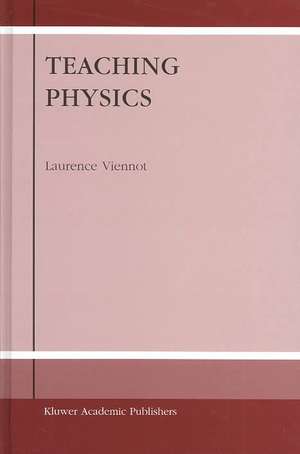
Teaching Physics
Autor L. Viennoten Limba Engleză Hardback – 30 iun 2003
Preț: 664.01 lei
Preț vechi: 781.20 lei
-15%
Puncte Express: 996
Carte tipărită la comandă
Livrare economică 27 noiembrie-11 decembrie
Livrare prin curier în România Termenul estimat este afișat lângă disponibilitate.
Transport gratuit pentru acest produs Plată online sau ramburs, în funcție de opțiunile comenzii.
Retur gratuit în 14 zile Comandă securizată și suport în română.
Specificații
ISBN-13: 9781402012754
ISBN-10: 1402012756
Pagini: 256
Ilustrații: XV, 235 p.
Dimensiuni: 160 x 241 x 19 mm
Greutate: 0.5 kg
Ediția:2003
Editura: Springer
Locul publicării:Dordrecht, Netherlands
ISBN-10: 1402012756
Pagini: 256
Ilustrații: XV, 235 p.
Dimensiuni: 160 x 241 x 19 mm
Greutate: 0.5 kg
Ediția:2003
Editura: Springer
Locul publicării:Dordrecht, Netherlands
V-ar putea interesa
Public țintă
ResearchCuprins
1 / Watersheds.- 1. How and What to Spotlight.- 2. How Much Should be Explained.- 3. Images: Are they always useful?.- 4. Experiments: Are they supposed to help?.- Appendix 1: Some General Intentions Are Very Similar in the Various Syllabuses.- Appendix 2: Why the Pinhole Camera is no Longer on the Syllabus.- 2 / Contact, friction and propulsion.- 1. Laws that Run Counter to Common Sense.- 2. A Method of Spotlighting the Basics.- 3. A Way of Spotlighting Friction: goals and difficulties.- 4. First Elements of Static Friction: step by step.- 5. Analysing the Sequence: lines of attention.- 6. Evaluation of the Sequence with Students.- 7. Reactions of Trainee Teachers.- 8. What Conclusion Should We Draw?.- Appendix 1: The Technique of Fragmented Diagrams.- Appendix 2: Two Situations for Studying Kinetic Friction.- Appendix 3: Trainee Teachers’ Comments on the Sequence.- 3 / Pressure in Fluids in the Presence of Gravity.- 1. Questions About the Merits of a Microscopic Approach.- 2. The Macroscopic Level: what quantities “have to be”?.- 3. Fluid Statics: common ideas among students.- 4. A Proposal for the Teaching of Fluid Statics.- 5. Analysing the Sequence: lines of attention.- 6. Evaluation of the Sequence with Students.- 7. Teachers’ Reactions.- 8. Conclusion.- Appendix: Main Results of the External Evaluation.- 4 / Superposition of Electric Fields.- 1. Interaction at a Distance and Superposition.- 2. Charges, Fields and Superposition: selected aspects.- 3. Superposition and Causality: common forms of reasoning.- 4. Elements of a Teaching Sequence.- 5. Analysing the Sequence: lines of attention.- 6. Evaluation of the Sequence.- 7. Conclusion.- Appendix 1: Contents Previously Taught to Students Questioned in the Preliminary Survey.- Appendix 2: Electrostatics andElectric Circuits Disconnected: the field in wires.- 5 / Superposition of Waves and Optical Imaging.- 1. Choosing a Model.- 2. Common Difficulties and “Spotlighting” of the Content.- 3. Analysing the Proposal: some elements.- 4. Reactions of In-Service or Trainee Teachers.- 5. Conclusion.- 6 / Colour Phenomena.- 1. A Topic at a Crossroads.- 2. Colour Phenomena and Light: the chosen approach.- 3. Common Ideas: too exclusive a linkage.- 4. A Proposed Sequence.- 5. More Detail, Following the Lines of Attention.- 6. Evaluation of the Sequence.- 7. Teachers’ Reactions.- 8. Conclusion.- Appendix 1: Additive and Subtractive Mixing.- Appendix 2: Aspects of Knowledge Whose Acquisition is Evaluated One Year after the Sequence.- Conclusion.- Index of Names.