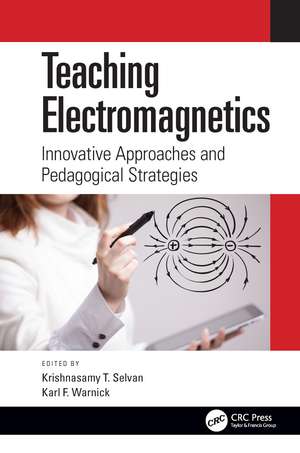
Teaching Electromagnetics: Innovative Approaches and Pedagogical Strategies
Editat de Krishnasamy T. Selvan, Karl F. Warnicken Limba Engleză Hardback – 18 iun 2021
Each chapter begins with a high-level consideration of the topic, reviews previous work and publications, and gives the reader a broad picture of the topic before delving into details. Chapters include specific guidance for those who want to implement the methods and assessment results and evaluation of the effectiveness of the methods. Respecting the limited time available to the average teacher to try new methods, the chapters focus on why an instructor should adopt the methods proposed in it. Topics include virtual laboratories, computer-assisted learning, and MATLAB® tools. The authors also review flipped classrooms and online teaching methods that support remote teaching and learning. The end result should be an impact on the reader represented by improvements to his or her practical teaching methods and curricular approach to electromagnetics education. The book is intended for electrical engineering professors, students, lab instructors, and practicing engineers with an interest in teaching and learning. In summary, this book:
- Surveys methods and tools for teaching the foundations of wireless communications and electromagnetic theory
- Presents practical experience and best practices for topical coverage, course sequencing, and content
- Covers virtual laboratories, computer-assisted learning, and MATLAB tools
- Reviews flipped classroom and online teaching methods that support remote teaching and learning
- Helps instructors in RF systems, field theory, and wireless communications bring their teaching practice up to date
Dr. Karl F. Warnick is Professor in the Department of Electrical and Computer Engineering at BYU.
Preț: 1354.94 lei
Preț vechi: 1652.37 lei
-18%
Puncte Express: 2032
Carte tipărită la comandă
Livrare economică 07-21 decembrie
Livrare prin curier în România Termenul estimat este afișat lângă disponibilitate.
Transport gratuit pentru acest produs Plată online sau ramburs, în funcție de opțiunile comenzii.
Retur gratuit în 14 zile Comandă securizată și suport în română.
Specificații
ISBN-13: 9780367710880
ISBN-10: 0367710889
Pagini: 258
Ilustrații: 174
Dimensiuni: 156 x 234 x 16 mm
Greutate: 0.64 kg
Ediția:1Prescurtată
Editura: CRC Press
Colecția CRC Press
ISBN-10: 0367710889
Pagini: 258
Ilustrații: 174
Dimensiuni: 156 x 234 x 16 mm
Greutate: 0.64 kg
Ediția:1Prescurtată
Editura: CRC Press
Colecția CRC Press
V-ar putea interesa
-
 Elements of ElectromagneticsMatthew Sadiku-23%Preț: 1683.18 lei2188.05 lei
 -
 Awesome Electricity and Mad MagnetsBig MannyPreț: 64.82 lei
 -
 -30%Preț: 450.54 lei648.01 lei
 -
 Electromagnetism 2eI. S. GrantPreț: 421.60 lei
 -
 Electromagnetism: Volume 2David TongPreț: 251.73 lei
 -
 Preț: 439.52 lei
 -
 Learning to Teach in the Primary SchoolTeresa CreminPreț: 399.27 lei
 -
 -20%Preț: 823.96 lei1029.96 lei
 -
 Preț: 321.32 lei
 -
 The Skillful TeacherStephen D BrookfieldPreț: 227.65 lei
 -
 Small Teaching OnlineFlower DarbyPreț: 191.67 lei
 -
 The Bloomsbury Handbook of Language Learning and TechnologyProfessor Regine Hampel-48%Preț: 713.77 lei1367.43 lei
 -
 -8%Preț: 153.20 lei166.99 lei
 -
 Reflective Teaching in Higher EducationPaul Ashwin-13%Preț: 275.14 lei317.75 lei
 -
 Virtual Synchronous Language Teaching and Learning: The New Frontier in Language AcquisitionDr. or Professor Slav Gratchev-33%Preț: 615.16 lei911.54 lei
 -
 -22%Preț: 181.52 lei233.38 lei
 -
 Teacher Education OnlineKathleen A. Boothe-22%Preț: 180.35 lei230.74 lei
 -
 Secondary Languages in ActionNatascia Servini-14%Preț: 116.93 lei136.55 lei
 -
 Trends in Educational Activity in the Field of Mechanism and Machine Theory (2018-2022)Juan Carlos García Prada-24%Preț: 1289.55 lei1696.78 lei
 -
 How to Teach the Epidural Block in Obstetric AnesthesiaGiorgio Capogna-5%Preț: 807.51 lei850.02 lei
Public țintă
Academic and Professional Practice & DevelopmentCuprins
1. Introduction.
2.Teaching and Learning Electromagnetics in 2020.
3. An Experiential Learning Approach in Electromagnetics Education.
4. Teaching and Learning Electromagnetics through MATLAB® Programming of Electromagnetic Fields.
5. Interactive Computational Tools for Electromagnetics Education Enhancement.
6. Computational Electromagnetics and Mobile Apps For Electromagnetics Education.
7. Teaching Electromagnetic Field Theory Using Differential Forms.
8. Maxwell’s Displacement Current: A Teaching Approach Infusing Ideas of Innovation and Creativity.
9. Teaching Electromagnetic Waves to Electrical Engineering Students: An Abridged Approach.
10. Taking Electromagnetics Beyond Electrical and Electronics Engineering.
11. HyFlex Flipping: Combining In-Person and On-Line Teaching for the Flexible Generation.
12. Learning and Teaching in a Time of Pandemic.
13. Conclusion and Outlook.
2.Teaching and Learning Electromagnetics in 2020.
3. An Experiential Learning Approach in Electromagnetics Education.
4. Teaching and Learning Electromagnetics through MATLAB® Programming of Electromagnetic Fields.
5. Interactive Computational Tools for Electromagnetics Education Enhancement.
6. Computational Electromagnetics and Mobile Apps For Electromagnetics Education.
7. Teaching Electromagnetic Field Theory Using Differential Forms.
8. Maxwell’s Displacement Current: A Teaching Approach Infusing Ideas of Innovation and Creativity.
9. Teaching Electromagnetic Waves to Electrical Engineering Students: An Abridged Approach.
10. Taking Electromagnetics Beyond Electrical and Electronics Engineering.
11. HyFlex Flipping: Combining In-Person and On-Line Teaching for the Flexible Generation.
12. Learning and Teaching in a Time of Pandemic.
13. Conclusion and Outlook.
Notă biografică
Dr. Krishnasamy T. Selvan is Professor in the Department of Electronics & Communication Engineering, SSN College of Engineering, since June 2012.
Dr. Karl F. Warnick is Professor in the Department of Electrical and Computer Engineering at BYU.
Dr. Karl F. Warnick is Professor in the Department of Electrical and Computer Engineering at BYU.
Recenzii
"The book’s structure allows for reading the chapters independently and in no particular order.…This nonbinding structure of independent and easy-to-read, stand-alone chapters is no coincidence. It clearly results from the editors’ effort to adequately capture the richness and variety of approaches to education and ideas on teaching. To this end, they assembled a lineup of 20 contributors, varying in their disciplinary backgrounds as well as geographic location, seniority, and gender. The resulting diversity of topics, writing styles, and offered techniques and strategies guarantees that there will be something of interest in the book for everyone. Personally, I found very inspiring and eye-opening many of the numerous examples for interactive numerical exercises as well as the review of available mobile apps for EM education. Chapter 7 stood out to me, as it (very enjoyably) put me back in the student role for a short while, but each of the chapters contains some ideas that I found appealing and suitable to my teaching style. Although carefully curated with a general philosophy in mind, the book does not advocate for one approach, nor does it impose a rigid teaching paradigm. It is more of a snapshot of contemporary thought on EM education and newly available teaching tools and techniques, suggested by peers, which serves as a substrate for further discussion. Indeed, my urge while the reading to bring up these topics with my colleagues immediately sparked some very passionate and intriguing conversations. Evidently, the book achieves its primary aim: to further the ever-continuing discussion among teachers and students on bettering education in our field." - Yaniv Brick, School of Electrical and Computer Engineering Ben-Gurion University of the Negev, Beer-Sheva, Israel/IEEE Antennas and Propogation Magazine
Descriere
A modern guide for electromagnetic educators addressing questions about curricular content and pedagogical methods primarily at the undergraduate level. Topics include teaching methods, lab experiences and hands-on learning, and course structures that help teachers respond effectively to trends in learning styles and evolving engineering curricula.