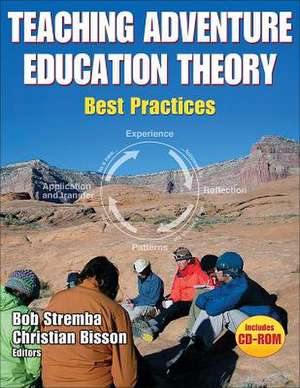
Teaching Adventure Education Theory: Best Practices
Autor Robert Stremba, Bob Strembaen Limba Engleză Mixed media product – 20 ian 2009 – vârsta de la 5 până la 21 ani
Ceea ce aduce nou Teaching Adventure Education Theory în peisajul academic este puntea metodologică solidă între conceptele teoretice abstracte și practica de teren. Remarcăm faptul că acest volum nu se rezumă la a descrie teorii, ci oferă un cadru aplicat prin cele 34 de planuri de lecție gata de utilizat, transformând sala de curs într-un mediu la fel de implicat ca cel outdoor. Autorii Robert Stremba și Bob Stremba integrează resurse multimedia esențiale, precum un CD-ROM cu prezentări PowerPoint și fișe de lucru, facilitând implementarea imediată la nivel universitar.
Suntem de părere că structura cărții este remarcabil de cuprinzătoare, acoperind de la rădăcinile filozofice ale lui John Dewey până la modele complexe de leadership și teorii ale auto-eficacității. Perspectiva internațională, oferită de experți din patru continente, asigură o viziune globală asupra eticii și justiției sociale în acest domeniu. Cititorii familiarizați cu Adventure Education de Inc. Project Adventure vor aprecia Teaching Adventure Education Theory pentru accentul pus pe fundamentarea științifică a activităților; în timp ce prima se concentrează pe strategii practice de jocuri și inițiative, lucrarea de față ancorează aceste experiențe în modele conceptuale de psihologie cognitivă și pedagogie critică.
Recomandăm acest titlu editat de HUMAN KINETICS pentru rigoarea cu care tratează conexiunea om-natură și procesele de facilitare. Este un instrument pedagogic care aliniază competențele educației prin aventură cu rezultatele învățământului de tip „liberal arts”, oferind instructorilor suportul necesar pentru a evalua și aprofunda reflexia critică a studenților.
Preț: 409.47 lei
Carte disponibilă
Livrare economică 16-30 noiembrie
Livrare express 30 octombrie-05 noiembrie pentru 61.72 lei
Specificații
ISBN-10: 0736071261
Pagini: 408
Dimensiuni: 213 x 277 x 30 mm
Greutate: 1.11 kg
Ediția:New.
Editura: HUMAN KINETICS
Locul publicării:United Kingdom
V-ar putea interesa
-
 What They Teach You at Harvard Business SchoolPhilip Delves Broughton-19%Preț: 75.27 lei93.06 lei
 -
 The Engaged CampusD. ButinPreț: 289.85 lei
 -
 We're Losing Our MindsR. KeelingPreț: 176.00 lei
 -
 The Good of This PlaceRichard H. BrodheadPreț: 265.47 lei
 -
 Teaching for Quality Learning at UniversityJohn BiggsPreț: 356.77 lei
 -
 Preț: 373.97 lei
 -
 The Heart of Higher EducationParker J PalmerPreț: 188.72 lei
 -
 Preț: 312.53 lei
 -
 Achieving Success with your Leadership ProjectDavid MiddlewoodPreț: 331.59 lei
 -
 Preț: 387.79 lei
 -
 The Lifelong Learning Sector: Reflective ReaderSusan WallacePreț: 312.55 lei
 -
 Becoming a Professional Tutor in the Lifelong Learning SectorJonathan TummonsPreț: 328.35 lei
 -
 Preț: 321.64 lei
 -
 -15%Preț: 492.24 lei579.11 lei
De ce să citești această carte
Recomandăm această lucrare profesorilor și formatorilor care doresc să predea bazele teoretice ale educației outdoor într-un mod interactiv. Cititorul câștigă acces la o metodologie verificată internațional, primind instrumente concrete precum planuri de lecție și materiale digitale. Este resursa ideală pentru a transforma teoria învățării experiențiale într-o experiență de curs dinamică, esențială pentru viitorii lideri de grup și facilitatori.
Descriere scurtă
"Teaching Adventure Education Theory: Best Practices" offers stimulating, fun, and engaging activities instructors can use to assist future adventure educators, outdoor leaders, and group facilitators in making the connections between adventure theory and practice. Written for students and instructors who want their classroom experience to be as involving as the field environment, this professional reference features ready-to-use lesson plans that employ experiential education strategies for presenting the theory underlying the technical and facilitation skills required in leading adventure experiences.
Editors Stremba and Bisson and leading adventure educators from the United States, Canada, Australia, and Japan provide an extensive perspective on teaching adventure theory, philosophy, history, and conceptual models through the use of activity-based learning. They offer a collection of 34 lesson plans that can be easily modified to fit individual teaching styles or student needs. Each lesson plan provides detailed activity instructions, teaching suggestions, and an overview of the theory taught in the lesson to provide the instructor with background conceptual material. An instructor CD-ROM, included with the text, contains student handouts, worksheets, and PowerPoint presentations to facilitate lesson implementation and assessment.
"Teaching Adventure Education Theory" presents experiential lesson plans covering such topics as these:
-Instructional theory and curriculum design processes
-History of adventure education
-Educational and philosophical foundations of adventure education, including lessons on John Dewey's contributions
-Central theories supporting common field practices, including optimal arousal theory, self-efficacy theory, attribution theory, and the flow theory
-Leadership models and theories
-Ethical and social justice issues
-Group development and social psychology
-Processing and facilitation models
-The human-to-nature connection
The book introduces core curriculum theories and models of adventure education, including a rationale on why students should know theory and how broader competencies within adventure education often align with colleges' liberal arts outcomes. It also explores the common pedagogical threads present in effective adventure education teaching processes and discusses the challenges and rewards of teaching adventure education. The book also provides a framework for implementing the lesson plans.
"Teaching Adventure Education Theory: Best Practices" assists instructors in bringing to the classroom the experiential learning, critical reflection, and interdependent community that a challenging outdoor environment facilitates, helping students broaden their view of adventure education to encompass its theoretical dimensions.