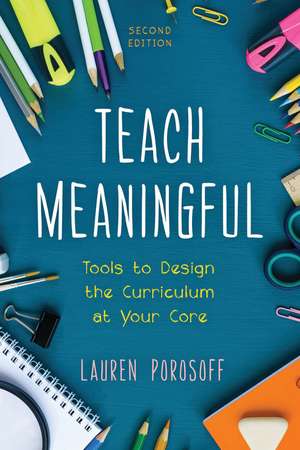
Teach Meaningful: Tools to Design the Curriculum at Your Core
Autor Lauren Porosoffen Limba Engleză Paperback – 30 iun 2020
? stories of failures and successes in designing curriculum from across subjects and grade levels
? metaphors from everyday life to help teachers understand curriculum design as a process rooted in values and culminating in meaningful learning
? examples of essential questions, assessment guidelines, lesson calendars, unit plans, and curriculum maps
? exercises and templates teachers can use to create and assess curriculum
? protocols designed to encourage inclusive participation and critical reflection when colleagues look at curriculum together
Preț: 256.21 lei
Preț vechi: 334.63 lei
-23%
Puncte Express: 384
Carte tipărită la comandă
Livrare economică 07-21 decembrie
Livrare prin curier în România Termenul estimat este afișat lângă disponibilitate.
Transport gratuit de la 400.00 lei Plată online sau ramburs, în funcție de opțiunile comenzii.
Retur gratuit în 14 zile Comandă securizată și suport în română.
Specificații
ISBN-13: 9781475851175
ISBN-10: 1475851170
Pagini: 200
Ilustrații: 31 b/w illustrations; 1 table
Dimensiuni: 154 x 229 x 12 mm
Greutate: 0.33 kg
Ediția:2
Editura: Bloomsbury Publishing
Colecția Rowman & Littlefield
Locul publicării:New York, United States
ISBN-10: 1475851170
Pagini: 200
Ilustrații: 31 b/w illustrations; 1 table
Dimensiuni: 154 x 229 x 12 mm
Greutate: 0.33 kg
Ediția:2
Editura: Bloomsbury Publishing
Colecția Rowman & Littlefield
Locul publicării:New York, United States
Cuprins
Table of Contents
Preface: The Values That Guided the Second Edition
Acknowledgements
Introduction: A Case for Values-Guided Curriculum Design
What Values Are-and Aren't
Values as Qualities of Action
Values as What the Educator Thinks Are Important
Making Values Manifest in a Classroom
How Values Differ from Goals and Preferences
Curriculum as Coherence
Essential Coherence
Social Coherence
Functional Coherence
How to Use This Book
Chapter 1: Discover the Values That Guide Your Teaching
Barriers to Values-Consistent Teaching
Getting Stuck in Self-Limiting Beliefs
Disregarding What Matters Most
Avoiding Uncomfortable Feelings
External Factors
Tools for Discovering the Values That Guide Your Teaching
Rate Your Teacher
Individual Exercise
Reflection Questions
Variation
Three Ups Three Downs
Individual Exercise
Reflection Questions
Extension
Values Rendering
Individual Exercise
Reflection Questions
Variation
Onward
Chapter 2: Discover Your Team's Shared Values
Values-Conscious Collaboration
Discovering Shared Values
Assume Diverse Thinking
Clarify Decision-Making Processes
Create Structures for Safe and Inclusive Communication
Make the Process Itself the Only Outcome of Values Exploration
Tools for Discovering Your Team's Shared Values
Learning Timeline
Group Protocol
Reflection Questions
Extension
Assignment Analysis
Group Protocol
Reflection Questions
Extension
Venn Values
Group Protocol
Reflection Questions
Extension
Onward
Chapter 3: Use Values to Imagine Learning
Imagining New Possibilities
Reimagining Content: Connecting to Current Concerns
Reimagining Tasks: Assigning Meaningful Work
Reimagining Resources: Drawing Upon All Relevant Knowledge
Reclaiming the Artistry of Curriculum Design
Tools for Using Values to Imagine Learning
Resource Brainstorm
Group Protocol
Reflection Questions
Extension
Work What-Ifs
Individual Exercise
Reflection Questions
Variation
Curriculum Dice
Group Protocol
Reflection Questions
Variations
Onward
Chapter 4: Use Values to Focus Learning
The Unity of a Unit
Why Teachers Create Heaps
From Heaps to Systems
Inquiry-Based Units: Exploring Important Ideas
Using Essential Questions
Writing Essential Questions
Rehearsal-Based Units: Practicing Important Skills
One Big Event vs. Several Smaller Ones
Authentic Performances vs. Simulations
Project-Based Units: Making Important Things
Project Assignments as Unit Outlines
Teaching Cross-Disciplinary Skills
Approaching Unit Formats Flexibly
Omitting Activities That Don't Advance Your Purpose
Tools for Using Values to Focus Learning
Unit Title Generator
Individual Exercise
Reflection Questions
Variation
Finding What's Essential
Group Protocol
Reflection Questions
Extension
Unit Story Quilt
Group Protocol
Reflection Questions
Extension
Onward
Chapter 5: Use Values to Organize Learning
Creating Foundational Experiences
Recalling Previous Experiences
Becoming Familiar with New Material
Renewing Curiosity
Selecting Learning Tasks
Choosing Receptive Learning Tasks
Choosing Expressive Learning Tasks
Balancing Task Types
Sequencing Learning Tasks
Inquiries are Integrative
Rehearsals are Cumulative
Projects are Iterative
Regularly Returning to What Matters
Allocating Time for a Unit
Unit Length and Expectations
Planned Flexibility
Tools for Using Values to Organize Learning
Unit Write-Up
Partner Protocol
Reflection Questions
Variation
Quarters
Individual Exercise
Reflection Questions
Extension
Grading Your Unit
Individual Exercise
Reflection Questions
Extension
Onward
Chapter 6: Use Values to Assess Learning
Learning Tasks as Assessment Tasks
Assessing What Matters
Defining What Success Means
Define Your Expectations but Leave Some Decisions for Your Students
Weight Expectations Based on Your Values
Copy Valued Expectations from Assignment to Assignment
Setting Students Up for Success on Assessment Tasks
Tools for Using Values to Assess Learning
Assessment Task Swapping
Individual Exercise
Reflection Questions
Extension
Assessment Filter
Individual Exercise
Reflection Questions
Variation
Assessing Your Rubric
Individual Exercise
Reflection Questions
Extension
Onward
Chapter 7: Use Values to Design Courses
Designing Strands to Create a Sense of Wholeness
Diversifying Experiences to Create a Sense of Balance
Knowledge Sources
Materials
Group Sizes
Stakes
Sequencing Units to Create a Sense of Progression
Skills Progressions
Conceptual Progressions
Work Product Progressions
Understanding Your Course in the Context of a Larger Program
Filling Programmatic Gaps
Building Programmatic Arcs
Tools for Using Values to Design Courses
Values Routines
Group Protocol
Reflection Questions
Variation
Assignment Mix
Individual Exercise
Reflection Questions
Variation
Unit Connections
Individual Exercise
Reflection Questions
Extension
Onward
Chapter 8: Use Values to Connect Disciplines
Deciding Whether to Connect Disciplines
Interdisciplinary Inquiries
Designing Interdisciplinary Essential Questions
Using Interdisciplinary Essential Questions Across Courses
Simultaneous and Serial Inquiries
Multidisciplinary Projects
Organizing a Multidisciplinary Project
Multidisciplinary Upcycling
Getting Colleagues Interested in Crossing Disciplines
Multidisciplinary Learning Events within Unidisciplinary Units
Tools for Using Values to Connect Disciplines
Finding What's Essential Across Disciplines
Group Protocol
Reflection Questions
Extension
Assignment Mashup
Partner Protocol
Reflection Questions
Variations
Participation Invitation
Group Protocol
Reflection Questions
Variation
Onward
Conclusion: The Teacher You Want to Be
Appendix A: Examples of Values
Appendix B: Types of Meaningful Work
Works Cited
Preface: The Values That Guided the Second Edition
Acknowledgements
Introduction: A Case for Values-Guided Curriculum Design
What Values Are-and Aren't
Values as Qualities of Action
Values as What the Educator Thinks Are Important
Making Values Manifest in a Classroom
How Values Differ from Goals and Preferences
Curriculum as Coherence
Essential Coherence
Social Coherence
Functional Coherence
How to Use This Book
Chapter 1: Discover the Values That Guide Your Teaching
Barriers to Values-Consistent Teaching
Getting Stuck in Self-Limiting Beliefs
Disregarding What Matters Most
Avoiding Uncomfortable Feelings
External Factors
Tools for Discovering the Values That Guide Your Teaching
Rate Your Teacher
Individual Exercise
Reflection Questions
Variation
Three Ups Three Downs
Individual Exercise
Reflection Questions
Extension
Values Rendering
Individual Exercise
Reflection Questions
Variation
Onward
Chapter 2: Discover Your Team's Shared Values
Values-Conscious Collaboration
Discovering Shared Values
Assume Diverse Thinking
Clarify Decision-Making Processes
Create Structures for Safe and Inclusive Communication
Make the Process Itself the Only Outcome of Values Exploration
Tools for Discovering Your Team's Shared Values
Learning Timeline
Group Protocol
Reflection Questions
Extension
Assignment Analysis
Group Protocol
Reflection Questions
Extension
Venn Values
Group Protocol
Reflection Questions
Extension
Onward
Chapter 3: Use Values to Imagine Learning
Imagining New Possibilities
Reimagining Content: Connecting to Current Concerns
Reimagining Tasks: Assigning Meaningful Work
Reimagining Resources: Drawing Upon All Relevant Knowledge
Reclaiming the Artistry of Curriculum Design
Tools for Using Values to Imagine Learning
Resource Brainstorm
Group Protocol
Reflection Questions
Extension
Work What-Ifs
Individual Exercise
Reflection Questions
Variation
Curriculum Dice
Group Protocol
Reflection Questions
Variations
Onward
Chapter 4: Use Values to Focus Learning
The Unity of a Unit
Why Teachers Create Heaps
From Heaps to Systems
Inquiry-Based Units: Exploring Important Ideas
Using Essential Questions
Writing Essential Questions
Rehearsal-Based Units: Practicing Important Skills
One Big Event vs. Several Smaller Ones
Authentic Performances vs. Simulations
Project-Based Units: Making Important Things
Project Assignments as Unit Outlines
Teaching Cross-Disciplinary Skills
Approaching Unit Formats Flexibly
Omitting Activities That Don't Advance Your Purpose
Tools for Using Values to Focus Learning
Unit Title Generator
Individual Exercise
Reflection Questions
Variation
Finding What's Essential
Group Protocol
Reflection Questions
Extension
Unit Story Quilt
Group Protocol
Reflection Questions
Extension
Onward
Chapter 5: Use Values to Organize Learning
Creating Foundational Experiences
Recalling Previous Experiences
Becoming Familiar with New Material
Renewing Curiosity
Selecting Learning Tasks
Choosing Receptive Learning Tasks
Choosing Expressive Learning Tasks
Balancing Task Types
Sequencing Learning Tasks
Inquiries are Integrative
Rehearsals are Cumulative
Projects are Iterative
Regularly Returning to What Matters
Allocating Time for a Unit
Unit Length and Expectations
Planned Flexibility
Tools for Using Values to Organize Learning
Unit Write-Up
Partner Protocol
Reflection Questions
Variation
Quarters
Individual Exercise
Reflection Questions
Extension
Grading Your Unit
Individual Exercise
Reflection Questions
Extension
Onward
Chapter 6: Use Values to Assess Learning
Learning Tasks as Assessment Tasks
Assessing What Matters
Defining What Success Means
Define Your Expectations but Leave Some Decisions for Your Students
Weight Expectations Based on Your Values
Copy Valued Expectations from Assignment to Assignment
Setting Students Up for Success on Assessment Tasks
Tools for Using Values to Assess Learning
Assessment Task Swapping
Individual Exercise
Reflection Questions
Extension
Assessment Filter
Individual Exercise
Reflection Questions
Variation
Assessing Your Rubric
Individual Exercise
Reflection Questions
Extension
Onward
Chapter 7: Use Values to Design Courses
Designing Strands to Create a Sense of Wholeness
Diversifying Experiences to Create a Sense of Balance
Knowledge Sources
Materials
Group Sizes
Stakes
Sequencing Units to Create a Sense of Progression
Skills Progressions
Conceptual Progressions
Work Product Progressions
Understanding Your Course in the Context of a Larger Program
Filling Programmatic Gaps
Building Programmatic Arcs
Tools for Using Values to Design Courses
Values Routines
Group Protocol
Reflection Questions
Variation
Assignment Mix
Individual Exercise
Reflection Questions
Variation
Unit Connections
Individual Exercise
Reflection Questions
Extension
Onward
Chapter 8: Use Values to Connect Disciplines
Deciding Whether to Connect Disciplines
Interdisciplinary Inquiries
Designing Interdisciplinary Essential Questions
Using Interdisciplinary Essential Questions Across Courses
Simultaneous and Serial Inquiries
Multidisciplinary Projects
Organizing a Multidisciplinary Project
Multidisciplinary Upcycling
Getting Colleagues Interested in Crossing Disciplines
Multidisciplinary Learning Events within Unidisciplinary Units
Tools for Using Values to Connect Disciplines
Finding What's Essential Across Disciplines
Group Protocol
Reflection Questions
Extension
Assignment Mashup
Partner Protocol
Reflection Questions
Variations
Participation Invitation
Group Protocol
Reflection Questions
Variation
Onward
Conclusion: The Teacher You Want to Be
Appendix A: Examples of Values
Appendix B: Types of Meaningful Work
Works Cited
Recenzii
Lauren Porosoff challenges readers to rethink their instructional practice and to incorporate their individual values into planning, instruction, and assessment. Without prescribing or presuming, Teach Meaningful: Tools to Design the Curriculum at Your Core provides illustrative, authentic examples from a wide range of content areas that offer steps that guide educators through the process of identifying their own values and using those values to adapt their teaching practices. Teachers from all grade-levels and content areas will find inspiration and guidance to redesign an individual lesson or an entire curriculum.
Lauren Porosoff makes a strong case that clarity on our values will ensure meaningful learning for our students. Teach Meaningful: Tools to Design the Curriculum at Your Core gives teachers and schools the tools to discover what is important to them and design curriculum accordingly. Curriculum design books can be boring but not this one. It strikes a nice balance between being informative and engaging.
In Teach Meaningful, Lauren Porosoff provides a road map for curriculum designers that helps mesh together content standards and individual teacher values. She provides background "mini-lessons" told through story-like examples and then turns to practical exercises to help teachers design relevant, engaging, and value laden curriculum.
When we bring our values into our teaching, real magic can happen in our classrooms. In Teach Meaningful, Lauren Porosoff shows how better understanding what's important to us as teachers can transpire into meaningful lessons for students. Taking charge of HOW we teach and reflecting on those lessons makes more meaningful experiences for our students. Porosoff provides a well-thought out step by step inventory to help all teachers begin to Teach Meaningful.
Lauren Porosoff makes a strong case that clarity on our values will ensure meaningful learning for our students. Teach Meaningful: Tools to Design the Curriculum at Your Core gives teachers and schools the tools to discover what is important to them and design curriculum accordingly. Curriculum design books can be boring but not this one. It strikes a nice balance between being informative and engaging.
In Teach Meaningful, Lauren Porosoff provides a road map for curriculum designers that helps mesh together content standards and individual teacher values. She provides background "mini-lessons" told through story-like examples and then turns to practical exercises to help teachers design relevant, engaging, and value laden curriculum.
When we bring our values into our teaching, real magic can happen in our classrooms. In Teach Meaningful, Lauren Porosoff shows how better understanding what's important to us as teachers can transpire into meaningful lessons for students. Taking charge of HOW we teach and reflecting on those lessons makes more meaningful experiences for our students. Porosoff provides a well-thought out step by step inventory to help all teachers begin to Teach Meaningful.