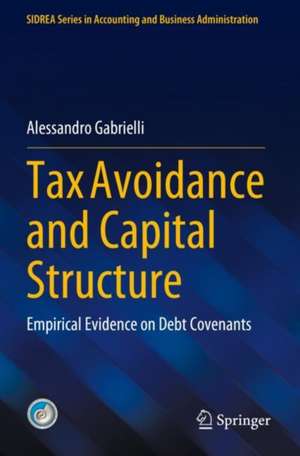
Tax Avoidance and Capital Structure: SIDREA Series in Accounting and Business Administration
Autor Alessandro Gabriellien Limba Engleză Paperback – 11 iun 2024
Overall, this book sheds light on the potential implications of tax avoidance activities for a firm’s capital structure. The book will be of interest to both experienced and early-stage scholars interested in the topic. Moreover, the book will also be of interest to policymakers, investors, analysts, lenders, and other market participants.
Din seria SIDREA Series in Accounting and Business Administration
- 24%
 Preț: 862.67 lei
 - 18%
 Preț: 741.79 lei
 - 18%
 Preț: 961.94 lei
 - 18%
 Preț: 742.70 lei
 - 18%
 Preț: 944.91 lei
 - 15%
 Preț: 611.17 lei
 - 15%
 Preț: 663.56 lei
 - 18%
 Preț: 851.71 lei
 - 18%
 Preț: 1122.78 lei
 - 18%
 Preț: 948.36 lei
 - 24%
 Preț: 839.69 lei
 - 24%
 Preț: 843.11 lei
 - 24%
 Preț: 753.49 lei
 - 24%
 Preț: 973.46 lei
 - 18%
 Preț: 702.70 lei
 - 24%
 Preț: 1061.52 lei
 - 18%
 Preț: 1121.84 lei
 - 24%
 Preț: 1028.24 lei
 - 18%
 Preț: 1113.41 lei
 - 24%
 Preț: 1031.93 lei
 - 24%
 Preț: 685.72 lei
 - 24%
 Preț: 735.85 lei
 - 24%
 Preț: 740.70 lei
 - 18%
 Preț: 1148.32 lei
 - 18%
 Preț: 1121.98 lei
 - 24%
 Preț: 677.36 lei
 - 24%
 Preț: 737.01 lei
 - 24%
 Preț: 797.15 lei
 - 24%
 Preț: 706.22 lei
Preț: 786.19 lei
Preț vechi: 1034.46 lei
-24%
Puncte Express: 1179
Carte tipărită la comandă
Livrare economică 21-27 noiembrie
Livrare prin curier în România Termenul estimat este afișat lângă disponibilitate.
Transport gratuit pentru acest produs Plată online sau ramburs, în funcție de opțiunile comenzii.
Retur gratuit în 14 zile Comandă securizată și suport în română.
Specificații
ISBN-13: 9783031309823
ISBN-10: 3031309820
Pagini: 108
Ilustrații: X, 96 p.
Dimensiuni: 155 x 235 x 7 mm
Greutate: 0.18 kg
Ediția:2023
Editura: Springer
Colecția SIDREA Series in Accounting and Business Administration
Seria SIDREA Series in Accounting and Business Administration
Locul publicării:Cham, Switzerland
ISBN-10: 3031309820
Pagini: 108
Ilustrații: X, 96 p.
Dimensiuni: 155 x 235 x 7 mm
Greutate: 0.18 kg
Ediția:2023
Editura: Springer
Colecția SIDREA Series in Accounting and Business Administration
Seria SIDREA Series in Accounting and Business Administration
Locul publicării:Cham, Switzerland
V-ar putea interesa
-
 Policy Responses to Tax CompetitionDavid R. Agrawal-9%Preț: 949.31 lei1043.19 lei
 -
 -15%Preț: 435.21 lei512.01 lei
 -
 -19%Preț: 369.83 lei456.05 lei
 -
 The Theory of Corporate FinanceJean Tirole-16%Preț: 723.48 lei861.28 lei
 -
 Corporate FinancePierre Vernimmen-19%Preț: 476.29 lei588.01 lei
 -
 Behavioral Corporate FinanceHersh Shefrin-28%Preț: 385.75 lei535.18 lei
 -
 Principles of Corporate Finance: 2025 Release ISERichard Brealey-4%Preț: 424.36 lei442.05 lei
 -
 Taxes for HumansHannah ColePreț: 144.03 lei
 -
 Tax, Public Finance, and the Rule of LawDominic de Cogan-39%Preț: 555.00 lei913.40 lei
 -
 Taxation of Corporate FinanceDavid Southern-22%Preț: 1281.62 lei1638.84 leiNou
 -
 -29%Preț: 1292.58 lei1828.18 lei
 -
 Advances in Capital Structure ResearchKarel Marleau-15%Preț: 531.31 lei625.07 lei
 -
 InevitableMike ColiasPreț: 195.49 lei
 -
 -25%Preț: 70.34 lei94.31 lei
 -
 With the Law on Our SideLady HalePreț: 191.77 lei
 -
 -24%Preț: 107.48 lei140.54 lei
Notă biografică
Alessandro Gabrielli is a postdoctoral researcher in the Department of Economics and Management at the University of Pisa, Italy. His main research interests concern the role of tax losses in businesses’ corporate reorganization decisions, the relationship between tax avoidance and capital structure and the assessment of tax information as bankruptcy predictors.
Textul de pe ultima copertă
This book provides a comprehensive overview of the implications of tax avoidance for a firm’s capital structure, highlighting the key role played by free cash flow and agency conflicts. First, the book provides an outline of the theories and empirical evidence concerning the role of taxes in the Theory of Capital Structure. It reviews the studies investigating the relationship between agency conflicts and capital structure. The book explores the role of free cash flow and agency conflicts in the relationship between tax avoidance and capital structure. In the final section, the results of an empirical investigation conducted on a sample of U.S. public firms are also presented. The empirical research examines whether and how tax avoidance is associated with debt covenant violation across the stages of the corporate life cycle. Specifically, the research uses the concept of the corporate life cycle stage to analyse whether and how the association between tax avoidance and debt covenant violation varies in different agency settings. Consistent with the hypotheses drawn on the Agency Theory, the findings of the empirical research suggest life cycle stages moderate the association between tax avoidance and debt covenant violation. Overall, this book sheds light on the potential implications of tax avoidance activities for a firm’s capital structure. The book will be of interest to both experienced and early-stage scholars interested in the topic. Moreover, the book will also be of interest to policymakers, investors, analysts, lenders, and other market participants.