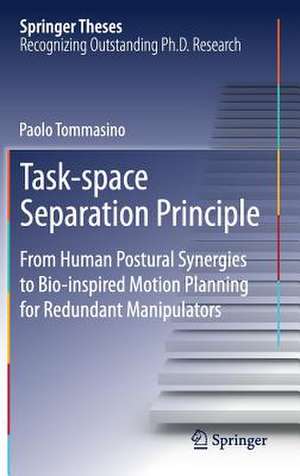
Task-space Separation Principle: Springer Theses
Autor Paolo Tommasinoen Limba Engleză Hardback – 6 iun 2018
Din seria Springer Theses
- 15%
 Preț: 663.23 lei
 - 15%
 Preț: 661.49 lei
 - 15%
 Preț: 660.04 lei
 - 18%
 Preț: 1438.89 lei
 -
 Preț: 397.39 lei
 - 18%
 Preț: 1150.06 lei
 - 18%
 Preț: 1261.12 lei
 - 15%
 Preț: 665.20 lei
 -
 Preț: 404.91 lei
 -
 Preț: 401.44 lei
 - 18%
 Preț: 1151.50 lei
 -
 Preț: 410.46 lei
 - 18%
 Preț: 1034.72 lei
 - 18%
 Preț: 977.51 lei
 - 18%
 Preț: 1144.10 lei
 - 15%
 Preț: 663.23 lei
 - 18%
 Preț: 1031.60 lei
 - 15%
 Preț: 638.81 lei
 - 18%
 Preț: 978.49 lei
 -
 Preț: 398.83 lei
 - 15%
 Preț: 667.93 lei
 -
 Preț: 399.72 lei
 - 15%
 Preț: 658.80 lei
 - 15%
 Preț: 663.97 lei
 - 15%
 Preț: 664.46 lei
 - 18%
 Preț: 1263.02 lei
 - 15%
 Preț: 663.48 lei
 - 18%
 Preț: 1035.90 lei
 - 18%
 Preț: 1273.75 lei
 - 18%
 Preț: 1152.69 lei
 - 15%
 Preț: 661.99 lei
 - 18%
 Preț: 1152.90 lei
 - 18%
 Preț: 1264.69 lei
 - 18%
 Preț: 1038.03 lei
 - 18%
 Preț: 1036.63 lei
 - 18%
 Preț: 1156.95 lei
 - 18%
 Preț: 1036.70 lei
 - 18%
 Preț: 979.42 lei
 - 15%
 Preț: 642.59 lei
 - 15%
 Preț: 665.96 lei
 - 18%
 Preț: 976.57 lei
 - 18%
 Preț: 1443.18 lei
 -
 Preț: 401.44 lei
 -
 Preț: 399.14 lei
 - 18%
 Preț: 1034.98 lei
 - 18%
 Preț: 1148.15 lei
 - 15%
 Preț: 658.33 lei
 - 15%
 Preț: 662.51 lei
 - 15%
 Preț: 659.03 lei
 - 15%
 Preț: 659.78 lei
Preț: 660.18 lei
Preț vechi: 776.69 lei
-15%
Puncte Express: 990
Carte tipărită la comandă
Livrare economică 07-21 decembrie
Livrare prin curier în România Termenul estimat este afișat lângă disponibilitate.
Transport gratuit pentru acest produs Plată online sau ramburs, în funcție de opțiunile comenzii.
Retur gratuit în 14 zile Comandă securizată și suport în română.
Specificații
ISBN-13: 9789811303524
ISBN-10: 9811303525
Pagini: 124
Ilustrații: XVII, 105 p. 48 illus., 7 illus. in color.
Dimensiuni: 160 x 241 x 13 mm
Greutate: 0.31 kg
Ediția:1st ed. 2019
Editura: Springer
Colecția Springer Theses
Seria Springer Theses
Locul publicării:Singapore, Singapore
ISBN-10: 9811303525
Pagini: 124
Ilustrații: XVII, 105 p. 48 illus., 7 illus. in color.
Dimensiuni: 160 x 241 x 13 mm
Greutate: 0.31 kg
Ediția:1st ed. 2019
Editura: Springer
Colecția Springer Theses
Seria Springer Theses
Locul publicării:Singapore, Singapore
Cuprins
Introduction.- Background: Posture, Movement & Redundancy.- Task-Space Separation Principle: A Force Field Approach to Posture and Movement Planning for Redundant Manipulators.- Capturing Human-Like Postural Kinematic Synergies Via Non-Linear Inverse Optimization.- Assessment of Postural Muscular Synergies.- Effects of Mechanical Impedance (Joint Stiffness And Damping) on Wrist Movement.- Conclusion and Outlook.
Textul de pe ultima copertă
This book addresses two fundamental issues of motor control for both humans and robots: kinematic redundancy and the posture/movement problem. It blends traditional robotic constrained-optimal approaches with neuroscientific and evidence-based principles, proposing a “Task-space Separation Principle,” a novel scheme for planning both posture and movement in redundant manipulators. The proposed framework is first tested in simulation and then compared with experimental motor strategies displayed by humans during redundant pointing tasks. The book also shows how this model builds on and expands traditional formulations such as the Passive Motion Paradigm and the Equilibrium Point Theory. Lastly, breaking with the neuroscientific tradition of planar movements and linear(ized) kinematics, the theoretical formulation and experimental scenarios are set in the nonlinear space of 3D rotations which are essential for wrist motions, a somewhat neglected area despite its importance in daily tasks.
Caracteristici
Addresses two fundamental issues of motor control for both humans and robots: kinematic redundancy and the posture/movement problem Proposes the “Task-space Separation Principle” and a general computational framework for posture and movement planning for redundant manipulators Provides theoretical formulation and experimental scenarios for nonlinear space of 3D rotations, which are essential for wrist motions