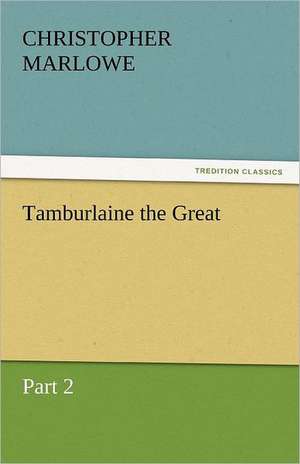
Tamburlaine the Great
Autor Christopher Marloween Limba Engleză Paperback – 31 oct 2011
Preț: 124.88 lei
Puncte Express: 187
Carte tipărită la comandă
Livrare economică 08-22 iunie
Specificații
ISBN-13: 9783842440166
ISBN-10: 3842440162
Pagini: 84
Dimensiuni: 129 x 198 x 4 mm
Greutate: 0.09 kg
Editura: TREDITION CLASSICS
ISBN-10: 3842440162
Pagini: 84
Dimensiuni: 129 x 198 x 4 mm
Greutate: 0.09 kg
Editura: TREDITION CLASSICS
V-ar putea interesa
-
 TamerlaneJustin MarozziPreț: 103.47 lei
 -
 The Complete PlaysChristopher Marlowe-27%Preț: 76.81 lei105.75 lei
 -
 -18%Preț: 63.85 lei77.60 lei
 -
 Doctor FaustusChristopher MarlowePreț: 37.71 lei
 -
 Dr. FaustusChristopher MarlowePreț: 25.41 lei
 -
 Cyrano de BergeracEdmond RostandPreț: 32.21 lei
 -
 The PoemsWilliam ShakespearePreț: 56.40 lei
 -
 Rosencrantz and Guildenstern Are DeadTom StoppardPreț: 74.03 lei
 -
 Ben JonsonBen JonsonPreț: 28.11 lei
 -
 TamburlaineChristopher Marlowe-24%Preț: 70.27 lei92.77 lei
 -
 -21%Preț: 76.38 lei96.47 lei
 -
 Tamburlaine the Great - Part IChristopher MarlowePreț: 38.67 lei
 -
 The Jew of MaltaChristopher MarlowePreț: 39.46 lei
 -
 Sir Thomas MoreWilliam ShakespearePreț: 91.61 lei
 -
 Edward the SecondChristopher MarlowePreț: 31.67 lei
 -
 King JohnWilliam ShakespearePreț: 37.70 lei
 -
 Preț: 69.35 lei
 -
 The Spanish TragedyThomas KydPreț: 34.91 lei
 -
 The RoverAphra BehnPreț: 58.60 lei
 -
 The Importance of Being EarnestOscar WildePreț: 31.83 lei
Descriere
Descriere de la o altă ediție sau format:
Tamburlaine the Great, Part One and Part Two are the first plays that Christopher Marlowe wrote for London’s then new freestanding, open-air public playhouses. They trace the progress of Tamburlaine, a Central Asian leader, as he “scourge[s] kingdoms with his conquering sword” and rises to imperial power. The plays were a powerful beginning to Marlowe’s brief career as a public theatre dramatist: the brutally masculine and martial main character immediately captured audiences, and the plays were widely imitated and parodied. Even four hundred years later, Marlowe’s Tamburlaine remains a shocking and seductive figure.
The introduction and historical appendices to this new Broadview Edition provide many avenues for readers to understand these plays, presenting other portrayals of Islam from the period, related lives of Tamburlaine from other writers, and material on Marlowe’s scandalous reputation.
Tamburlaine the Great, Part One and Part Two are the first plays that Christopher Marlowe wrote for London’s then new freestanding, open-air public playhouses. They trace the progress of Tamburlaine, a Central Asian leader, as he “scourge[s] kingdoms with his conquering sword” and rises to imperial power. The plays were a powerful beginning to Marlowe’s brief career as a public theatre dramatist: the brutally masculine and martial main character immediately captured audiences, and the plays were widely imitated and parodied. Even four hundred years later, Marlowe’s Tamburlaine remains a shocking and seductive figure.
The introduction and historical appendices to this new Broadview Edition provide many avenues for readers to understand these plays, presenting other portrayals of Islam from the period, related lives of Tamburlaine from other writers, and material on Marlowe’s scandalous reputation.
Recenzii
Tamburlaine the Great, Part One and Part Two are the first plays that Christopher Marlowe wrote for London’s then new freestanding, open-air public playhouses. They trace the progress of Tamburlaine, a Central Asian leader, as he “scourge[s] kingdoms with his conquering sword” and rises to imperial power. The plays were a powerful beginning to Marlowe’s brief career as a public theatre dramatist: the brutally masculine and martial main character immediately captured audiences, and the plays were widely imitated and parodied. Even four hundred years later, Marlowe’s Tamburlaine remains a shocking and seductive figure.
The introduction and historical appendices to this new Broadview Edition provide many avenues for readers to understand these plays, presenting other portrayals of Islam from the period, related lives of Tamburlaine from other writers, and material on Marlowe’s scandalous reputation.
“Mathew R. Martin’s edition of Christopher Marlowe’s Tamburlaine the Great, Part One and Part Two has everything one needs to ensure these powerful plays come alive in the undergraduate classroom: a clear and wonderfully annotated text, a lively yet erudite introduction, and a treasure trove of contextual materials. While other editions routinely refer students to key historical documents such as the Richard Baines letter, this edition offers a wealth of materials that can open the door to a sophisticated understanding of Marlowe’s appeal. In addition to sources attesting to Marlowe’s outsized reputation even in his day, the edition includes materials that will help students grasp the complexity of these dramas, such as early accounts of the historical Temur and a well-chosen archive of documents revealing early modern English views of Islam. Supplementing such historical documents is a brilliant collection of literary ‘intertexts’—excerpts from Jonson, Middleton, and others that will help students understand both Marlowe’s trailblazing aesthetic sensibility and the plays’ extraordinary afterlife. This is a first-rate edition and I very much look forward to using it in the classroom.” — Patricia Cahill, Emory University
“Christopher Marlowe’s Tamburlaine plays had a profound impact on the literary and dramatic culture of Elizabethan England. Mathew R. Martin’s new edition draws upon a wide range of recent scholarship, and the editor’s own extensive research, to recover the forms of that initial impact. Martin’s detailed introduction presents us with the awe-inspiring conqueror in all his bloody pomp and glorious contradictions: a Scythian warlord who came to embody a particularly English sense of the world. In this edition Martin boldly overturns editorial convention to make the third Octavo edition of 1597 his copytext, with striking and provocative results. The combination of an expansive introduction, rigorous textual scholarship and careful collation, and a thorough and varied collection of primary-source appendices makes this a valuable and engaging edition, worthy of Marlowe’s extraordinary creation.” — Matthew Dimmock, University of Sussex
“Matthew R. Martin has prepared a solid undergraduate-level edition of Marlowe’s Tamburlaine the Great: Part One and Part Two for Broadview Press. In addition to a comprehensive introduction, Martin provides appendices that include a selection of documents concerning early modern perceptions of Islam and the East.” — Kevin Curran, Studies in English Literature 1500-1900
The introduction and historical appendices to this new Broadview Edition provide many avenues for readers to understand these plays, presenting other portrayals of Islam from the period, related lives of Tamburlaine from other writers, and material on Marlowe’s scandalous reputation.
“Mathew R. Martin’s edition of Christopher Marlowe’s Tamburlaine the Great, Part One and Part Two has everything one needs to ensure these powerful plays come alive in the undergraduate classroom: a clear and wonderfully annotated text, a lively yet erudite introduction, and a treasure trove of contextual materials. While other editions routinely refer students to key historical documents such as the Richard Baines letter, this edition offers a wealth of materials that can open the door to a sophisticated understanding of Marlowe’s appeal. In addition to sources attesting to Marlowe’s outsized reputation even in his day, the edition includes materials that will help students grasp the complexity of these dramas, such as early accounts of the historical Temur and a well-chosen archive of documents revealing early modern English views of Islam. Supplementing such historical documents is a brilliant collection of literary ‘intertexts’—excerpts from Jonson, Middleton, and others that will help students understand both Marlowe’s trailblazing aesthetic sensibility and the plays’ extraordinary afterlife. This is a first-rate edition and I very much look forward to using it in the classroom.” — Patricia Cahill, Emory University
“Christopher Marlowe’s Tamburlaine plays had a profound impact on the literary and dramatic culture of Elizabethan England. Mathew R. Martin’s new edition draws upon a wide range of recent scholarship, and the editor’s own extensive research, to recover the forms of that initial impact. Martin’s detailed introduction presents us with the awe-inspiring conqueror in all his bloody pomp and glorious contradictions: a Scythian warlord who came to embody a particularly English sense of the world. In this edition Martin boldly overturns editorial convention to make the third Octavo edition of 1597 his copytext, with striking and provocative results. The combination of an expansive introduction, rigorous textual scholarship and careful collation, and a thorough and varied collection of primary-source appendices makes this a valuable and engaging edition, worthy of Marlowe’s extraordinary creation.” — Matthew Dimmock, University of Sussex
“Matthew R. Martin has prepared a solid undergraduate-level edition of Marlowe’s Tamburlaine the Great: Part One and Part Two for Broadview Press. In addition to a comprehensive introduction, Martin provides appendices that include a selection of documents concerning early modern perceptions of Islam and the East.” — Kevin Curran, Studies in English Literature 1500-1900
Cuprins
Acknowledgements
Introduction
Christopher Marlowe: A Brief Chronology
A Note on the Text
Tamburlaine the Great
Part One
Part Two
Appendix A: Lives of Tamburlaine
Introduction
Christopher Marlowe: A Brief Chronology
A Note on the Text
Tamburlaine the Great
Part One
Part Two
Appendix A: Lives of Tamburlaine
- From George Whetstone, The English Mirror (1586)
- From Chapter 11. The contention that envy set between the Emperor of Constantinople, the Lord of Bulgaria, and other princes was the first ground and sure foundation of the great Turk’s empire
- Chapter 12. The wonderful conquest of Tamberlaine, reconquered and his large kingdom overthrown by theenvy and discord of his two sons
- From John Foxe, Acts and Monuments (1610)
- From Richard Knolles, The General History of the Turks (1603)
- From Jean Dubec-Crespin, The History of the Great Emperor Tamerlan (1597)
- Introduction
- Description of Tamerlan
- Axalla and Tamerlan’s monotheism
- Tamerlan demonstrates his justice and his mercy after defeating the rebel lord Calix in a civil war
- Having subdued China and celebrated his conquests at the city of Cambalu, Tamerlan marches toward Bajazet in defence of the Byzantine Empire
- Tamerlan and the diversity of religions
- Tamerlan and his son
- Tamerlan dies
- From George Whetstone, The English Mirror (1586)
- From Anon., Sir Bevis of Hampton (1585)
- How Bevis was sold unto the Paynims and carried over the sea into Armeny, and was presented unto King Ermine
- Having defeated King Bradmond and his knights, Bevis quarrels with Josian, who promises to convert to Christianity to gain his love
- How Bevis went on message to King Bradmond, and how he fought in the city of Damascus against the Saracens that made sacrifice to idols, and how he tore them down and cast them into the dirt and afterward was taken and put in prison
- From Giles Fletcher, The Policy of the Turkish Empire (1597)
- Of the Turkish Alcoran, and of the great reverence which the Turks bear unto it
- Of the principles and grounds of the Turks’ religion and of the eight commandments prescribed in their Alcoran
- On the nature of God
- Moses, Christ, and Mahomet
- Heaven and hell
- Conclusion
- From Robert Greene, Perimedes the Blacksmith (1588)
- Christopher Marlowe, “The Passionate Shepherd to HisLove,” in England’s Helicon (1600)
- From Joseph Hall, Virgidemiarum (1597)
- From Ben Jonson, Timber, or Discoveries, in The Works of Benjamin Jonson (1641)
- From Anon., The Troublesome Reign of John King of England(1591)
- From Thomas Dekker, Old Fortunatus (1600)
- The dumb show
- Fortune describes the four kings to Old Fortunatus
- From Thomas Middleton, The Triumphs of Integrity (1623)
- From Thomas Nashe, Christ’s Tears over Jerusalem (1613)
- From Thomas Dekker, The Wonderful Year (1603)
- From Robert Greene, A Groatsworth of Wit (1592)
- Thomas Kyd’s Letters to Sir John Puckering about Marlowe (June 1593)
- Richard Baines, “A Note Containing the Opinion of Christopher Marlowe Concerning His Damnable Judgmentof Religion and Scorn of God’s Word” (26 May 1593)
- From Thomas Beard, The Theatre of God’s Judgements (1597)
Notă biografică
Dramatist, son of a shoemaker at Canterbury, where he was born, was educated at the King's School there, and in 1581 went to Benet's (now Corpus Christi) College, Cambridge, where he graduated B.A. 1583, and M.A. in 1587. Marlowe shunned a life as a clergyman which university wits like himself were expected to follow, and moved to London to pursue the insecure craft of a playwright. Among his early plays were 'Tamburlaine the Great' and 'The Famous Tragedy of the Rich Jew of Malta', all well-received by Elizabethan audiences and displaying an impressive poetic talent that was bold enough to use high-quality blank verse for the first time in English theatre. He collaborated with friend and literary colleague, William Shakespeare, on 'Henry VI' and 'Titus Andronicus' and his influence on Shakespeare is seen in the latter's restrained use of rhyme in 'Richard III'. Traditional rhyme was eschewed by Marlowe in preference for blank verse, over which he acquired a constantly increasing mastery.