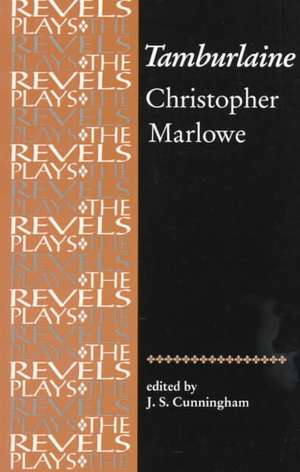
Tamburlaine the Great
Editat de J. S. Cunningham, Eithne Hensonen Limba Engleză Paperback – iul 1999
Preț: 228.56 lei
Puncte Express: 343
Carte tipărită la comandă
Livrare economică 07-21 decembrie
Livrare prin curier în România Termenul estimat este afișat lângă disponibilitate.
Transport gratuit de la 400.00 lei Plată online sau ramburs, în funcție de opțiunile comenzii.
Retur gratuit în 14 zile Comandă securizată și suport în română.
Specificații
ISBN-13: 9780719030963
ISBN-10: 071903096X
Pagini: 356
Dimensiuni: 140 x 216 x 22 mm
Greutate: 0.5 kg
Editura: MANCHESTER UNIVERSITY PRESS
Locul publicării:United Kingdom
ISBN-10: 071903096X
Pagini: 356
Dimensiuni: 140 x 216 x 22 mm
Greutate: 0.5 kg
Editura: MANCHESTER UNIVERSITY PRESS
Locul publicării:United Kingdom
V-ar putea interesa
-
 TamerlaneJustin MarozziPreț: 108.62 lei
-
 The Complete PlaysChristopher Marlowe-26%Preț: 82.24 lei110.60 lei
-
 -15%Preț: 69.02 lei81.46 lei
-
 Doctor FaustusChristopher MarlowePreț: 45.52 lei
-
 Doctor FaustusChristopher MarlowePreț: 32.07 lei
-
 Cyrano de BergeracEdmond RostandPreț: 49.42 lei
-
 The PoemsWilliam ShakespearePreț: 58.34 lei
-
 Rosencrantz and Guildenstern Are DeadTom StoppardPreț: 77.73 lei
-
 Ben JonsonBen JonsonPreț: 29.09 lei
-
 TamburlaineChristopher Marlowe-17%Preț: 75.81 lei91.49 lei
-
 -13%Preț: 82.21 lei94.96 lei
-
 Tamburlaine the Great - Part IChristopher MarlowePreț: 38.67 lei
-
 The Jew of MaltaChristopher MarlowePreț: 39.46 lei
-
 Sir Thomas MoreWilliam ShakespearePreț: 91.61 lei
-
 Edward the SecondChristopher MarlowePreț: 34.02 lei
-
 King JohnWilliam ShakespearePreț: 37.70 lei
-
 Preț: 72.83 lei
-
 The Spanish TragedyThomas KydPreț: 37.34 lei
-
 The RoverAphra BehnPreț: 60.67 lei
-
 Preț: 34.20 lei
Notă biografică
Dramatist, son of a shoemaker at Canterbury, where he was born, was educated at the King's School there, and in 1581 went to Benet's (now Corpus Christi) College, Cambridge, where he graduated B.A. 1583, and M.A. in 1587. Marlowe shunned a life as a clergyman which university wits like himself were expected to follow, and moved to London to pursue the insecure craft of a playwright. Among his early plays were 'Tamburlaine the Great' and 'The Famous Tragedy of the Rich Jew of Malta', all well-received by Elizabethan audiences and displaying an impressive poetic talent that was bold enough to use high-quality blank verse for the first time in English theatre. He collaborated with friend and literary colleague, William Shakespeare, on 'Henry VI' and 'Titus Andronicus' and his influence on Shakespeare is seen in the latter's restrained use of rhyme in 'Richard III'. Traditional rhyme was eschewed by Marlowe in preference for blank verse, over which he acquired a constantly increasing mastery.
Descriere
This fully annotated version, with parts one and two in a single volume, takes account of the recent work on Marlowe. This text is related to contemporary theatrical conventions and conditions, and offers a critical account of the play closely attuned to a sense of theatre.