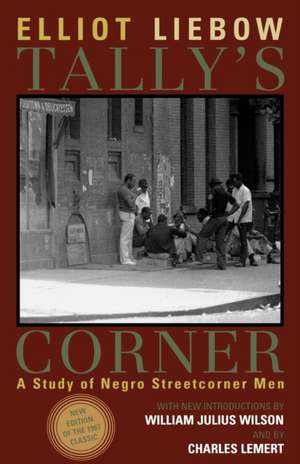
Tally's Corner: A Study of Negro Streetcorner Men: Legacies of Social Thought Series
Autor Elliot Liebow William Julius Wilson Cuvânt înainte de Charles Lemerten Limba Engleză Paperback – 8 iul 2003



Preț: 177.86 lei
Preț vechi: 238.10 lei
-25%
Puncte Express: 267
Carte tipărită la comandă
Livrare economică 08-22 decembrie
Livrare prin curier în România Termenul estimat este afișat lângă disponibilitate.
Transport gratuit de la 400.00 lei Plată online sau ramburs, în funcție de opțiunile comenzii.
Retur gratuit în 14 zile Comandă securizată și suport în română.
Specificații
ISBN-13: 9780742528963
ISBN-10: 0742528960
Pagini: 224
Dimensiuni: 144 x 219 x 15 mm
Greutate: 0.27 kg
Ediția:New.
Editura: Bloomsbury Publishing
Colecția Rowman & Littlefield
Seria Legacies of Social Thought Series
Locul publicării:New York, United States
ISBN-10: 0742528960
Pagini: 224
Dimensiuni: 144 x 219 x 15 mm
Greutate: 0.27 kg
Ediția:New.
Editura: Bloomsbury Publishing
Colecția Rowman & Littlefield
Seria Legacies of Social Thought Series
Locul publicării:New York, United States
V-ar putea interesa
-
 The Complete Book of Pilates for MenDaniel LyonPreț: 126.42 lei
 -
 Thats My BoyJenni MurrayPreț: 115.81 lei
 -
 Biddulph, S: ManhoodSteve Biddulph-27%Preț: 97.70 lei134.60 lei
 -
 Tell Them Who I AmElliot LiebowPreț: 148.35 lei
 -
 What the Hell is He Thinking?Zoe StrimpelPreț: 115.57 lei
 -
 Feminism and MasculinitiesPeter F. Murphy-27%Preț: 391.33 lei537.93 lei
 -
 Meanings of Manhood in Early Modern EnglandAlexandra Shepard-27%Preț: 452.96 lei623.21 lei
 -
 Preț: 476.19 lei
 -
 Uncommon: Finding Your Path to SignificanceTony DungyPreț: 96.02 lei
 -
 The Hidden Spirituality of MenMatthew FoxPreț: 124.02 lei
 -
 Masculinities in Polish, Czech and Slovak CinemaEwa MazierskaPreț: 161.86 lei
 -
 Men in the NurseryClaire Cameron-18%Preț: 693.07 lei845.21 lei
Descriere
The first edition of Tally's Corner, a sociological classic selling more than one million copies, was the first compelling response to the culture of poverty thesis-that the poor are different and, according to conservatives, morally inferior-and alternative explanations that many African Americans are caught in a tangle of pathology owing to the absence of black men in families. The debate has raged up to the present day. Yet Liebow's shadow theory of values-especially the values of poor, urban, black men-remains the single most parsimonious account of the reasons why the behavior of the poor appears to be at odds with the values of the American mainstream.
While Elliot Liebow's vivid narrative of "street-corner" black men remains unchanged, the new introductions to this long-awaited revised edition bring the book up to date. Wilson and Lemert describe the debates since 1965 and situate Liebow's classic text in respect to current theories of urban poverty and race. They account for what Liebow might have seen had he studied the street corner today after welfare has been virtually ended and the drug economy had taken its toll. They also take stock of how the new global economy is a source of added strain on the urban poor. Discussion of field methods since the 1960s rounds out the book's new coverage.
While Elliot Liebow's vivid narrative of "street-corner" black men remains unchanged, the new introductions to this long-awaited revised edition bring the book up to date. Wilson and Lemert describe the debates since 1965 and situate Liebow's classic text in respect to current theories of urban poverty and race. They account for what Liebow might have seen had he studied the street corner today after welfare has been virtually ended and the drug economy had taken its toll. They also take stock of how the new global economy is a source of added strain on the urban poor. Discussion of field methods since the 1960s rounds out the book's new coverage.
Cuprins
Chapter 1 Foreword to the 2003 Edition
Chapter 2 Foreword to the 1967 Edition
Chapter 3 Chapter 1: Introduction to the 2003 Edition
Chapter 4 Chapter 2: Men and Jobs
Chapter 5 Chapter 3: Fathers without Children
Chapter 6 Chapter 4: Husbands and Wives
Chapter 7 Chapter 5: Lovers and Exploiters
Chapter 8 Chapter 6: Friends and Networks
Chapter 9 Chapter 7: Conclusion
Chapter 10 Appendix: A Field Experience in Retrospect
Chapter 2 Foreword to the 1967 Edition
Chapter 3 Chapter 1: Introduction to the 2003 Edition
Chapter 4 Chapter 2: Men and Jobs
Chapter 5 Chapter 3: Fathers without Children
Chapter 6 Chapter 4: Husbands and Wives
Chapter 7 Chapter 5: Lovers and Exploiters
Chapter 8 Chapter 6: Friends and Networks
Chapter 9 Chapter 7: Conclusion
Chapter 10 Appendix: A Field Experience in Retrospect
Recenzii
Tally's Corner is an important book for anyone seeking to understand America.
Whenever and wherever people come out of the dark to face the shadow of America's befuddled relation to the Black man of the city, Tally's Corner is somewhere on the penumbra of consciousness, serving as a lifeline against the currents of ill-informed racist blather about urban poverty. . . . The story of the Black man of the city is ultimately the story of the modern city itself, and in turn of the postmodern global economy. It is a story that is nowhere near its final chapter.
The true mark of a classic book is whether it can withstand the test of time. [Liebow's] arguments concerning the work experience and family life of black street-corner men in a Washington, D.C. ghetto still ring true today. . . . In the last three decades, low-skilled African-American males have encountered greater difficulty gaining access to jobs, even menial jobs.
It's a remarkable book, an academic work - it grew out of Liebow's doctoral thesis - that isn't dry or boring. It's an in-depth look at a group of men who routinely hung out on a Washington street corner in the early 1960s. These are poor men, flawed men, unemployed and underemployed men. But they are treated with respect. And although Liebow used pseudonyms, giving the men such names as Tally, Sea Cat, Richard and Leroy, they come across as flesh-and-blood individuals. When Tally's Corner was published in 1967, the New York Times called it "a valuable and even surprising triumph." The late senator Daniel Patrick Moynihan (D-N.Y.) called it "nothing short of brilliant."
Whenever and wherever people come out of the dark to face the shadow of America's befuddled relation to the Black man of the city, Tally's Corner is somewhere on the penumbra of consciousness, serving as a lifeline against the currents of ill-informed racist blather about urban poverty. . . . The story of the Black man of the city is ultimately the story of the modern city itself, and in turn of the postmodern global economy. It is a story that is nowhere near its final chapter.
The true mark of a classic book is whether it can withstand the test of time. [Liebow's] arguments concerning the work experience and family life of black street-corner men in a Washington, D.C. ghetto still ring true today. . . . In the last three decades, low-skilled African-American males have encountered greater difficulty gaining access to jobs, even menial jobs.
It's a remarkable book, an academic work - it grew out of Liebow's doctoral thesis - that isn't dry or boring. It's an in-depth look at a group of men who routinely hung out on a Washington street corner in the early 1960s. These are poor men, flawed men, unemployed and underemployed men. But they are treated with respect. And although Liebow used pseudonyms, giving the men such names as Tally, Sea Cat, Richard and Leroy, they come across as flesh-and-blood individuals. When Tally's Corner was published in 1967, the New York Times called it "a valuable and even surprising triumph." The late senator Daniel Patrick Moynihan (D-N.Y.) called it "nothing short of brilliant."