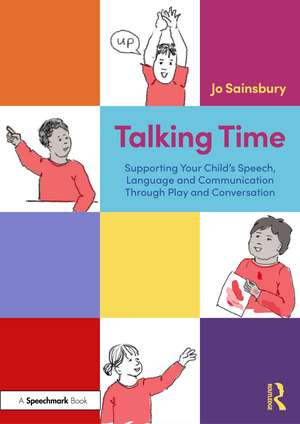
Talking Time: Supporting Your Child’s Speech, Language and Communication Through Play and Conversation
Autor Johanna Sainsburyen Limba Engleză Paperback – 28 dec 2026
Are you wondering what you can do to help at this amazing stage of their development?
Dip into this book to find out how you can turn any time into a ‘talking time’. Use your talking times to learn more about your child’s communication - and your own, and make small but effective and research-based changes to the way you listen, talk and play when you are with your child.
‘Talking Time’ is a practical guide for parents, early years practitioners and anyone else who is interested in what they can do to support a child who is learning to talk. Illustrated throughout and divided into easy-to-digest segments, each chapter covers a different communication strategy, with examples of how it can be used in real situations and prompts to use it in your own talking times and other daily routines. For readers with specific queries or concerns, there is a comprehensive FAQ section, a chapter that addresses common speech and language difficulties, and a guide to finding other resources and help. A perfect companion to supporting your child’s speech, language and communication.
Preț: 112.10 lei
Preț vechi: 139.94 lei
-20% Precomandă
Puncte Express: 168
Carte nepublicată încă
Livrare prin curier în România Precomanda se expediază când titlul devine disponibil.
Transport gratuit de la 400.00 lei Plată online sau ramburs, în funcție de opțiunile comenzii.
Retur gratuit în 14 zile Comandă securizată și suport în română.
Doresc să fiu notificat când acest titlu va fi disponibil:
Se trimite...
Specificații
ISBN-13: 9781041136804
ISBN-10: 1041136803
Pagini: 138
Ilustrații: 170
Dimensiuni: 174 x 246 mm
Ediția:1
Editura: Taylor & Francis
Colecția Routledge
Locul publicării:Oxford, United Kingdom
ISBN-10: 1041136803
Pagini: 138
Ilustrații: 170
Dimensiuni: 174 x 246 mm
Ediția:1
Editura: Taylor & Francis
Colecția Routledge
Locul publicării:Oxford, United Kingdom
Public țintă
General, Parents, and Professional Practice & DevelopmentCuprins
Contents
Introduction
How to use this book
1. Talking time
Why build a regular talking time into your day? How to make it work for you.
2. Noticing
How and why does your child communicate now? What do you notice about your own communication?
3. Watching and waiting
Slowing down the pace. Give yourself more time to notice. Give your child more time to focus their attention and communicate.
4. Who’s the leader?
Making it easier for your child to be the leader in play and conversation.
5. Questions
How and why to use questions carefully with your child.
6. Name it – repeat it - add more
How and when to say more words to help your child learn them.
7. Noticing opportunities
Opportunities for your child to have some influence on their world, including making choices and asking for help.
8. Recasting
Showing your child the way to say words and sentences in a supportive and natural way.
9. Gestures, signs and pictures
Use your hands and pictures to make communication easier.
10. Talking clearly
All about sounds. What to do if people don’t understand your child’s speech. What to do to help your child speak more clearly.
11. Beyond talking time
Using what you have learnt and practised in your talking times at other times of the day.
12. Songs, rhymes and books
How these help your child’s talking and communication.
13. Frequently asked questions
14. Where to find help in this book and elsewhere if you have a specific concern or query
15. Where to find other help
16. Recording your progress
Space to keep track of what you did and what happened
17. What’s the evidence?
A short overview of the research evidence.
Sources
Introduction
How to use this book
1. Talking time
Why build a regular talking time into your day? How to make it work for you.
2. Noticing
How and why does your child communicate now? What do you notice about your own communication?
3. Watching and waiting
Slowing down the pace. Give yourself more time to notice. Give your child more time to focus their attention and communicate.
4. Who’s the leader?
Making it easier for your child to be the leader in play and conversation.
5. Questions
How and why to use questions carefully with your child.
6. Name it – repeat it - add more
How and when to say more words to help your child learn them.
7. Noticing opportunities
Opportunities for your child to have some influence on their world, including making choices and asking for help.
8. Recasting
Showing your child the way to say words and sentences in a supportive and natural way.
9. Gestures, signs and pictures
Use your hands and pictures to make communication easier.
10. Talking clearly
All about sounds. What to do if people don’t understand your child’s speech. What to do to help your child speak more clearly.
11. Beyond talking time
Using what you have learnt and practised in your talking times at other times of the day.
12. Songs, rhymes and books
How these help your child’s talking and communication.
13. Frequently asked questions
o At what age should my child be able to talk clearly? When do children start talking in sentences?
o Does screen time affect speech and language development?
o Are there any special toys that help with speech and language development?
o Do dummies affect speech and language development?
o Do I need to get my child’s hearing tested?
o We speak a different language (or 2 or more different languages) at home. Does that cause speech and language delay?
14. Where to find help in this book and elsewhere if you have a specific concern or query
o My child is stammering
o My child is very chatty at home, but doesn’t talk at all at nursery
o I think my child is autistic
o My child can’t say words and sounds clearly
o My child doesn’t say many words/my child isn’t putting words together/my child’s sentences are very short with lots of mistakes
o My child can’t focus
o I don’t think my child understands what I am saying
o I have been given some advice, or found it online, but it doesn’t seem to be helping
15. Where to find other help
o Local services
o We have an appointment to see a Speech and Language Therapist. What will happen?
o Other resources and useful websites
16. Recording your progress
Space to keep track of what you did and what happened
17. What’s the evidence?
A short overview of the research evidence.
Sources
Notă biografică
Jo Sainsbury is a Speech and Language Therapist with over 30 years’ experience of sharing speech and language development strategies with parents of preschool children and early years practitioners.
Descriere
Dip into this book to find out how you can turn any time into a ‘talking time’. Use your talking times to learn more about your child’s communication - and your own, and make small but effective and research-based changes to the way you listen, talk and play when you are with your child.