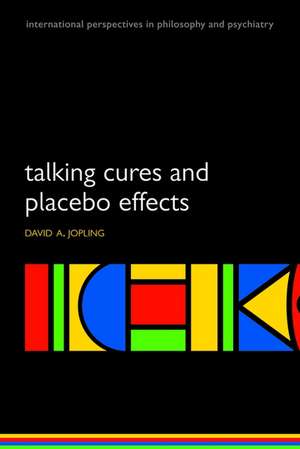
Talking Cures and Placebo Effects: International Perspectives in Philosophy & Psychiatry
Autor David A. Joplingen Limba Engleză Paperback – 29 mai 2008
Din seria International Perspectives in Philosophy & Psychiatry
- 15%
 Preț: 385.17 lei
 - 23%
 Preț: 675.97 lei
 - 23%
 Preț: 673.05 lei
 - 23%
 Preț: 585.28 lei
 - 23%
 Preț: 675.97 lei
 - 23%
 Preț: 610.67 lei
 - 23%
 Preț: 669.09 lei
 - 23%
 Preț: 580.34 lei
 - 24%
 Preț: 498.36 lei
 - 23%
 Preț: 584.08 lei
 - 24%
 Preț: 437.63 lei
 - 23%
 Preț: 630.50 lei
 - 25%
 Preț: 546.69 lei
 - 23%
 Preț: 464.56 lei
 - 23%
 Preț: 404.38 lei
 - 27%
 Preț: 670.12 lei
 - 23%
 Preț: 567.83 lei
 - 23%
 Preț: 474.49 lei
 - 23%
 Preț: 672.08 lei
 - 28%
 Preț: 407.36 lei
 - 21%
 Preț: 656.40 lei
 - 23%
 Preț: 714.52 lei
 - 24%
 Preț: 438.79 lei
 - 22%
 Preț: 347.22 lei
 - 28%
 Preț: 492.50 lei
 - 23%
 Preț: 730.37 lei
 - 23%
 Preț: 543.99 lei
 - 23%
 Preț: 495.98 lei
 - 20%
 Preț: 557.55 lei
 - 23%
 Preț: 475.24 lei
 - 23%
 Preț: 544.74 lei
 - 16%
 Preț: 606.66 lei
 - 24%
 Preț: 622.47 lei
 - 25%
 Preț: 572.46 lei
 - 27%
 Preț: 449.39 lei
 - 23%
 Preț: 485.23 lei
Preț: 476.83 lei
Preț vechi: 617.83 lei
-23%
Puncte Express: 715
Carte tipărită la comandă
Livrare economică 04-15 decembrie
Livrare prin curier în România Termenul estimat este afișat lângă disponibilitate.
Transport gratuit pentru acest produs Plată online sau ramburs, în funcție de opțiunile comenzii.
Retur gratuit în 14 zile Comandă securizată și suport în română.
Specificații
ISBN-13: 9780199239504
ISBN-10: 0199239509
Pagini: 334
Dimensiuni: 157 x 235 x 20 mm
Greutate: 0.5 kg
Editura: OUP OXFORD
Colecția OUP Oxford
Seria International Perspectives in Philosophy & Psychiatry
Locul publicării:Oxford, United Kingdom
ISBN-10: 0199239509
Pagini: 334
Dimensiuni: 157 x 235 x 20 mm
Greutate: 0.5 kg
Editura: OUP OXFORD
Colecția OUP Oxford
Seria International Perspectives in Philosophy & Psychiatry
Locul publicării:Oxford, United Kingdom
V-ar putea interesa
-
 The Examined LifeStephen Grosz-37%Preț: 58.02 lei92.46 lei
 -
 Psychoanalysis: A Very Short IntroductionDaniel Pick-20%Preț: 56.97 lei70.82 lei
 -
 How Does Analysis Cure?Heinz KohutPreț: 243.96 lei
 -
 Meaning, Medicine and the 'Placebo Effect'Daniel E. MoermanPreț: 197.29 lei
 -
 If You Meet the Buddha on the Road, Kill HimSheldon KoppPreț: 60.30 lei
 -
 -30%Preț: 65.27 lei93.51 lei
 -
 -5%Preț: 296.91 lei312.54 lei
 -
 Preț: 409.53 lei
 -
 -25%Preț: 60.38 lei80.29 lei
 -
 The TellAmy GriffinPreț: 121.51 lei
 -
 Psychedelic Healing: The Promise of Entheogens for Psychotherapy and Spiritual DevelopmentNeal M. Goldsmith Ph.D.-24%Preț: 88.10 lei115.32 lei
 -
 Apothecary for the Afflicted: Shadow Work for Invisible WoundsDr. Melissa Kim Corter-23%Preț: 119.28 lei155.44 leiRecomandat
 -
 You Are the PlaceboJoe Dispenza-16%Preț: 104.97 lei124.96 lei
 -
 PsychoanalysisJanet MalcolmPreț: 78.13 lei
 -
 Introducing PsychoanalysisIvan WardPreț: 64.54 lei
 -
 The Fundamentals of Psychoanalytic TechniqueR. Horacio Etchegoyen-5%Preț: 590.56 lei621.64 lei
 -
 The Cure for PsychoanalysisAdam Phillips-28%Preț: 126.03 lei175.97 lei
 -
 What is Psychotherapy?The School Of Life-20%Preț: 56.83 lei70.60 lei
 -
 Embrace Pleasure: How Psychedelics Can Heal Our SexualityDee Dee Goldpaugh-23%Preț: 118.63 lei154.99 leiRecomandat
 -
 -18%Preț: 99.39 lei121.63 leiRecomandat
Notă biografică
David A. Jopling is Associate Professor in the Department of Philosophy at York University, in Toronto, Ontario, Canada. His research interests include the philosophy of psychology and psychiatry, early modern philosophy, and cognitive science. He has published books and articles on the concept of self, self-knowledge, phenomenology, and cognitive science.