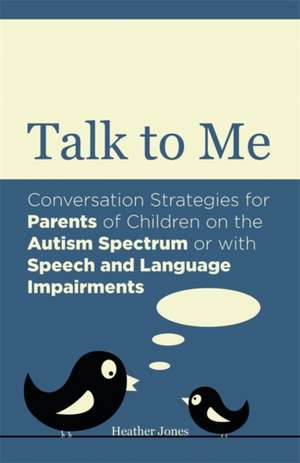
Talk to Me: Conversation Strategies for Parents of Children on the Autism Spectrum or with Speech and Language Impairments
Autor Heather Jonesen Limba Engleză Paperback – 21 feb 2014
Găsim în literatura de specialitate numeroase resurse axate pe dezvoltarea vocabularului, însă remarcăm o lacună acută în ceea ce privește ghidurile practice dedicate mecanismelor sociale ale dialogului pentru copiii cu autism. Talk to Me completează exact acest gol, oferind o metodologie aplicată pentru trecerea de la stadiul de monolog sau tăcere la cel de interacțiune funcțională. Reținem premisa autoarei Heather Jones, care demonstrează că simpla cunoaștere a cuvintelor nu garantează abilitatea de a susține o conversație; este necesară o instruire explicită în regulile nescrise ale schimbului de replici.
Structura cărții este extrem de riguroasă, fiind organizată în 19 secțiuni ce decortichează procesul comunicării: de la adresarea întrebărilor de tip „Wh-” și respectarea rândului la vorbire, până la concepte mai complexe precum „comunicarea fatică” (funcția socială a limbajului) și menținerea subiectului fără a cădea în capcana intereselor speciale restrictive. Volumul este comparabil cu The Autism Language Launcher de Kate Wilde în ceea ce privește rigurozitatea pașilor propuși, dar Talk to Me este actualizat specific pentru contextul în care limbajul există deja, dar nu este utilizat social, punând un accent mai mare pe tranziția către viața adultă și independență.
Spre deosebire de lucrările sale academice anterioare, precum Violence Against Prisoners of War in the First World War, unde Heather Jones analizează fenomene macro-sociale și istorice, acest volum reprezintă o schimbare de paradigmă către sfera pedagogiei aplicate și a intervenției timpurii. Tonul rămâne însă unul analitic și precis, transformând experiența personală într-un instrument de lucru structurat, esențial pentru părinți și cadre didactice care doresc să faciliteze integrarea socială a copiilor prin stăpânirea artei conversației.
Preț: 114.91 lei
Preț vechi: 144.95 lei
-21%
Carte disponibilă
Livrare economică 02-16 noiembrie
Specificații
ISBN-10: 1849054282
Pagini: 168
Ilustrații: 10 black and white
Dimensiuni: 173 x 219 x 10 mm
Greutate: 0.23 kg
Editura: JESSICA KINGSLEY PUBLISHERS
Colecția Jessica Kingsley Publishers
Locul publicării:London, United Kingdom
V-ar putea interesa
-
 Engaging Every LearnerPatricia Vitale-ReillyPreț: 209.09 lei
 -
 Preț: 67.07 lei
 -
 The RockHeather JonesPreț: 107.98 lei
 -
 Violence Against Prisoners of War in the First World WarHeather JonesPreț: 246.30 lei
 -
 For King and CountryHeather JonesPreț: 343.38 lei
 -
 Preț: 371.03 lei
 -
 Learning Disabilities in the Primary ClassroomLeonora HardingPreț: 371.03 lei
 -
 The Education and Training of the Mentally Retarded: Recent AdvancesAdrian F. AshmanPreț: 396.85 lei
 -
 Preț: 359.84 lei
 -
 Reading for Slow Learners: A Curriculum GuideW. K. BrennanPreț: 371.03 lei
 -
 Motivating Writers in Class: Theory and InterventionsBruce Saddler-15%Preț: 415.58 lei488.92 lei
 -
 First Words: A Parent's Step-by-Step Guide to Helping a Child with Speech and Language DelaysBarbara Levine Offenbacher-24%Preț: 146.09 lei191.00 lei
 -
 Special Needs, Different Abilities: The Interactive Method for Teaching and LearningMarjorie S. Schiering-21%Preț: 367.02 lei461.89 lei
 -
 Special Needs, Different Abilities: The Interactive Method for Teaching and LearningMarjorie S. Schiering-25%Preț: 177.09 lei237.61 lei
 -
 In the Mind's EyeThomas G. WestPreț: 144.53 lei
 -
 Aurora BorealiceJoan SteacyPreț: 123.75 lei
 -
 Good GriefHeather JonesPreț: 85.20 lei
De ce să citești această carte
Această carte este indispensabilă părinților și educatorilor care caută soluții dincolo de logopedia clasică. Cititorul câștigă un set de strategii testate pentru a transforma interacțiunile dificile în momente de conexiune reală. Este un ghid practic care demonstrează cum dezvoltarea abilităților conversaționale devine fundamentul pentru succesul viitor al copilului, de la legarea prieteniilor până la susținerea unui interviu de angajare.
Despre autor
Heather Jones este o cercetătoare cu o pregătire academică de elită, fiind absolventă a Trinity College Dublin și St John's College, Cambridge, și deținând o bursă „Max Weber” la Institutul Universitar European din Florența. Deși recunoscută internațional pentru studiile sale asupra Primului Război Mondial, Jones s-a implicat activ în domeniul educației speciale în urma experienței personale cu fiul său diagnosticat cu sindrom Asperger. Expertiza sa în analiză și structurare informațională se reflectă în calitatea metodologiei propuse în Talk to Me. În prezent, este director la Milkwood Educational, unde coordonează publicarea de manuale educaționale.
Descriere
In this hands-on guide, Heather Jones offers practical advice, born of experience with her own son, which will help you teach your child the principles of communication. Full of strategies and examples, it shows how you can allay fears, build confidence and teach your child to enjoy conversation. Once a child gets used to talking with other people, many life skills can develop more easily as they grow up – from making friends and shopping for themselves, to being interviewed and eventually getting a job.
This handy book provides guidance and inspiration to parents, teachers and anyone else who cares for a child who finds language and comprehension difficult.
Recenzii
With the benefit of hindsight and personal experience, Heather Jones has provided a powerful insight into the complexities of raising a child with Asperger Syndrome and significant speech language impairment. This enlightening account of Jamie's journey from angry, frustrated child to communicative young adult should not be missed.
“Heather Jones has given us an easy-to-read book on an important and complex topic—conversation. She brings a wealth of experience and understanding of her son who, like many others, lacks the skills (though not the interest) to talk with us. Lots of tips for parents here. We need more books from those who live with those coping with autism.”
This should be read by parents of all children, not just those with autism.
... those who have Asperger syndrome. They need help to learn the art of conversation and how this might be done is what the author of this book demonstrates. Jessica Jones writes from a wealth of practical experience: she has a son, now a young adult, who has Asperger syndrome and language impairment... She stresses the importance of asking open questions to develop meaningful conversations and reminds readers that the skill of conversational turn taking has to be taught to aspies, again providing personal examples... There are useful chapters on making friends, coping with social situations such as parties and youth groups and how to cope with authority figures... All in all, a very helpful, empowering and affirming book for parents and others working with children who need help in communicating.
Talk to Me provides an array of strategies which aim to provide confidence in children whose conversational skills are limited. The chapters are short, easy to read and cover a variety of topics... A must read for parents.