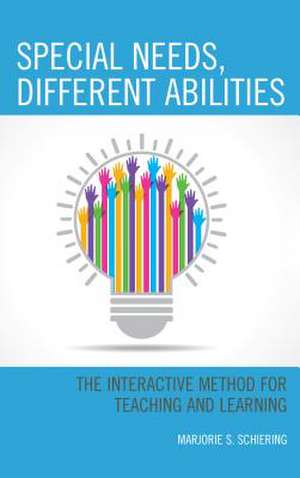
Special Needs, Different Abilities: The Interactive Method for Teaching and Learning
Autor Marjorie S. Schieringen Limba Engleză Hardback – 24 iul 2019
Preț: 367.02 lei
Preț vechi: 461.89 lei
-21%
Puncte Express: 551
Carte tipărită la comandă
Livrare economică 23 noiembrie-07 decembrie
Livrare prin curier în România Termenul estimat este afișat lângă disponibilitate.
Transport gratuit de la 400.00 lei Plată online sau ramburs, în funcție de opțiunile comenzii.
Retur gratuit în 14 zile Comandă securizată și suport în română.
Specificații
ISBN-13: 9781475849936
ISBN-10: 1475849931
Pagini: 156
Dimensiuni: 160 x 229 x 17 mm
Greutate: 0.4 kg
Editura: Bloomsbury Publishing
Colecția Rowman & Littlefield
Locul publicării:New York, United States
ISBN-10: 1475849931
Pagini: 156
Dimensiuni: 160 x 229 x 17 mm
Greutate: 0.4 kg
Editura: Bloomsbury Publishing
Colecția Rowman & Littlefield
Locul publicării:New York, United States
Cuprins
Prelude
Foreword: Patricia Eckardt and Madeline Craig
Preface
Acknowledgments
Introduction
Part one: information gathering and distribution concerning special needs and different ability learners
Chapter One: Reaching/Teaching Varied Learners
Chapter Two: Response to Intervention, Individual Education Plan and Classroom Organization
Chapter Three: Individual Processing Style and Social Cognition
Chapter Four: The Interactive Method, Student Engagement and Self-Efficacy
Chapter Five: Memories and Interactive Learning Techniques
Chapter Six:Interactive Learning Technique Pluses, Leadership Building, and Alternative Means of Assessment
Chapter Seven: The Reciprocity of Thinking
Chapter Eight: The Cognitive Collective: Thinking and Feeling
Chapter Nine: Definition and Examples of Reciprocal Thinking Phases' Skills
Part two: different ways of teaching, personal commentaries, and author's closing thoughts
Chapter Ten:The IM's Self-Reliance and the "How To" of Teaching Thinking
Chapter Eleven: Objectives of the Interactive Method and its Components
Chapter Twelve: Two Personal Perspectives Addressing Special Education
Disabilities, Differences and Diversity: Maggie Blair
Autism Awareness: Author Interview of a Different Abilities Child's Parent: Kevin Cooney
Chapter Thirteen: Commentary and Personal Experience: Teaching and Being Special Needs
Commentaries and Personal Experiences: Special Needs and Different Abilities
Commentary: Engaging Students with Exceptionalities: Patricia Mason
A Teacher with Epilepsy: From Childhood through Retirement: Marc Hoberman
Chapter Fourteen: Author's Summative Sharing: Classroom Comfort Zone
References
About the Author
Foreword: Patricia Eckardt and Madeline Craig
Preface
Acknowledgments
Introduction
Part one: information gathering and distribution concerning special needs and different ability learners
Chapter One: Reaching/Teaching Varied Learners
Chapter Two: Response to Intervention, Individual Education Plan and Classroom Organization
Chapter Three: Individual Processing Style and Social Cognition
Chapter Four: The Interactive Method, Student Engagement and Self-Efficacy
Chapter Five: Memories and Interactive Learning Techniques
Chapter Six:Interactive Learning Technique Pluses, Leadership Building, and Alternative Means of Assessment
Chapter Seven: The Reciprocity of Thinking
Chapter Eight: The Cognitive Collective: Thinking and Feeling
Chapter Nine: Definition and Examples of Reciprocal Thinking Phases' Skills
Part two: different ways of teaching, personal commentaries, and author's closing thoughts
Chapter Ten:The IM's Self-Reliance and the "How To" of Teaching Thinking
Chapter Eleven: Objectives of the Interactive Method and its Components
Chapter Twelve: Two Personal Perspectives Addressing Special Education
Disabilities, Differences and Diversity: Maggie Blair
Autism Awareness: Author Interview of a Different Abilities Child's Parent: Kevin Cooney
Chapter Thirteen: Commentary and Personal Experience: Teaching and Being Special Needs
Commentaries and Personal Experiences: Special Needs and Different Abilities
Commentary: Engaging Students with Exceptionalities: Patricia Mason
A Teacher with Epilepsy: From Childhood through Retirement: Marc Hoberman
Chapter Fourteen: Author's Summative Sharing: Classroom Comfort Zone
References
About the Author
Recenzii
With the current explosion of children being born with various special needs, especially on the autism spectrum, it becomes imperative that educators seek ways in which they can best meet the educational needs of these children, and all those they educate, so they can reach their potential. Educators, over the past decade, differentiated the curricula by adapting and adopting new ways of teaching the students they serve. However, there have not necessarily been real workbooks for educators to reference and use.
Dr. Schiering's interactive new book acknowledges neurodiversity as a form of human diversity to be embraced! The acceptance of every learners' unique set of strengths and needs propels the educator to developing instruction that is creative and caters to each person's learning process. This book advocates for acceptance and evoking in each learner the idea, 'I am enough'. A wonderful contribution to the field.
Dr. Marjorie Schiering examines a most interesting, important, challenging issue in her latest book: The need to see students as individuals, with diverse talents and struggles. In her carefully-researched work, she pinpoints practical approaches the educator should consider to achieve the best learning, offers colleagues personal narratives and commentaries of how some have experienced different abilities and the books interactive approaches, and invites us to do likewise. A truly rewarding work!
As both an educator and parent of special needs children, I am well aware of how the world of special education can seem overwhelming. Different Abilities: Special Needs: Different Ways...An Interactive Workbook, is a vital tool for both educators and parents at all levels. It provides practical researched information, as well as that of veteran teachers. There are time-tested strategies and useful anecdotes to help teachers and parents navigate the often-confounding waters of special education, as well as different abilities students. For teachers, it offers first-rate techniques for making their classrooms most inclusive and welcoming for students of varied abilities. For parents, the anecdotes validate the struggles they go through to do what is best for their children and leaves them with this reminder: You are not alone. Truly, this book is an invaluable addition to any teacher or parent's library.
This workbook demonstrates how and why alternative thinking is necessary when experiencing different abilities of students. It viably addresses a wide variety of circumstances encountered in teaching students with different abilities. It reminds us of how traditional methodologies oftentimes do not apply in special needs situations. Subsequently, applying differentiated instruction to meet the multi-variate needs of students must be explored until one is found. That is the essence of this author's messages for teaching thinking and addressing students' aptitudes.
Dr. Schiering's interactive new book acknowledges neurodiversity as a form of human diversity to be embraced! The acceptance of every learners' unique set of strengths and needs propels the educator to developing instruction that is creative and caters to each person's learning process. This book advocates for acceptance and evoking in each learner the idea, 'I am enough'. A wonderful contribution to the field.
Dr. Marjorie Schiering examines a most interesting, important, challenging issue in her latest book: The need to see students as individuals, with diverse talents and struggles. In her carefully-researched work, she pinpoints practical approaches the educator should consider to achieve the best learning, offers colleagues personal narratives and commentaries of how some have experienced different abilities and the books interactive approaches, and invites us to do likewise. A truly rewarding work!
As both an educator and parent of special needs children, I am well aware of how the world of special education can seem overwhelming. Different Abilities: Special Needs: Different Ways...An Interactive Workbook, is a vital tool for both educators and parents at all levels. It provides practical researched information, as well as that of veteran teachers. There are time-tested strategies and useful anecdotes to help teachers and parents navigate the often-confounding waters of special education, as well as different abilities students. For teachers, it offers first-rate techniques for making their classrooms most inclusive and welcoming for students of varied abilities. For parents, the anecdotes validate the struggles they go through to do what is best for their children and leaves them with this reminder: You are not alone. Truly, this book is an invaluable addition to any teacher or parent's library.
This workbook demonstrates how and why alternative thinking is necessary when experiencing different abilities of students. It viably addresses a wide variety of circumstances encountered in teaching students with different abilities. It reminds us of how traditional methodologies oftentimes do not apply in special needs situations. Subsequently, applying differentiated instruction to meet the multi-variate needs of students must be explored until one is found. That is the essence of this author's messages for teaching thinking and addressing students' aptitudes.