
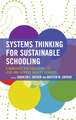
Systems Thinking for Sustainable Schooling: A Mindshift for Educators to Lead and Achieve Quality Schools: Bridging Theory and Practice
Editat de Karolyn J. Snyder, Kristen M. Snyderen Limba Engleză Hardback – 15 feb 2023


Preț: 463.89 lei
Preț vechi: 642.29 lei
-28%
Puncte Express: 696
Carte tipărită la comandă
Livrare economică 02-16 decembrie
Livrare prin curier în România Termenul estimat este afișat lângă disponibilitate.
Transport gratuit pentru acest produs Plată online sau ramburs, în funcție de opțiunile comenzii.
Retur gratuit în 14 zile Comandă securizată și suport în română.
Specificații
ISBN-13: 9781475866391
ISBN-10: 1475866399
Pagini: 156
Dimensiuni: 160 x 230 x 16 mm
Greutate: 0.4 kg
Editura: Bloomsbury Publishing
Colecția Rowman & Littlefield
Seria Bridging Theory and Practice
Locul publicării:New York, United States
ISBN-10: 1475866399
Pagini: 156
Dimensiuni: 160 x 230 x 16 mm
Greutate: 0.4 kg
Editura: Bloomsbury Publishing
Colecția Rowman & Littlefield
Seria Bridging Theory and Practice
Locul publicării:New York, United States
Cuprins
Series Editor Introduction
Foreword
Skardon Bliss & Janet Greenwood
Editors' Introduction
Karolyn J. Snyder & Kristen M. Snyder
Tribute to Joyce B. Swarzman, Kristen Snyder
Systems Thinking and Sustainable Schooling: Foundations in PhysicsKarolyn J. Snyder
Expanding How We Think about Quality in Education Kristen M. Snyder
A Quantum Worldview of Responsive Power for Sustainable LearningMichele Acker-Hocevar
The Quantum School Leader as a Strategic Systems ThinkerElaine C. Sullivan
Networking for Principal Sustainability David Scanga & Renee Sedlack
The Beginnings of Collaboration in Schools: Team Teaching, Nongradedness, and Multi-Aged Grouping
Robert H. Anderson
Introduction by Karolyn J. Snyder & Joyce B. Swarzman
Approaching Systems Thinking in Schools by Linking Quality and Sustainability: Moving from Theory to Practice
Anna Martensson & Kristen M. Snyder
Appreciative School Systems: A Path to School SuccessJohn Mann
Toward the School as a Sustainable Global Learning Center SystemJohn Fitzgerald & Elaine C. Sullivan
About the Editors and Other Authors
Foreword
Skardon Bliss & Janet Greenwood
Editors' Introduction
Karolyn J. Snyder & Kristen M. Snyder
Tribute to Joyce B. Swarzman, Kristen Snyder
Systems Thinking and Sustainable Schooling: Foundations in PhysicsKarolyn J. Snyder
Expanding How We Think about Quality in Education Kristen M. Snyder
A Quantum Worldview of Responsive Power for Sustainable LearningMichele Acker-Hocevar
The Quantum School Leader as a Strategic Systems ThinkerElaine C. Sullivan
Networking for Principal Sustainability David Scanga & Renee Sedlack
The Beginnings of Collaboration in Schools: Team Teaching, Nongradedness, and Multi-Aged Grouping
Robert H. Anderson
Introduction by Karolyn J. Snyder & Joyce B. Swarzman
Approaching Systems Thinking in Schools by Linking Quality and Sustainability: Moving from Theory to Practice
Anna Martensson & Kristen M. Snyder
Appreciative School Systems: A Path to School SuccessJohn Mann
Toward the School as a Sustainable Global Learning Center SystemJohn Fitzgerald & Elaine C. Sullivan
About the Editors and Other Authors
Recenzii
Systems Thinking for Sustainable Schooling presents a compelling case for the adoption of systems thinking in schools . The authors' practical insights make the book a valuable resource for those committed to transforming education practices and achieving sustainable, high-quality outcomes.
Finally, a book that in a scientific and accurate way addresses system thinking and sustainable development as the education sector's important future challenge. Through the authors' different perspectives, reading becomes both interesting and entertaining. I recommend this book to anyone active in education, and to others interested in these same challenges for society at large.
Over 50 years ago Karolyn Snyder and Robert Anderson launched a movement with educators around Systems Thinking that took them around the world to teach, train, and conduct research. They influenced generations of educators and doctoral students by producing worldwide digital networks, school visits, task forces, study groups, school district training series, partnerships, global summits, and numerous publications. Their early work helped to reimagine change in schools as something natural and welcomed, rather than forced and resisted. In this new book, Snyder and Snyder lovingly carry on this earlier work by revisiting the value of Systems Thinking, reporting its impact on school development, and imagining its possibilities and its importance to continuous growth and sustainability in schools. While the current scholars of improvement science are rediscovering this early work, these editors and their authors are the real deal in Systems Thinking!
In our society all schools (public, private and charter) need to become learning organizations. It is the only way to develop the full potential of every student as an inquirer, able to reach the highest level of his or her abilities/skills. It will change every student into a 'life-long learner' who is able to contribute to society. A key factor for the learning organization is 'Systems-Thinking'. It is hard because it implies a real mind shift for all professionals in the school, as well as for students and families. And, it is the best way to achieve the highest level of quality in education.
Understanding the roots and principles of Systems Thinking is vital to any true educator. This book is an excellent guide to the world of Systems Thinking and its role in education. The book also supports the reader to develop systems thinking skills that are needed in the sustainable development of education. My own experience in leading educational reforms at the state, local and school levels in Finland certifies the value of this important book.
Finally, a book that in a scientific and accurate way addresses system thinking and sustainable development as the education sector's important future challenge. Through the authors' different perspectives, reading becomes both interesting and entertaining. I recommend this book to anyone active in education, and to others interested in these same challenges for society at large.
Over 50 years ago Karolyn Snyder and Robert Anderson launched a movement with educators around Systems Thinking that took them around the world to teach, train, and conduct research. They influenced generations of educators and doctoral students by producing worldwide digital networks, school visits, task forces, study groups, school district training series, partnerships, global summits, and numerous publications. Their early work helped to reimagine change in schools as something natural and welcomed, rather than forced and resisted. In this new book, Snyder and Snyder lovingly carry on this earlier work by revisiting the value of Systems Thinking, reporting its impact on school development, and imagining its possibilities and its importance to continuous growth and sustainability in schools. While the current scholars of improvement science are rediscovering this early work, these editors and their authors are the real deal in Systems Thinking!
In our society all schools (public, private and charter) need to become learning organizations. It is the only way to develop the full potential of every student as an inquirer, able to reach the highest level of his or her abilities/skills. It will change every student into a 'life-long learner' who is able to contribute to society. A key factor for the learning organization is 'Systems-Thinking'. It is hard because it implies a real mind shift for all professionals in the school, as well as for students and families. And, it is the best way to achieve the highest level of quality in education.
Understanding the roots and principles of Systems Thinking is vital to any true educator. This book is an excellent guide to the world of Systems Thinking and its role in education. The book also supports the reader to develop systems thinking skills that are needed in the sustainable development of education. My own experience in leading educational reforms at the state, local and school levels in Finland certifies the value of this important book.