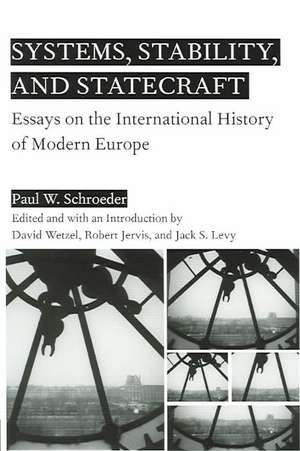
Systems, Stability, and Statecraft
Autor P. Schröderen Limba Engleză Paperback – 15 oct 2004
Tematica centrală a volumului Systems, Stability, and Statecraft gravitează în jurul istoriei relațiilor internaționale și a mecanismelor care guvernează stabilitatea sistemică. Remarcăm o abordare critică a metodologiilor clasice de analiză politică, autorul P. Schröder oferind o perspectivă nuanțată asupra evoluției diplomației moderne, de la epoca napoleoniană până la conflictele contemporane. Considerăm că forța acestui volum rezidă în capacitatea de a chestiona fundamentele 'balanței puterii', sugerând că stabilitatea europeană din secolul al XIX-lea s-a bazat mai degrabă pe un consens asupra regulilor de conduită decât pe simpla opoziție a forțelor militare. Structura volumului este organizată riguros în patru secțiuni: epoca lui Napoleon și Concertul European, originile structurale ale Primului Război Mondial, instrumentele de stat (precum alianțele și politicile de 'containment') și, în final, implicațiile teoretice ale istoriei internaționale. Această progresie permite cititorului să treacă de la studiul de caz istoric la reflecția teoretică profundă. Systems, Stability, and Statecraft completează excelent lucrarea The States System of Europe, 1640-1990 de Andreas Osiander, aducând o analiză mai detaliată asupra modului în care alianțele funcționează ca instrumente de management intern, nu doar ca arme împotriva inamicilor externi. În contextul operei sale, această colecție de eseuri din 2004 reprezintă o sinteză a gândirii lui P. Schröder, fiind mai aplicată pe dinamica puterii politice decât lucrările sale teoretice precum Early Modern Natural Law Theories. Descoperim aici un stil argumentativ provocator, care obligă atât istoricii, cât și politologii să își reevalueze convingerile despre cauzalitate și moralitate în arena internațională.
Preț: 387.52 lei
Carte disponibilă
Livrare economică 03-17 noiembrie
Specificații
ISBN-10: 1403963584
Pagini: 370
Ilustrații: VII, 370 p.
Dimensiuni: 151 x 228 x 30 mm
Greutate: 0.52 kg
Ediția:2004 edition
Editura: Palgrave Macmillan US
Locul publicării:New York, United States
V-ar putea interesa
-
 JosephineKate WilliamsPreț: 116.89 lei
 -
 -15%Preț: 632.93 lei744.62 lei
 -
 The Long Shadow of the British EmpireJ. Milner-Thornton-15%Preț: 645.34 lei759.23 lei
 -
 Mary IS. DuncanPreț: 426.27 lei
 -
 Debating American ExceptionalismF. HilfrichPreț: 391.06 lei
 -
 Communal Labor in Colonial KenyaO. OkiaPreț: 386.21 lei
 -
 The Last Plantagenet ConsortsKenneth A LoparoPreț: 400.83 lei
 -
 Preț: 282.36 lei
 -
 Preț: 231.19 lei
 -
 A Monarchy of LettersRayne Allinson-15%Preț: 714.38 lei840.45 lei
 -
 Liberal Imperialism in EuropeM. Fitzpatrick-20%Preț: 632.77 lei790.96 lei
 -
 Citizen Emperor: Napoleon in Power 1799-1815Philip Dwyer-40%Preț: 139.74 lei231.36 lei
 -
 Preț: 146.15 lei
De ce să citești această carte
Recomandăm această carte specialiștilor în relații internaționale și istorie diplomatică dornici să exploreze o alternativă la realismul politic clasic. Cititorul câștigă o înțelegere profundă a modului în care ordinea internațională este construită prin norme și instituții, nu doar prin forță brută. Este o resursă esențială pentru a înțelege de ce anumite sisteme de stat rezistă, în timp ce altele se prăbușesc sub presiunea crizelor de negociere.
Despre autor
P. Schröder este recunoscut drept unul dintre cei mai importanți istorici ai relațiilor internaționale, celebru pentru expertiza sa în diplomația europeană a secolelor XVIII și XIX. Opera sa se distinge prin rigoarea cercetării surselor primare și prin dorința constantă de a provoca paradigmele consacrate ale științelor politice. Pe lângă analizele sistemice complexe, autorul a explorat și fundamentele intelectuale ale dreptului natural, demonstrând o viziune interdisciplinară care îmbină istoria ideilor cu pragmatismul politic al statelor moderne.
Descriere scurtă
Cuprins
Recenzii
"These essays are provocative, wonderfully written, drawing on an unrivalled storehouse of historical knowledge and bridging history and social science. Agree or disagree with them, they evoke unstinting admiration. Paul Schroeder is a national scholarly treasure." - Richard Ned Lebow, Dartmouth College
"Paul Schroeder is perhaps the most important living North American historian of European diplomacy. His reflections on theory and history are unsurpassed; they have challenged conventional interpretations and have provided original insights about the deeper forces underlying world politics. Scholars and students of history and political science will find in this collection the best of Schroeder's articles from the famous 'Galloping Gertie' thesis and his work on the balance of power and the Vienna Settlement to his most recent essay on counterfactuals and World War I. No college or personal library with a focus on international relations should be without it." - John Vasquez, Picker Chair in International Relations, Colgate University
"Paul Schroeder's scholarship provocatively re-examines the critical assumptions and decisions that have preserved peace or squandered it from the mid-eighteenth century to the present. Reading Schroeder's work is like playing chess against a grand master who, even as he inexorably moves to defeat you, patiently explains why each of your moves has been deficient. These essays will be fundamental for historians and theorists alike, and invaluable for teaching in the field." - Charles S. Maier, Leverett Saltonstall Professor of History, Harvard University