
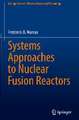
Systems Approaches to Nuclear Fusion Reactors: Springer Series in Plasma Science and Technology
Autor Frederick B. Marcusen Limba Engleză Paperback – 3 ian 2024
The book examines the engineering and physics design and optimization process for each machine, analysing their performance and major results achieved, thus establishing a basis for the improvement of future machines. The reader will gain a broad historical and up-to-date perspective of the status of nuclear fusion research from both an engineering and physics point of view. Explanations are given of the computational tools needed to design and operate successful experiments and reactor-relevant machines.
This book is aimed at both graduate students and practitioners of nuclear fusion science and engineering, as well as those specializing in other fields demanding large and integrated experimental equipment. Systems engineers will obtain valuable insights into fusion applications. References are given to associated complex mathematical derivations, which are beyond the scope of this book. The general reader interested in nuclear fusion will find here an accessible summary of the current state of nuclear fusion.


Preț: 974.14 lei
Preț vechi: 1187.97 lei
-18%
Puncte Express: 1461
Carte tipărită la comandă
Livrare economică 24 noiembrie-08 decembrie
Livrare prin curier în România Termenul estimat este afișat lângă disponibilitate.
Transport gratuit pentru acest produs Plată online sau ramburs, în funcție de opțiunile comenzii.
Retur gratuit în 14 zile Comandă securizată și suport în română.
Specificații
ISBN-13: 9783031177132
ISBN-10: 3031177134
Pagini: 496
Ilustrații: XXV, 470 p. 1 illus.
Dimensiuni: 155 x 235 x 27 mm
Greutate: 0.74 kg
Ediția:1st ed. 2022
Editura: Springer
Colecția Springer Series in Plasma Science and Technology
Seria Springer Series in Plasma Science and Technology
Locul publicării:Cham, Switzerland
ISBN-10: 3031177134
Pagini: 496
Ilustrații: XXV, 470 p. 1 illus.
Dimensiuni: 155 x 235 x 27 mm
Greutate: 0.74 kg
Ediția:1st ed. 2022
Editura: Springer
Colecția Springer Series in Plasma Science and Technology
Seria Springer Series in Plasma Science and Technology
Locul publicării:Cham, Switzerland
Cuprins
Introduction to systems approaches and nuclear fusion.- Doublet III and DIII-D – robustness and adaptation.- TCV – A case study in systems approaches and robustness.- JET and fusion plasmas – systems optimization.- ITER – fusion proto-reactor and large scale systems integration.- Mirrors and other reactor concepts.- Alternative systems approaches.- Conclusions on systems approaches.
Notă biografică
Frederick B Marcus graduated from MIT with high honours in physics, and obtained a doctorate in plasma physics from the University of Oxford, followed by a post-doc at Oxford and the UKAEA Culham Laboratory on the Superconducting Levitron. At the Oak Ridge National Lab, a detailed design was produced of a potential Tokamak fusion reactor, after which the author worked at General Atomics on the Doublet III experiment. At the Swiss Federal Institute of Technology at Lausanne, he was responsible for the physics and engineering design and initial construction phase of TCV. At the European Commission fusion project JET at Culham, he developed and operated neutron diagnostics and was scientific secretary for designing and carrying out the high power deuterium-tritium fusion experiments. After JET, he supervised European projects on systems approaches to computational biology.
Textul de pe ultima copertă
This book offers an overall review, applying systems engineering and architecture approaches, of the design, optimization, operation and results of leading fusion experiments. These approaches provide a unified means of evaluating reactor design. Methodologies are developed for more coherent construction or evaluation of fusion devices, associated experiments and operating procedures. The main focus is on tokamaks, with almost all machines and their important results being integrated into a systems design space. Case studies focus on DIII-D, TCV, JET, WEST, the fusion reactor prototype ITER and the EU DEMO concept. Stellarator, Mirror and Laser inertial confinement experiments are similarly analysed.
The book examines the engineering and physics design and optimization process for each machine, analysing their performance and major results achieved, thus establishing a basis for the improvement of future machines. The reader will gain a broad historical and up-to-dateperspective of the status of nuclear fusion research from both an engineering and physics point of view. Explanations are given of the computational tools needed to design and operate successful experiments and reactor-relevant machines.
This book is aimed at both graduate students and practitioners of nuclear fusion science and engineering, as well as those specializing in other fields demanding large and integrated experimental equipment. Systems engineers will obtain valuable insights into fusion applications. References are given to associated complex mathematical derivations, which are beyond the scope of this book. The general reader interested in nuclear fusion will find here an accessible summary of the current state of nuclear fusion.
The book examines the engineering and physics design and optimization process for each machine, analysing their performance and major results achieved, thus establishing a basis for the improvement of future machines. The reader will gain a broad historical and up-to-dateperspective of the status of nuclear fusion research from both an engineering and physics point of view. Explanations are given of the computational tools needed to design and operate successful experiments and reactor-relevant machines.
This book is aimed at both graduate students and practitioners of nuclear fusion science and engineering, as well as those specializing in other fields demanding large and integrated experimental equipment. Systems engineers will obtain valuable insights into fusion applications. References are given to associated complex mathematical derivations, which are beyond the scope of this book. The general reader interested in nuclear fusion will find here an accessible summary of the current state of nuclear fusion.
Caracteristici
Applies systems engineering and architecture approaches to fusion reactor design Presents a comprehensive historical and current overview of nuclear fusion research Describes a full range of plasma physics and engineering practice in reactor concepts