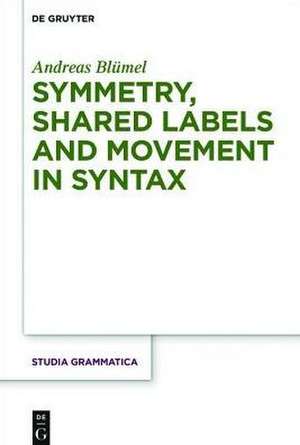
Symmetry, Shared Labels and Movement in Syntax: Studia grammatica, cartea 81
Autor Andreas Blümelen Limba Engleză Electronic book text – 19 mar 2017
Within the Minimalist Program a standard answer to the first question is that it is driven by morphosyntactic features. This monograph challenges that view and suggests that the role of features in driving syntactic computation has been overestimated. Instead it proposes that "labeling" -- the detection of a prominent element in sets formed by Merge -- plays a role in driving transformations, and labeling itself is understood to derive from an interplay of efficient computation and the need for a label at the Conceptual-Intentional systems. It explores this idea in four empirical domains: Long-distance dependencies, Criterial Freezing-phenomena, nested dependencies and ATB-movement. The languages considered include English, German and Hebrew.
Din seria Studia grammatica
- 9%
 Preț: 748.38 lei
 - 23%
 Preț: 754.30 lei
 - 23%
 Preț: 1020.39 lei
 - 27%
 Preț: 660.23 lei
 - 23%
 Preț: 581.77 lei
 - 23%
 Preț: 619.98 lei
 - 23%
 Preț: 619.98 lei
 - 23%
 Preț: 619.98 lei
 - 23%
 Preț: 619.98 lei
 - 27%
 Preț: 805.13 lei
 - 27%
 Preț: 732.68 lei
 - 27%
 Preț: 805.13 lei
 - 27%
 Preț: 805.13 lei
 - 27%
 Preț: 732.68 lei
 - 27%
 Preț: 805.13 lei
 - 23%
 Preț: 581.77 lei
 - 27%
 Preț: 805.13 lei
 - 27%
 Preț: 877.58 lei
 - 8%
 Preț: 629.75 lei
 - 23%
 Preț: 551.86 lei
 - 27%
 Preț: 805.13 lei
 - 23%
 Preț: 551.86 lei
Preț: 576.27 lei
Preț vechi: 748.40 lei
-23% Precomandă
Puncte Express: 864
Nepublicat încă
Livrare prin curier în România Precomanda se expediază când titlul devine disponibil.
Transport gratuit pentru acest produs Plată online sau ramburs, în funcție de opțiunile comenzii.
Retur gratuit în 14 zile Comandă securizată și suport în română.
Doresc să fiu notificat când acest titlu va fi disponibil:
Se trimite...
Specificații
ISBN-13: 9783110520187
ISBN-10: 3110520184
Pagini: 180
Editura: De Gruyter
Colecția De Gruyter Mouton
Seria Studia grammatica
Locul publicării:Berlin/Boston
ISBN-10: 3110520184
Pagini: 180
Editura: De Gruyter
Colecția De Gruyter Mouton
Seria Studia grammatica
Locul publicării:Berlin/Boston
V-ar putea interesa
-
 -41%Preț: 44.97 lei76.58 lei
 -
 -20%Preț: 303.33 lei380.91 lei
 -
 The Origins of Grammar: Language in the Light of Evolution IIJames R. Hurford-9%Preț: 480.16 lei528.69 lei
 -
 The Complementizer Phase: Subjects and OperatorsE. Phoevos Panagiotidis-26%Preț: 426.34 lei575.24 lei
 -
 The Oxford Handbook of CompoundingRochelle Lieber-20%Preț: 366.02 lei456.25 lei
 -
 Syntactic TheoryGeoffrey PoolePreț: 282.14 lei
 -
 The Linguistic Theory of NumeralsJames R. HurfordPreț: 303.74 lei
 -
 A Grammar of SemelaiNicole KruspePreț: 381.35 lei
 -
 The Syntax of IcelandicHoskuldur Thrainsson-11%Preț: 433.93 lei487.57 lei
 -
 Preț: 401.71 lei
 -
 An Introduction to English SyntaxJim Miller-5%Preț: 142.39 lei150.38 lei
 -
 MorphologyAntonio Fábregas-14%Preț: 179.22 lei208.46 lei
 -
 Halliday's Introduction to Functional GrammarM. A. K. Halliday-15%Preț: 493.35 lei580.41 lei
Descriere
What is the trigger for displacement phenomena in natural language syntax? And how can constraints on syntactic movement be derived from interface conditions and so-called Third Factor principles?
Within the Minimalist Program a standard answer to the first question is that it is driven by morphosyntactic features. This monograph challenges that view and suggests that the role of features in driving syntactic computation has been overestimated. Instead it proposes that "labeling" -- the detection of a prominent element in sets formed by Merge -- plays a role in driving transformations, and labeling itself is understood to derive from an interplay of efficient computation and the need for a label at the Conceptual-Intentional systems. It explores this idea in four empirical domains: Long-distance dependencies, Criterial Freezing-phenomena, nested dependencies and ATB-movement. The languages considered include English, German and Hebrew.
Within the Minimalist Program a standard answer to the first question is that it is driven by morphosyntactic features. This monograph challenges that view and suggests that the role of features in driving syntactic computation has been overestimated. Instead it proposes that "labeling" -- the detection of a prominent element in sets formed by Merge -- plays a role in driving transformations, and labeling itself is understood to derive from an interplay of efficient computation and the need for a label at the Conceptual-Intentional systems. It explores this idea in four empirical domains: Long-distance dependencies, Criterial Freezing-phenomena, nested dependencies and ATB-movement. The languages considered include English, German and Hebrew.