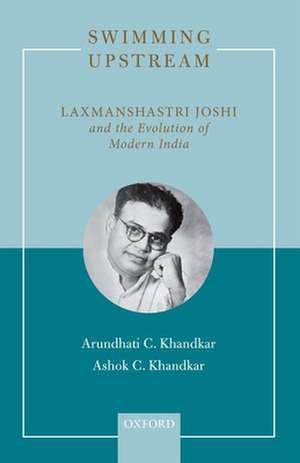
Swimming Upstream: Laxmanshastri Joshi and the Evolution of Modern India
Autor Arundhati C. Khandkar, Ashok C. Khandkaren Limba Engleză Hardback – 10 oct 2019
Remarcăm în Swimming Upstream o analiză riguroasă a uneia dintre cele mai influente, deși uneori trecute cu vederea, figuri ale renașterii indiene: Laxmanshastri Joshi. Ediția de față, publicată de OUP India, aduce în prim-plan parcursul intelectual al unui savant vedic care a ales să „înoate împotriva curentului” ortodoxiei hinduse pentru a pune bazele unei națiuni moderne. Descoperim aici modul în care erudiția în limba sanscrită a fost utilizată nu pentru conservarea tradiției, ci ca instrument de reformă socială radicală.
Textul scris de Arundhati C. Khandkar și Ashok C. Khandkar evidențiază un aspect critic al istoriei Indiei: colaborarea dintre Joshi și Gandhi. Notăm cu interes cum Joshi i-a furnizat lui Mahatma argumentele scripturale necesare pentru a integra comunitățile marginalizate („untouchables”) în curentul principal al societății. Stilul narativ este unul echilibrat, evitând hagiografia în favoarea unei expuneri bazate pe dovezi istorice despre polemicile religioase și politice ale epocii.
Cititorii familiarizați cu Indian Nationalism and Hindu Social Reform de Charles Herman Heimsath vor aprecia modul în care acest volum personalizează mișcarea de reformă prin prisma unui singur gânditor. În timp ce volumul lui Heimsath oferă o perspectivă panoramică asupra provinciilor indiene, Swimming Upstream se concentrează pe mecanismele interne ale transformării unui intelectual: de la opoziția față de imperialismul britanic la decizia pragmatică de a susține Aliații împotriva Japoniei, o mișcare ce subliniază umanismul său profund în fața dogmei politice rigide.
Preț: 340.87 lei
Carte disponibilă
Livrare economică 04-18 noiembrie
Specificații
ISBN-10: 0199495157
Pagini: 232
Ilustrații: 15 images
Dimensiuni: 146 x 222 x 20 mm
Greutate: 0.36 kg
Editura: OUP INDIA
Colecția OUP India
Locul publicării:Delhi, India
V-ar putea interesa
-
 Blood Red SunsetMa BoPreț: 153.95 lei
 -
 DownfallRichard B FrankPreț: 120.20 lei
 -
 Shameful Flight: The Last Years of the British Empire in IndiaStanley Wolpert-20%Preț: 137.98 lei171.44 lei
 -
 Reading ShenbaoW. Tsai-15%Preț: 642.58 lei755.98 lei
 -
 The Turks of Central AsiaCharles W. Hostler-30%Preț: 474.07 lei675.32 lei
 -
 Modern Japanese ThoughtBob T. WakabayashiPreț: 268.14 lei
 -
 The Politics of Imagining AsiaHui WangPreț: 400.43 lei
 -
 -19%Preț: 344.02 lei423.95 lei
 -
 Preț: 353.41 lei
 -
 Kokoro - Hints and Echoes of Japanese Inner LifeLafcadio HearnPreț: 159.56 lei
 -
 Lyrics from the ChineseHelen WaddellPreț: 87.83 lei
 -
 Life or Death in IndiaFlorence NightingalePreț: 93.18 lei
 -
 Indian Raids in Lincoln County, Kansas, 1864 and 1869; Story of Those KilledChristian BernhardtPreț: 93.36 lei
 -
 The Medieval Kingdoms of Cyprus and ArmeniaWilliam StubbsPreț: 92.80 lei
 -
 Working Women of JapanSidney Lewis GulickPreț: 129.83 lei
 -
 Historical Grammar of the Ancient Persian LanguageEdwin Lee JohnsonPreț: 153.99 lei
 -
 The Unmannerly Tiger, and Other Korean TalesWilliam Elliot GriffisPreț: 129.43 lei
 -
 A Short History of JapanErnest Wilson ClementPreț: 135.56 lei
 -
 Manila and the PhilippinesMargherita Arlina HammPreț: 159.34 lei
 -
 The Russian AdvanceAlbert Jeremiah BeveridgePreț: 196.41 lei
 -
 Hernando de los Ríos Coronel and the Spanish Philippines in the Golden AgeJohn Newsome Crossley-18%Preț: 1291.72 lei1575.27 lei
 -
 The Chinese Economy Under Maoism: The Early Years, 1949-1969Walter GalensonPreț: 475.68 lei
 -
 -38%Preț: 658.88 lei1058.81 lei
 -
 -33%Preț: 704.15 lei1055.87 lei
 -
 On Mao's Political IdeologyYang FengchengPreț: 180.51 lei
De ce să citești această carte
Această biografie este esențială pentru cei care doresc să înțeleagă fundamentele intelectuale ale democrației indiene. Cititorul va descoperi cum un expert în texte sacre a reușit să reformeze hinduismul din interior, oferind o perspectivă rară asupra modului în care ideile filosofice devin politici sociale. Este o lectură recomandată studenților la istorie și științe politice care caută să depășească viziunea simplistă asupra independenței Indiei.
Despre autor
Arundhati C. Khandkar și Ashok C. Khandkar explorează în lucrările lor intersecția dintre tradiția academică indiană și reformele socio-politice care au definit secolul XX. Prin volumul dedicat lui Laxmanshastri Joshi, autorii reușesc să recupereze vocea unui „om al renașterii” indiene, documentând cu precizie arhivistică evoluția acestuia de la un specialist în sanscrită la un arhitect al Indiei seculare. Expertiza lor se concentrează pe evidențierea figurilor intelectuale care au modelat discursul public despre caste și identitate națională în perioada pre și post-independență.