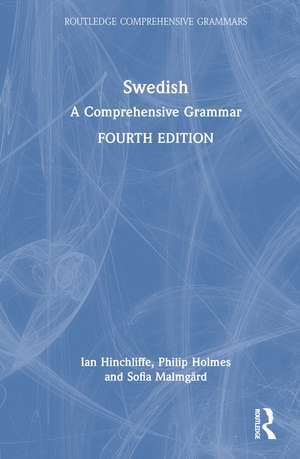
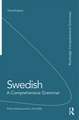
Swedish: A Comprehensive Grammar: Routledge Comprehensive Grammars
Autor Ian Hinchliffe, Philip Holmes, Sofia Malmgården Limba Engleză Hardback – 17 iul 2026
This fourth edition has been exhaustively researched and updated to align with current standards in the description of language and to incorporate the most recent recommendations of Språkrådet, the Language Council of Sweden. The emphasis is on Swedish in everyday communication, drawing on contemporary corpus material and a wide range of printed and online sources to illustrate the use of high-frequency words and expressions. Examples have been systematically updated to reflect contemporary conventions and usage, and new content has been added to reflect the increasing democratisation of written Swedish.
Key features include:
- detailed treatment of grammatical structures and parts of speech
- a wealth of authentic examples, many drawn from mainstream news media and reliable online sources
- careful attention to areas that typically cause confusion or difficulty for learners
- Swedish/English contrasts highlighted throughout the book
- a new chapter outlining major differences in written and spoken Swedish, with notes on slang and youth argot
Din seria Routledge Comprehensive Grammars
- 8%
 Preț: 637.94 lei
 - 15%
 Preț: 632.16 lei
 - 8%
 Preț: 561.96 lei
 - 15%
 Preț: 572.77 lei
 - 9%
 Preț: 634.02 lei
 - 15%
 Preț: 598.45 lei
 - 18%
 Preț: 1116.11 lei
 - 8%
 Preț: 603.91 lei
 - 9%
 Preț: 720.10 lei
 - 15%
 Preț: 540.14 lei
 - 15%
 Preț: 686.81 lei
 - 15%
 Preț: 680.07 lei
 - 15%
 Preț: 458.24 lei
 - 18%
 Preț: 948.11 lei
 - 15%
 Preț: 608.00 lei
 - 18%
 Preț: 725.55 lei
 -
 Preț: 411.03 lei
 - 18%
 Preț: 738.93 lei
 - 9%
 Preț: 791.76 lei
 - 18%
 Preț: 714.03 lei
 - 18%
 Preț: 1272.95 lei
 - 15%
 Preț: 638.06 lei
 - 15%
 Preț: 623.73 lei
 - 15%
 Preț: 560.11 lei
 - 18%
 Preț: 865.87 lei
 - 15%
 Preț: 679.05 lei
 - 9%
 Preț: 664.37 lei
 - 18%
 Preț: 1389.33 lei
 -
 Preț: 352.95 lei
Preț: 1116.89 lei
Preț vechi: 1474.62 lei
-24%
Puncte Express: 1675
Carte indisponibilă temporar
Doresc să fiu notificat când acest titlu va fi disponibil:
Se trimite...
Specificații
ISBN-13: 9781032989280
ISBN-10: 1032989289
Pagini: 638
Ilustrații: 6
Dimensiuni: 156 x 234 mm
Greutate: 1.34 kg
Ediția:4. Auflage
Editura: Taylor & Francis
Colecția Routledge
Seria Routledge Comprehensive Grammars
Locul publicării:Oxford, United Kingdom
ISBN-10: 1032989289
Pagini: 638
Ilustrații: 6
Dimensiuni: 156 x 234 mm
Greutate: 1.34 kg
Ediția:4. Auflage
Editura: Taylor & Francis
Colecția Routledge
Seria Routledge Comprehensive Grammars
Locul publicării:Oxford, United Kingdom
Public țintă
Undergraduate AdvancedCuprins
Preface
Symbols and abbreviations used in the text
Chapter 1 Nouns
1.1 Introduction
1.2 Gender rules
1.3 Miscellaneous points of gender
1.4 Plural noun forms – the declensions
1.5 Miscellaneous points on indefinite plural forms
1.6 Special uses of the singular and plural
1.7 Noun homonyms
1.8 The genitive
1.9 The form of the indefinite article
1.10 The form of the definite (end) article
1.11 The use of the indefinite and definite (end) article
Chapter 2 Adjectives
2.1 Form and order
2.2 The indefinite declension
2.3 The definite declension
2.4 Adjectival nouns
2.5 Comparison of adjectives
Chapter 3 Pronouns
3.1 Personal pronouns
3.2 Function and reference of personal pronouns
3.3 Subject and object pronouns
3.4 Reflexive pronouns
3.5 Emphatic pronouns
3.6 Possessive adjectives and pronouns
3.7 Demonstrative pronouns
3.8 Determinative pronouns
3.9 Indefinite pronouns
3.10 Interrogative pronouns
3.11 Relative pronouns
Chapter 4 Numerals
4.1 Forms of numerals
4.2 The use of cardinal numbers
4.3 The use of ordinal numbers
4.4 Fractions
4.5 Dates
4.6 Telling the time
Chapter 5 Verbs
5.1 Form
5.2 The use of the tenses
5.3 Ways of expressing mood
5.4 Transitive, intransitive and reflexive verbs
5.5 −s forms of the verb and the passive
5.6 Compound verbs
5.7 Some translation hints
Chapter 6 Adverbs
6.1 Form
6.2 Meaning and function
6.3 Location and movement
6.4 Translating adverbs
Chapter 7 Prepositions
7.1 Introduction
7.2 The fifteen most common Swedish prepositions
7.3 Prepositional usage
Chapter 8 Conjunctions
8.1 Coordination and subordination
8.2 Coordinating conjunctions
8.3 Subordinating conjunctions
8.4 Other subordinators
8.5 Some translation hints
Chapter 9 Interjections
9.1 Introduction
9.2 Affirmations and denials
9.3 Reactions in conversation
9.4 Commands
9.5 Imitations
9.6 Polite expressions
9.7 Expletives
Chapter 10 Sentence structure and word order
10.1 Clause elements
10.2 Phrases
10.3 Main clause word order – basic positions
10.4 Subordinate clause word order – basic positions
10.5 Order within positions
10.6 Main clause transformations
10.7 Subordinate clauses
10.8 Emphasis
10.9 Ellipsis
10.10 Swedish word order summarised
Chapter 11 Word formation
11.1 Introduction
11.2 Affixation
11.3 Compounding
11.4 Expressive formation
11.5 Abbreviation
11.6 Foreign influences on Swedish
11.7 Conversion
Chapter 12 Orthography
12.1 Symbols and sounds
12.2 Spelling
12.3 Upper-case and lower-case letters
12.4 Miscellaneous
Chapter 13 Punctuation
13.1 Introduction –Punctuation marks
13.2 Addresses
13.3 Dates
Chapter 14 Written and spoken Swedish
14.1 Word choices in written and spoken Swedish
14.2 Swedish slang
14.3 Youth argot - förortssvenska
Symbols and abbreviations used in the text
Chapter 1 Nouns
1.1 Introduction
1.2 Gender rules
1.3 Miscellaneous points of gender
1.4 Plural noun forms – the declensions
1.5 Miscellaneous points on indefinite plural forms
1.6 Special uses of the singular and plural
1.7 Noun homonyms
1.8 The genitive
1.9 The form of the indefinite article
1.10 The form of the definite (end) article
1.11 The use of the indefinite and definite (end) article
Chapter 2 Adjectives
2.1 Form and order
2.2 The indefinite declension
2.3 The definite declension
2.4 Adjectival nouns
2.5 Comparison of adjectives
Chapter 3 Pronouns
3.1 Personal pronouns
3.2 Function and reference of personal pronouns
3.3 Subject and object pronouns
3.4 Reflexive pronouns
3.5 Emphatic pronouns
3.6 Possessive adjectives and pronouns
3.7 Demonstrative pronouns
3.8 Determinative pronouns
3.9 Indefinite pronouns
3.10 Interrogative pronouns
3.11 Relative pronouns
Chapter 4 Numerals
4.1 Forms of numerals
4.2 The use of cardinal numbers
4.3 The use of ordinal numbers
4.4 Fractions
4.5 Dates
4.6 Telling the time
Chapter 5 Verbs
5.1 Form
5.2 The use of the tenses
5.3 Ways of expressing mood
5.4 Transitive, intransitive and reflexive verbs
5.5 −s forms of the verb and the passive
5.6 Compound verbs
5.7 Some translation hints
Chapter 6 Adverbs
6.1 Form
6.2 Meaning and function
6.3 Location and movement
6.4 Translating adverbs
Chapter 7 Prepositions
7.1 Introduction
7.2 The fifteen most common Swedish prepositions
7.3 Prepositional usage
Chapter 8 Conjunctions
8.1 Coordination and subordination
8.2 Coordinating conjunctions
8.3 Subordinating conjunctions
8.4 Other subordinators
8.5 Some translation hints
Chapter 9 Interjections
9.1 Introduction
9.2 Affirmations and denials
9.3 Reactions in conversation
9.4 Commands
9.5 Imitations
9.6 Polite expressions
9.7 Expletives
Chapter 10 Sentence structure and word order
10.1 Clause elements
10.2 Phrases
10.3 Main clause word order – basic positions
10.4 Subordinate clause word order – basic positions
10.5 Order within positions
10.6 Main clause transformations
10.7 Subordinate clauses
10.8 Emphasis
10.9 Ellipsis
10.10 Swedish word order summarised
Chapter 11 Word formation
11.1 Introduction
11.2 Affixation
11.3 Compounding
11.4 Expressive formation
11.5 Abbreviation
11.6 Foreign influences on Swedish
11.7 Conversion
Chapter 12 Orthography
12.1 Symbols and sounds
12.2 Spelling
12.3 Upper-case and lower-case letters
12.4 Miscellaneous
Chapter 13 Punctuation
13.1 Introduction –Punctuation marks
13.2 Addresses
13.3 Dates
Chapter 14 Written and spoken Swedish
14.1 Word choices in written and spoken Swedish
14.2 Swedish slang
14.3 Youth argot - förortssvenska
Recenzii
Winner of the Swedish National Language Council’s Erik Wellander Prize, 2003
Praise for the first edition
'This grammar has great assets. The first is that it is compiled by English-speaking people who have an excellent command of Swedish but who know at first hand where the difficulties of learning Swedish lie ... The second is that it represents contemporary Swedish and draws attention to different styles and registers ... a good reliable guide to modern Swedish and should serve as a standard reference of many years.'
- Scandinavica
'The strong points of this grammar are: (a) it concentrates on everyday informal language; (b) it gives a wealth of examples; (c) by being "unashamedly comparative" it highlights some aspects of the Swedish language that are hardly ever touched upon in Swedish grammars written by native speakers.'
- Tijdschrift voor Skandinavistiek
Praise for the second edition
'A vital contribution to the presentation of Swedish to an international audience. The book adopts a valuable external perspective on Swedish, from which native speakers of Swedish can also benefit, and is a major source of knowledge for all of those either within or outside Sweden who teach Swedish as a second language or as a foreign language.'
-The Swedish Language Council
‘We have in Swedish: A Comprehensive Grammar an extraordinarily workable teaching and reference tool that should continue to be a source of linguistic enrichment for many years to come.’
- Marilyn Johns Blackwell, Ohio State University, USA
'(T)his is a reference work of the first rank ... Above all, however, this book constitutes the most important international work of reference for everyone with an interest in linguistics in search of detailed information about the morphology and syntax of Swedish.'
- Skandinavistik
Praise for the third edition
'A thorough, clear guide to the rules of Swedish grammar… Holmes and Hinchliffe cover everything from basics such as nouns and adjectives to more advanced topics such as interjections and prepositions, and they do it all with ease and clarity. Javisst, this is the best reference book to Swedish grammar you’ll find in English.'
- B.J. Epstein, University of East Anglia, UK
Praise for the first edition
'This grammar has great assets. The first is that it is compiled by English-speaking people who have an excellent command of Swedish but who know at first hand where the difficulties of learning Swedish lie ... The second is that it represents contemporary Swedish and draws attention to different styles and registers ... a good reliable guide to modern Swedish and should serve as a standard reference of many years.'
- Scandinavica
'The strong points of this grammar are: (a) it concentrates on everyday informal language; (b) it gives a wealth of examples; (c) by being "unashamedly comparative" it highlights some aspects of the Swedish language that are hardly ever touched upon in Swedish grammars written by native speakers.'
- Tijdschrift voor Skandinavistiek
Praise for the second edition
'A vital contribution to the presentation of Swedish to an international audience. The book adopts a valuable external perspective on Swedish, from which native speakers of Swedish can also benefit, and is a major source of knowledge for all of those either within or outside Sweden who teach Swedish as a second language or as a foreign language.'
-The Swedish Language Council
‘We have in Swedish: A Comprehensive Grammar an extraordinarily workable teaching and reference tool that should continue to be a source of linguistic enrichment for many years to come.’
- Marilyn Johns Blackwell, Ohio State University, USA
'(T)his is a reference work of the first rank ... Above all, however, this book constitutes the most important international work of reference for everyone with an interest in linguistics in search of detailed information about the morphology and syntax of Swedish.'
- Skandinavistik
Praise for the third edition
'A thorough, clear guide to the rules of Swedish grammar… Holmes and Hinchliffe cover everything from basics such as nouns and adjectives to more advanced topics such as interjections and prepositions, and they do it all with ease and clarity. Javisst, this is the best reference book to Swedish grammar you’ll find in English.'
- B.J. Epstein, University of East Anglia, UK
Notă biografică
Ian Hinchliffe, Ph.D, is a former lecturer in Swedish, a freelance translator and founder member of the Swedish Association of Professional Translators.
Philip Holmes, Ph.D, (1944–2019) was Reader Emeritus in Scandinavian Studies at the University of Hull, UK.
Sofia Malmgård, B.A., is an experienced translator, language consultant and author of Sveriges språkflora, a handbook for a multilingual society.
Philip Holmes, Ph.D, (1944–2019) was Reader Emeritus in Scandinavian Studies at the University of Hull, UK.
Sofia Malmgård, B.A., is an experienced translator, language consultant and author of Sveriges språkflora, a handbook for a multilingual society.
Descriere
Swedish: A Comprehensive Grammar is an award-winning complete reference guide to modern Swedish grammar. This volume is organised to promote a thorough understanding of Swedish grammar, presenting the complexities of the language in a concise and readable form.