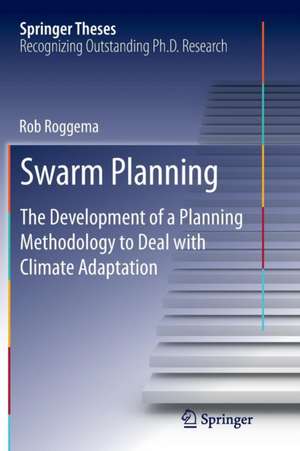
Swarm Planning: The Development of a Planning Methodology to Deal with Climate Adaptation: Springer Theses
Autor Rob Roggemaen Limba Engleză Paperback – 27 aug 2016
“This book is a must for planners in government and the private sector as it outlines the concept, strategies and techniques for swarm planning. It is also an important guide for policymakers looking to engage communities in a dialogue about the adaptation planningprocess.”
Professor John Martin, La Trobe University
“The ultimate value of the book lies in encouraging the planning community to consider options that go far beyond those offered by business-as-usual planning methodologies developed for a set of operating conditions that are fast becoming obsolete. As such it makes an important and much needed contribution to the field.”
Assistant Professor Dr. Chrisna du Plessis, University of Pretoria
| Toate formatele și edițiile | Preț | Express |
|---|---|---|
| Paperback (1) | 616.64 lei 6-8 săpt. | |
| SPRINGER NETHERLANDS – 27 aug 2016 | 616.64 lei 6-8 săpt. | |
| Hardback (1) | 620.86 lei 6-8 săpt. | |
| SPRINGER NETHERLANDS – 20 sep 2013 | 620.86 lei 6-8 săpt. |
Din seria Springer Theses
- 18%
 Preț: 1064.50 lei
 - 15%
 Preț: 615.35 lei
 - 18%
 Preț: 1169.91 lei
 - 18%
 Preț: 909.08 lei
 -
 Preț: 378.41 lei
 - 18%
 Preț: 1172.17 lei
 - 15%
 Preț: 615.35 lei
 - 18%
 Preț: 908.31 lei
 -
 Preț: 372.50 lei
 -
 Preț: 375.07 lei
 - 18%
 Preț: 1329.13 lei
 - 15%
 Preț: 618.34 lei
 - 18%
 Preț: 961.40 lei
 - 18%
 Preț: 1067.54 lei
 - 18%
 Preț: 1060.72 lei
 - 15%
 Preț: 614.60 lei
 - 18%
 Preț: 906.80 lei
 - 18%
 Preț: 962.00 lei
 - 18%
 Preț: 1336.71 lei
 - 15%
 Preț: 621.97 lei
 - 15%
 Preț: 616.15 lei
 -
 Preț: 372.31 lei
 - 15%
 Preț: 612.23 lei
 - 15%
 Preț: 616.15 lei
 -
 Preț: 370.62 lei
 - 18%
 Preț: 966.67 lei
 - 15%
 Preț: 612.55 lei
 - 18%
 Preț: 853.71 lei
 - 18%
 Preț: 1065.27 lei
 -
 Preț: 407.71 lei
 - 18%
 Preț: 749.08 lei
 - 18%
 Preț: 1067.54 lei
 - 18%
 Preț: 960.76 lei
 - 18%
 Preț: 1063.77 lei
 - 18%
 Preț: 1061.89 lei
 - 18%
 Preț: 960.54 lei
 - 18%
 Preț: 1172.94 lei
 - 18%
 Preț: 1068.71 lei
 - 15%
 Preț: 615.35 lei
 - 18%
 Preț: 959.13 lei
 - 15%
 Preț: 615.35 lei
 - 18%
 Preț: 1062.99 lei
 - 15%
 Preț: 611.89 lei
 - 15%
 Preț: 611.43 lei
 - 18%
 Preț: 911.34 lei
 - 18%
 Preț: 744.53 lei
 -
 Preț: 374.91 lei
 - 15%
 Preț: 617.89 lei
 - 15%
 Preț: 613.31 lei
Preț: 616.64 lei
Preț vechi: 725.45 lei
-15%
Puncte Express: 925
Preț estimativ în valută:
109.03€ • 126.01$ • 94.20£
109.03€ • 126.01$ • 94.20£
Carte tipărită la comandă
Livrare economică 04-18 mai
Specificații
ISBN-13: 9789402407341
ISBN-10: 9402407340
Pagini: 315
Ilustrații: XXIX, 286 p. 130 illus., 100 illus. in color.
Dimensiuni: 155 x 235 x 17 mm
Greutate: 0.45 kg
Ediția:Softcover reprint of the original 1st ed. 2014
Editura: SPRINGER NETHERLANDS
Colecția Springer
Seria Springer Theses
Locul publicării:Dordrecht, Netherlands
ISBN-10: 9402407340
Pagini: 315
Ilustrații: XXIX, 286 p. 130 illus., 100 illus. in color.
Dimensiuni: 155 x 235 x 17 mm
Greutate: 0.45 kg
Ediția:Softcover reprint of the original 1st ed. 2014
Editura: SPRINGER NETHERLANDS
Colecția Springer
Seria Springer Theses
Locul publicării:Dordrecht, Netherlands
V-ar putea interesa
-
 High TideMark LynasPreț: 108.99 lei
 -
 Six DegreesMark LynasPreț: 75.66 lei
 -
 -20%Preț: 77.72 lei96.80 lei
 -
 Climate Change Begins at HomeD. ReayPreț: 145.25 lei
 -
 The Ethics of Climate Change: Right and Wrong in a Warming WorldProfessor James Garvey-46%Preț: 109.50 lei204.61 lei
 -
 The Earthscan Reader on Adaptation to Climate ChangeE. Lisa F. SchipperPreț: 418.64 lei
 -
 -18%Preț: 775.47 lei945.69 lei
Cuprins
Summary.- Introduction.- Chapter One: Introduction, Methodology, Limitations.- Chapter Two: Towards a Spatial Planning Framework for Climate Adaptation.- Chapter Three: Developing a Planning Theory for Wicked Problems: Swarm Planning.- Chapter Four: Incremental Change, Transition or Transformation? Optimising Change Pathways for Climate Adaptation in Spatial Planning.- Chapter Five: The Use of Spatial Planning to Increase the Resilience for Future Turbulence in the Spatial System of the Groningen Region to Deal with Climate Change.- Chapter Six: Swarming Landscapes, New Pathways for Resilient Cities.- Chapter Seven: Quadruple the Potential: Scaling the Energy Supply.- Chapter Eight: Beyond the Ordinary: Innovative Spatial Energy Framework Offers Perspectives on Increased Energy and Carbon Objectives.- Chapter Nine: Swarm Planning for Climate Change: An Alternative Pathway for Resilience.- Chapter Ten: Conclusion, Discussion and Recommendations.- Index.
Notă biografică
Textul de pe ultima copertă
This book shows that the problem of climate adaptation, which is described in social planning terms as ‘wicked,’ is at odds with the contemporary practice of spatial planning. The author proposes a new adjusted framework which is more adaptable to unpredictable, wicked, dynamic and non-linear processes. The inspiration for this new method is the behaviour of swarms: bees, ants, birds and fish are capable of self-organization, which enables the system to become less vulnerable to sudden environmental changes. The framework proposed in Swarm Planning consists of these four elements: Two levels of complexity, the first being the whole system and the second its individual components. Each of these has different attributes for adapting to change. Five layers, consisting of networks, focal points, unplanned space, natural resources and emerging occupation patterns. Each layer has its own spatial dynamic, and each is connected to a spatial scale. Non-linear processes, which emerge in different parts of the framework and include emerging patterns, connectedness and tipping points among others. Two planning processes; the first, ‘from small to large’ works upward from the slowest changing elements to more rapidly-changing ones. The second, ‘on the list of partners’ addresses each layer from networks through emerging occupation patterns. Swarm Planning applies this framework to a series of pilot studies, and appraises its performance using criteria for an adaptive landscape. The results show that the use of the Swarm Planning Framework reduces the vulnerability of landscapes as well as the impact of climate hazards and disasters, improves response to unexpected hazards and contains adaptation strategies.
“This book is a must for planners in government and the private sector as it outlines the concept, strategies and techniques for swarm planning. It is also an important guide for policymakers looking to engage communities in a dialogue about the adaptation planningprocess.”
Professor John Martin, La Trobe University
“The ultimate value of the book lies in encouraging the planning community to consider options that go far beyond those offered by business-as-usual planning methodologies developed for a set of operating conditions that are fast becoming obsolete. As such it makes an important and much needed contribution to the field.”
Assistant Professor Dr. Chrisna du Plessis, University of Pretoria
“This book is a must for planners in government and the private sector as it outlines the concept, strategies and techniques for swarm planning. It is also an important guide for policymakers looking to engage communities in a dialogue about the adaptation planningprocess.”
Professor John Martin, La Trobe University
“The ultimate value of the book lies in encouraging the planning community to consider options that go far beyond those offered by business-as-usual planning methodologies developed for a set of operating conditions that are fast becoming obsolete. As such it makes an important and much needed contribution to the field.”
Assistant Professor Dr. Chrisna du Plessis, University of Pretoria
Caracteristici
Opens a new, more flexible way of thinking about how to plan for and respond to climate adaptation, based on the behavior of swarms in nature Emphasizes new approaches to spatial design and planning which anticipate future uncertainty Offers many examples using the Swarm Planning Framework to design landscapes Richly illustrated with color maps and images