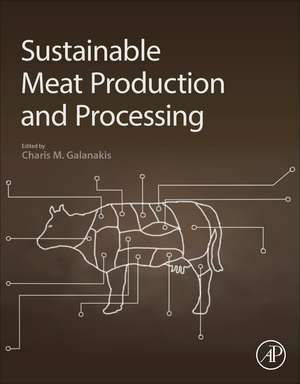
Sustainable Meat Production and Processing
Editat de Charis M. Galanakisen Limba Engleză Paperback – noi 2018
Finally, the book covers the preferred technologies for sustainable meat production, natural antioxidants as additives in meat products, and facilitators and barriers for foods containing meat co-products.
- Analyzes the role of novel technologies for sustainable meat processing
- Covers how to maintain sustainability and achieve high levels of meat quality and safety
- Presents solutions to improve productivity and environmental sustainability
- Takes a proteomic approach to characterize the biochemistry of meat quality defects
Preț: 1061.08 lei
Preț vechi: 1342.31 lei
-21%
Puncte Express: 1592
Carte tipărită la comandă
Livrare economică 28 decembrie 26 - 11 ianuarie 27
Livrare prin curier în România Termenul estimat este afișat lângă disponibilitate.
Transport gratuit pentru acest produs Plată online sau ramburs, în funcție de opțiunile comenzii.
Retur gratuit în 14 zile Comandă securizată și suport în română.
Specificații
ISBN-13: 9780128148747
ISBN-10: 0128148748
Pagini: 274
Dimensiuni: 216 x 276 x 19 mm
Greutate: 0.64 kg
Editura: ELSEVIER SCIENCE
ISBN-10: 0128148748
Pagini: 274
Dimensiuni: 216 x 276 x 19 mm
Greutate: 0.64 kg
Editura: ELSEVIER SCIENCE
V-ar putea interesa
-
 Olive Mill Waste: Recent Advances for Sustainable ManagementCharis M. Galanakis-30%Preț: 569.03 lei811.33 lei
-
 Handbook of Coffee Processing By-Products: Sustainable ApplicationsCharis M. Galanakis-20%Preț: 778.84 lei971.97 lei
-
 Sustainable Fish Production and ProcessingCharis M. Galanakis-25%Preț: 1017.06 lei1357.01 lei
-
 Innovation Strategies in the Food Industry: Tools for ImplementationCharis M. Galanakis-9%Preț: 1012.48 lei1112.61 lei
-
 Dialogues in Urban and Regional Planning: Volume 2Bruce StiftelPreț: 490.15 lei
-
 Human Immunodeficiency Virus Reverse TranscriptaseStuart Legrice-15%Preț: 704.85 lei829.24 lei
-
 Humanized Mice for HIV ResearchLarisa Y. Poluektova-5%Preț: 1076.57 lei1133.23 lei
-
 -5%Preț: 185.75 lei195.53 lei
-
 Probiotics and PrebioticsKoen Venema-9%Preț: 1437.15 lei1579.29 lei
-
 ArbovirusesNikos Vasilakis-9%Preț: 1384.00 lei1520.88 lei
-
 Gas Plasma Sterilization in MicrobiologyHideharu Shintani-5%Preț: 1397.75 lei1471.32 lei
-
 Trends in Sustainable Chocolate ProductionCharis M. Galanakis-18%Preț: 1158.32 lei1412.59 lei
-
 The Age of Clean Label FoodsCharis M. Galanakis-18%Preț: 1152.85 lei1405.90 lei
-
 Biodiversity, Functional Ecosystems and Sustainable Food ProductionCharis M. Galanakis-18%Preț: 988.44 lei1205.42 lei
-
 Marburg and Ebola VirusesHans-Dieter Klenk-15%Preț: 640.89 lei753.99 lei
-
 Prions Prions PrionsStanley B. Prusiner-15%Preț: 671.74 lei790.28 lei
-
 -5%Preț: 694.07 lei730.60 lei
-
 -5%Preț: 685.11 lei721.18 lei
-
 Transforming Proteins of DNA Tumor VirusesRolf Knippers-15%Preț: 646.25 lei760.29 lei
-
 Oncogenes and RetrovirusesPeter K. Vogt-5%Preț: 711.90 lei749.36 lei
-
 RetrovirusesRonald Swanstrom-15%Preț: 642.81 lei756.25 lei
-
 Viral Expression VectorsNicholas Muzyczka-15%Preț: 638.15 lei750.76 lei
-
 Herpes Simplex VirusBarry T. Rouse-15%Preț: 638.36 lei751.01 lei
-
 Pathology of Septic ShockErnst T. Rietschel-5%Preț: 721.76 lei759.74 lei
Public țintă
Food and animal scientists and technologists; Professional working in the meat industry; Food engineers who work in the meat industry and are seeking to improve their by-products management by actively utilizing waste streams in effective applications; Food, agricultural, chemical and environmental engineers ; Researchers working in the edge of food and environmental fieldCuprins
1. Practical Agricultural and Animal Welfare Sustainability
2. Production strategies and processing systems of meat
3. Techno-functional ingredients for meat products: current challenges
4. Proteins recovery from meat processing co-products
5. Blood Proteins as Functional Ingredients
6. Plant-based meat analogues
7. Membrane technology for the recovery of high-added value compounds from meat processing co-products
8. Possible uses of processed slaughter by-products
9. Packaging sustainability in the meat industry
10. Emerging Technologies of Meat Processing
11. Natural antioxidants in fresh and processed meat
12. Facilitators and barriers for foods containing meat co-products
Notă biografică
Dr. Galanakis is a dynamic and interdisciplinary scientist with a fast-expanding work that balances between food and environment, industry and academia. His research targets mainly the separation and recovery of functional macro- and micro-molecules from different food by-products, as well as their implementation as additives in food and other products. He is the research & innovation director of Galanakis Laboratories (Chania, Greece) and the coordinator of Food Waste Recovery Group (SIG5) of ISEKI Food Association (Vienna, Austria). He serves as an editorial board member and subject editor of Food and Bioproducts Processing and Food Research International, whereas he has published dozens research articles, reviews, monographs and conference proceedings. He has edited 4 books entitled "Food Waste Recovery" (Academic Press, 2015), "Innovation Strategies in the Food Industry" (Academic Press, 2016), "Nutraceutical and Functional Food Components" (Academic Press, 2017) and "Olive Mill Waste" (Academic Press, 2017).
Follow Dr. Galanakis via Twitter, LinkedIn, ResearchGate or Blog. Join his open discussion forums at the Food Waste Recovery & Innovation 2020 LinkedIn group or the Food Waste Recovery FB Page.