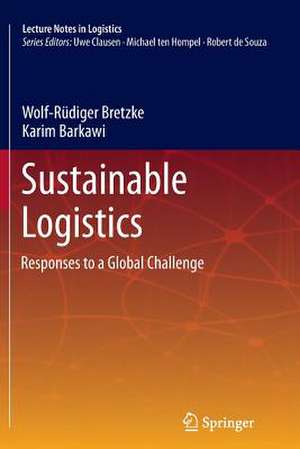
Sustainable Logistics
Autor Wolf-Rüdiger Bretzke, Karim Barkawien Limba Engleză Paperback – 29 ian 2015
In order to make logistics sustainable large parts will have to be reinvented. The focus needs to be on decoupling transportation activities from economic growth rates.
Preț: 685.78 lei
Preț vechi: 806.80 lei
-15%
Puncte Express: 1029
Carte tipărită la comandă
Livrare economică 05-19 iunie
Specificații
ISBN-13: 9783642448829
ISBN-10: 3642448828
Pagini: 544
Ilustrații: XXVI, 518 p.
Dimensiuni: 155 x 235 x 30 mm
Greutate: 0.81 kg
Ediția:2013
Editura: Springer
Locul publicării:Berlin, Heidelberg, Germany
ISBN-10: 3642448828
Pagini: 544
Ilustrații: XXVI, 518 p.
Dimensiuni: 155 x 235 x 30 mm
Greutate: 0.81 kg
Ediția:2013
Editura: Springer
Locul publicării:Berlin, Heidelberg, Germany
V-ar putea interesa
-
 -8%Preț: 469.10 lei509.89 lei
 -
 Del Hogar Digital a la Casa RedElena Jorge SierraPreț: 150.17 lei
 -
 Numerical and Analytical Methods with MATLABWilliam Bober-20%Preț: 938.13 lei1172.66 lei
 -
 Preț: 151.58 lei
 -
 -15%Preț: 675.37 lei794.55 lei
 -
 Technik der tiefen TemperaturenJ. A. Lammeren-15%Preț: 451.71 lei531.42 lei
 -
 Preț: 397.19 lei
 -
 -15%Preț: 477.90 lei562.24 lei
 -
 Preț: 400.32 lei
 -
 -15%Preț: 504.30 lei593.28 lei
 -
 -15%Preț: 527.41 lei620.48 lei
 -
 -15%Preț: 480.09 lei564.80 lei
 -
 -15%Preț: 447.63 lei526.62 lei
 -
 Preț: 407.84 lei
 -
 Preț: 418.99 lei
 -
 Nachhaltige Logistik: Zukunftsfähige Netzwerk- und ProzessmodelleWolf-Rüdiger Bretzke-18%Preț: 873.25 lei1064.93 lei
 -
 -15%Preț: 506.88 lei596.34 lei
 -
 Logistische NetzwerkeWolf-Rüdiger Bretzke-18%Preț: 724.02 lei882.95 lei
 -
 Preț: 263.40 lei
 -
 Bemastung und Takelung der Schiffe (1903)Friedrich Ludwig Middendorf-19%Preț: 431.72 lei532.99 lei
 -
 Handbuch Der Dampfmaschine (1833): A Case Study in ContextualizationChristoph Bernoulli-19%Preț: 617.04 lei761.78 lei
 -
 -19%Preț: 479.65 lei592.16 lei
 -
 Handbook for the 20-25 Rolls-Royce CarRolls Royce-19%Preț: 409.26 lei505.26 lei
 -
 Handbook for Bentley, Mk. VIOwen Bentley-19%Preț: 411.84 lei508.45 lei
 -
 -19%Preț: 463.76 lei572.54 lei
 -
 Disseny I Clcul de MollesCarles Riba RomevaPreț: 100.69 lei
Public țintă
GraduateCuprins
Basics.- Strategies and Concepts to Promote Sustainability.- Summary and Outlook.
Textul de pe ultima copertă
Currently the notion of "sustainability" is used in an inflationary manner. Therefore the authors start with a definition which is stable to serve as an anchor for further research as well as for discussions among scientists, managers and politicians, ideally across different disciplines. The character of this book is purely conceptual. The argumentation is based on comparison of new and demanding requisites with existing models (process and network architectures in the field of logistics). Formerly neglected impacts on the environment will be included. Main features of a new approach will be developed which are capable to avoid these impacts and to align logistics with the requirements of sustainability.
In order to make logistics sustainable large parts will have to be reinvented. The focus needs to be on decoupling transportation activities from economic growth rates.
In order to make logistics sustainable large parts will have to be reinvented. The focus needs to be on decoupling transportation activities from economic growth rates.
Caracteristici
The discussion of the necessary adjustments of process models and network architectures in the field of logistics is embedded into the lager picture of the discussion of "sustainability" on the level of the whole economic system and of politics intervening into the market mechanism Models still regarded as "best practiced" are seriously questioned referring to their environmental implications The book covers a broad field of action including political options like road pricing or markets for emission permits, the decentralization of distribution and production networks or the challenges posed by unsolved problems in the field of city logistics