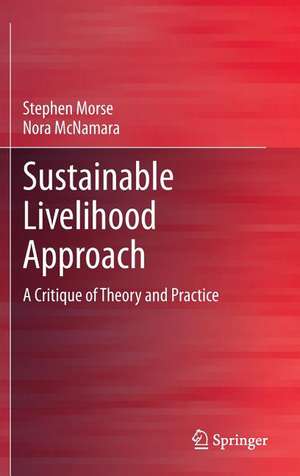
Sustainable Livelihood Approach
Autor Stephen Morse, Nora McNamaraen Limba Engleză Hardback – mar 2013
We all view the ubiquitous term ‘sustainability’ as a worthwhile goal. But how can we apply the principles of sustainability in the real world, at the sharp end of communities in developing nations where income insecurity is the troubled norm? This volume provides some practical answers, explaining the precepts of the ‘sustainable livelihood approach’ (SLA) through the case study of a microfinance scheme in Africa.
The case study, centered around the work of the Catholic Church’s Diocesan Development Services organization, involved an SLA implemented over two years designed in part to help enhance its existing microfinance operation through closer links between local communities and international donors. The book’s central conclusion is that we must move beyond the concept of sustainable livelihood itself, with its in-built polarities between developed and developing nations, and embrace a more global notion of ‘sustainable lifestyle’; a more nuanced and inclusive approach that encompasses not just how we make a sustainable living, but how we can live sustainable lives.
Preț: 664.79 lei
Preț vechi: 782.11 lei
-15%
Puncte Express: 997
Carte tipărită la comandă
Livrare economică 23 noiembrie-07 decembrie
Livrare prin curier în România Termenul estimat este afișat lângă disponibilitate.
Transport gratuit pentru acest produs Plată online sau ramburs, în funcție de opțiunile comenzii.
Retur gratuit în 14 zile Comandă securizată și suport în română.
Specificații
ISBN-13: 9789400762671
ISBN-10: 9400762674
Pagini: 208
Ilustrații: XVIII, 190 p. 36 illus.
Dimensiuni: 160 x 241 x 16 mm
Greutate: 0.43 kg
Ediția:2013
Editura: Springer
Locul publicării:Dordrecht, Netherlands
ISBN-10: 9400762674
Pagini: 208
Ilustrații: XVIII, 190 p. 36 illus.
Dimensiuni: 160 x 241 x 16 mm
Greutate: 0.43 kg
Ediția:2013
Editura: Springer
Locul publicării:Dordrecht, Netherlands
V-ar putea interesa
-
 SustainabilityStephen MorsePreț: 361.14 lei
 -
 Geographical Information Systems for Urban and Regional PlanningHenk J. Scholten-18%Preț: 982.49 lei1198.17 lei
 -
 Implicate RelationsJuval Portugali-15%Preț: 662.27 lei779.14 lei
 -
 -15%Preț: 663.74 lei780.86 lei
 -
 -18%Preț: 930.26 lei1134.46 lei
 -
 The Institutional Position of SeaportsH. Stevens-18%Preț: 984.67 lei1200.82 lei
 -
 -15%Preț: 665.32 lei782.74 lei
 -
 Sustainable Development and Corporate Social ResponsibilityDongyong ZhangPreț: 440.00 lei
 -
 Towards Sustainable BuildingN. Maiellaro-15%Preț: 650.15 lei764.88 lei
 -
 -15%Preț: 651.63 lei766.62 lei
 -
 Parks and People in Postcolonial SocietiesM. Ramutsindela-15%Preț: 642.98 lei756.44 lei
 -
 Cities in TransitionRita Schneider-Sliwa-18%Preț: 955.93 lei1165.77 lei
 -
 Political Economies of Landscape ChangeJames L Wescoat-15%Preț: 644.89 lei758.69 lei
 -
 Planning Support Systems Best Practice and New MethodsStan Geertman-38%Preț: 1150.32 lei1851.95 lei
 -
 Urban Social Capital: Civil Society and City LifeGregory W. Streich-18%Preț: 1260.85 lei1537.62 lei
 -
 Preț: 411.72 lei
Public țintă
ResearchCuprins
Foreword.- Acknowledgements.- Chapter 1: Sustainability and Sustainable Livelihoods.- Chapter 2: The Theory Behind the Sustainable Livelihood Approach.- Chapter 3: Context of the Sustainable Livelihood Approach.- Chapter 4: The Sustainable Livelihood Approach in Practice.- Chapter 5: Livelihood into Livestyle.
Textul de pe ultima copertă
We all view the ubiquitous term ‘sustainability’ as a worthwhile goal. But how can we apply the principles of sustainability in the real world, at the sharp end of communities in developing nations where income insecurity is the troubled norm? This volume provides some practical answers, explaining the precepts of the ‘sustainable livelihood approach’ (SLA) through the case study of a microfinance scheme in Africa.
The case study, centered around the work of the Catholic Church’s Diocesan Development Services organization, involved an SLA implemented over two years designed in part to help enhance its existing microfinance operation through closer links between local communities and international donors. The book’s central conclusion is that we must move beyond the concept of sustainable livelihood itself, with its in-built polarities between developed and developing nations, and embrace a more global notion of ‘sustainable lifestyle’; a more nuanced and inclusive approach that encompasses not just how we make a sustainable living, but how we can live sustainable lives.
Caracteristici
Provides a critical review of the sustainable livelihood approach Looks at SLA in practice and not just in theory Explores some of the central challenges of putting SLA into practice Suggests how SLA can be modified to make it more relevant to all places on the globe; from sustainable livelihood to sustainable lifestyle Includes supplementary material: sn.pub/extras
Notă biografică
Stephen Morse holds the Chair in Systems Analysis for Sustainability at the Centre for Environment and Sustainability, University of Surrey, UK. Steve has a background in applied ecology and the environment and his research and teaching interests are broad spanning both the natural and social sciences. He is a Fellow of the Royal Geographical Society, the Royal Society of Biology and the Higher Education Academy and has authored and edited 22 books and over 140 academic papers, many of them on the assessment of sustainability (including indicators) and sustainable livelihoods in Africa.
Nora McNamara trained as a social scientist and in 1970 Nora was appointed coordinator for Social Development for Diocese of Idah (Igalaland), Nigeria. Agriculture formed the basis for most of the development in the area but this incorporated every possible aspect including water, nutrition and primary health care and micro credit. She has been a director of a number of Boards in Nigeria and in Ireland including the first Misean Cara board which was the conduit through which Irish Aid was channeled through to over 80 orders of priests and Religious worldwide. She was the director for all Holy Rosary Development projects and programmes from 2003 to 2015. She is currently a board Member of the German Foundation Nachstenliebe Weltweit.