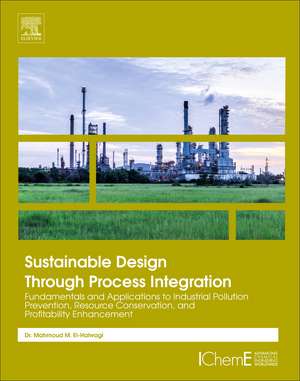
Sustainable Design Through Process Integration: Fundamentals and Applications to Industrial Pollution Prevention, Resource Conservation, and Profitability Enhancement
Autor Mahmoud M. El-Halwagien Limba Engleză Paperback – 10 aug 2017
- Allows the reader to methodically develop rigorous targets that benchmark the performance of industrial processes then develop cost-effective implementations
- Contains state-of-the-art process integration and improvement approaches and techniques including graphical, algebraic, and mathematical methods
- Covers topics and applications that include profitability enhancement, mass and energy conservation, synthesis of innovative processes, retrofitting of existing systems, design and assessment of water, energy, and water-energy-nexus systems, and reconciliation of various sustainability objectives
Preț: 766.92 lei
Preț vechi: 1096.18 lei
-30%
Puncte Express: 1150
Carte tipărită la comandă
Livrare economică 13-27 noiembrie
Livrare prin curier în România Termenul estimat este afișat lângă disponibilitate.
Transport gratuit pentru acest produs Plată online sau ramburs, în funcție de opțiunile comenzii.
Retur gratuit în 14 zile Comandă securizată și suport în română.
Specificații
ISBN-13: 9780128098233
ISBN-10: 0128098236
Pagini: 618
Dimensiuni: 216 x 276 x 35 mm
Greutate: 1.66 kg
Ediția:2
Editura: ELSEVIER SCIENCE
ISBN-10: 0128098236
Pagini: 618
Dimensiuni: 216 x 276 x 35 mm
Greutate: 1.66 kg
Ediția:2
Editura: ELSEVIER SCIENCE
Public țintă
Practicing chemical and process engineers; plant and process designers; environmental and energy engineers; academics, researchers and students of chemical engineering.Cuprins
1. Introduction to Sustainability, Sustainable Design, and Process Integration
2. Overview of Process Economics
3. Benchmarking Process Performance Through Overall Mass Targeting
4. Direct-Recycle Networks: Graphical and Algebraic Targeting Approaches
5. Synthesis of Mass-Exchange Networks
6. Combining Mass-Integration Strategies
7. Heat Integration
8. Integration of Combined Heat and Power Systems
9. Synthesis of Heat-Induced Separation Network for Condensation of Volatile
10. Property Integration
11. Overview of Optimization
12. An Optimization Approach to Direct Recycle
13. Synthesis of Mass-Exchange Networks: A Mathematical Programming Approach
14. Synthesis of Reactive Mass-Exchange Networks
15. Mathematical Optimization Techniques for Mass Integration
16. Mathematical Techniques for the Synthesis of Heat-Exchange Networks
17. Synthesis of Combined Heat and Reactive Mass-Exchange Networks
18. Water- Energy Nexus for Thermal Desalination Processes
19. Design of Membrane-Separation Systems
20. Macroscopic Approaches of Process Integration
21. Concluding Thoughts: Launching Successful Process-Integration Initiatives and Applications
Appendix I: Conversion Relationships for Concentrations and Conversion Factor for Units
Appendix II: Modeling of Mass-Exchange Units for Environmental Applications
2. Overview of Process Economics
3. Benchmarking Process Performance Through Overall Mass Targeting
4. Direct-Recycle Networks: Graphical and Algebraic Targeting Approaches
5. Synthesis of Mass-Exchange Networks
6. Combining Mass-Integration Strategies
7. Heat Integration
8. Integration of Combined Heat and Power Systems
9. Synthesis of Heat-Induced Separation Network for Condensation of Volatile
10. Property Integration
11. Overview of Optimization
12. An Optimization Approach to Direct Recycle
13. Synthesis of Mass-Exchange Networks: A Mathematical Programming Approach
14. Synthesis of Reactive Mass-Exchange Networks
15. Mathematical Optimization Techniques for Mass Integration
16. Mathematical Techniques for the Synthesis of Heat-Exchange Networks
17. Synthesis of Combined Heat and Reactive Mass-Exchange Networks
18. Water- Energy Nexus for Thermal Desalination Processes
19. Design of Membrane-Separation Systems
20. Macroscopic Approaches of Process Integration
21. Concluding Thoughts: Launching Successful Process-Integration Initiatives and Applications
Appendix I: Conversion Relationships for Concentrations and Conversion Factor for Units
Appendix II: Modeling of Mass-Exchange Units for Environmental Applications