
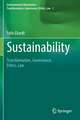
Sustainability: Environmental Humanities: Transformation, Governance, Ethics, Law
Autor Felix Ekardten Limba Engleză Paperback – 17 iul 2025
(Prof. Dr. Dr. h.c. mult. Ernst Ulrich von Weizsäcker, Club of Rome, Honorary President)
Taking a transdisciplinary perspective, the book canvasses the entire spectrum of issues relevant to sustainability. A most valuable and timely contribution to the debate.
(Prof. Dr. Klaus Bosselmann, University of Auckland, Author of “The Principle of Sustainability”)
This books breathes life into the concept of sustainability. Felix Ekardt tears down the barriers between disciplines and builds a holistic fundament for sustainablility; fit to guide long-term decision-making on the necessary transformation and societal change.
(Prof. Dr. Christina Voigt, Oslo University, Dept. of Public and International Law)
| Toate formatele și edițiile | Preț | Express |
|---|---|---|
| Paperback (2) | 375.44 lei 43-57 zile | |
| Springer International Publishing – 9 aug 2020 | 375.44 lei 43-57 zile | |
| Springer – 17 iul 2025 | 399.01 lei 38-44 zile | |
| Hardback (2) | 487.47 lei 43-57 zile | |
| Springer International Publishing – 9 aug 2019 | 487.47 lei 43-57 zile | |
| Springer International Publishing – 16 iul 2024 | 514.61 lei 38-44 zile |
Preț: 399.01 lei
Puncte Express: 599
Preț estimativ în valută:
70.55€ • 81.54$ • 60.95£
70.55€ • 81.54$ • 60.95£
Carte tipărită la comandă
Livrare economică 29 aprilie-05 mai
Specificații
ISBN-13: 9783031627132
ISBN-10: 303162713X
Pagini: 344
Dimensiuni: 155 x 235 x 19 mm
Greutate: 0.52 kg
Ediția:Second Edition 2024
Editura: Springer
Seria Environmental Humanities: Transformation, Governance, Ethics, Law
ISBN-10: 303162713X
Pagini: 344
Dimensiuni: 155 x 235 x 19 mm
Greutate: 0.52 kg
Ediția:Second Edition 2024
Editura: Springer
Seria Environmental Humanities: Transformation, Governance, Ethics, Law
Cuprins
Chapter 1. Foundations in natural science, economics and epistemology: problems, categories, strategies, and the issue of growth.- Chapter 2. Transformation to sustainability: an innovative perspective on societal change – with and against sociological, psychological, biological, economic and ethnologic findings.- Chapter 3. Ethics and law of sustainability – especially of freedom, human rights, democracy, and balancing in a reinterpreted perspective.- Chapter 4. Politics and governance of sustainability – on climate, energy, agriculture and conservation policy instruments with a new focus.- Summary.
Notă biografică
Felix Ekardt is the founder and head of the Forschungsstelle Nachhaltigkeit und Klimapolitik (Research Centre for Sustainability and Climate Policy) in Leipzig and Berlin. At the same time he serves as a Professor for Public Law and Legal Philosophy at Rostock University (Faculty of Law), and as member of the Science Campus Phosphorus Research Rostock. Visiting Professor at various German and Chinese universities since 2002. His research addresses questions of sustainability in the humanities, focusing on transformation, policy instruments and normativity (ethics and law) on an international, European, national and communal level.
Textul de pe ultima copertă
This book proposes a holistic transdisciplinary approach to sustainability and post-fossil societies as a subject of social sciences - at a time when post-fossilisation is becoming a core political concern due to the aggressive foreign policy of autocracies, also for reasons beyond sustainability. Furthermore, the book shows new ways, as perspectives of philosophy, political science, law, economics, sociology, cultural studies and others are here no longer regarded separately. Instead, integrated perspectives on the key issues are carved out: Perspectives on conditions of transformation to sustainability, on key instruments and the normative questions. This allows for a concise answer to urgent and controversial questions such as the following: Is the EU an environmental pioneer? Is it possible to achieve sustainability by purely technical means? If not: will that mean to end of the growth society? How to deal with the follow-up problems? How will societal change be successful? Are political power and capitalism the main barriers to sustainability? What is the role of emotions and conceptions of normality in the transformation process? To which degree are rebound and shifting effects the reason why sustainability politics fail? How much climate protection can be claimed ethically and legally e.g. on grounds of human rights? And what is freedom? Despite all rhetoric, the weak transition in energy, climate, agriculture and conservation serves as key example in this book. It is shown how the Paris Agreement is weak with regard to details and at the same time overrules the growth society by means of a radical 1,5 degrees temperature limit. It is shown how emissions trading must – and can – be reformed radically. It is shown why CSR, education, cooperation and happiness research are overrated. And we will see what an integrated politics on climate, biodiversity, nitrogen and soil might look like.
This book deals with conditions of transformation, governance instruments, ethics and law of sustainability. The relevance of the humanities to sustainability has never before been demonstrated so vividly and broadly as here. And in every area it opens up some completely new perspectives.
This book deals with conditions of transformation, governance instruments, ethics and law of sustainability. The relevance of the humanities to sustainability has never before been demonstrated so vividly and broadly as here. And in every area it opens up some completely new perspectives.
Caracteristici
Discusses the key to solving environmental problems and moving away from fossil fuels Examines industrialised and emerging countries efforts for creating sustainable societies Presents a new social-science-based theory of sustainability, responds to core questions of social sciences, human motivation, governance, and the grounds of normativity