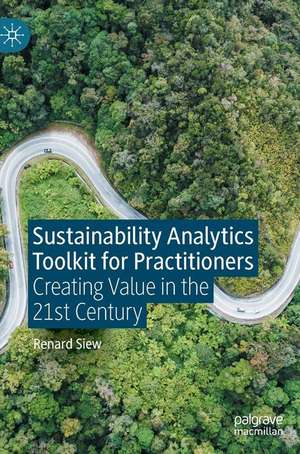
Sustainability Analytics Toolkit for Practitioners
Autor Renard Siewen Limba Engleză Hardback – 2 ian 2023
The book covers current analytical tools (eg: frameworks, standards, ESG indexes) to measure sustainability, and how these tools embed the Sustainable Development Goals (SDGs). In addition to that, a part of the book is also dedicated to the application of sustainability analytics, highlighting key challenges as well as the importance of engagement and communication in shaping the future direction of sustainability assessments.
This book will be extremely useful to both researchers and practitioners who are looking for best--in-class practices to create value from their sustainability initiatives.
Preț: 560.13 lei
Preț vechi: 629.36 lei
-11%
Puncte Express: 840
Carte tipărită la comandă
Livrare economică 26 octombrie-09 noiembrie
Livrare prin curier în România Termenul estimat este afișat lângă disponibilitate.
Transport gratuit pentru acest produs Plată online sau ramburs, în funcție de opțiunile comenzii.
Retur gratuit în 14 zile Comandă securizată și suport în română.
Specificații
ISBN-13: 9789811982361
ISBN-10: 9811982368
Pagini: 268
Ilustrații: XVIII, 250 p. 39 illus., 20 illus. in color.
Dimensiuni: 153 x 216 x 20 mm
Greutate: 0.46 kg
Ediția:1st ed. 2023
Editura: Springer
Locul publicării:Singapore, Singapore
ISBN-10: 9811982368
Pagini: 268
Ilustrații: XVIII, 250 p. 39 illus., 20 illus. in color.
Dimensiuni: 153 x 216 x 20 mm
Greutate: 0.46 kg
Ediția:1st ed. 2023
Editura: Springer
Locul publicării:Singapore, Singapore
V-ar putea interesa
-
 -29%Preț: 140.35 lei198.26 lei
 -
 -19%Preț: 548.85 lei677.59 lei
 -
 -23%Preț: 616.22 lei800.28 lei
 -
 -23%Preț: 603.30 lei783.50 lei
 -
 -19%Preț: 571.88 lei706.03 lei
 -
 -19%Preț: 459.98 lei567.88 lei
 -
 Asiatische ManagementmodelleHeike Annette Lang-19%Preț: 585.47 lei722.80 lei
 -
 -19%Preț: 498.68 lei615.65 lei
 -
 Rechtliche Aspekte der TelearbeitCorinna Wißmann-19%Preț: 459.98 lei567.88 lei
 -
 -19%Preț: 486.10 lei600.12 lei
 -
 Chancen einer Strombörse in DeutschlandStefan Moritz-19%Preț: 522.73 lei645.35 lei
 -
 -19%Preț: 409.76 lei505.87 lei
 -
 -19%Preț: 446.40 lei551.10 lei
 -
 Electronic Procurement auf virtuellen MarktplätzenMatthias Knoch-19%Preț: 571.88 lei706.03 lei
 -
 -19%Preț: 409.76 lei505.87 lei
 -
 -23%Preț: 735.51 lei955.20 lei
 -
 Branchenvergleich börsennotierter UnternehmenSascha Lantrebecq-19%Preț: 459.98 lei567.88 lei
 -
 -23%Preț: 747.46 lei970.73 lei
 -
 Bewertung von Unternehmen des Electronic CommerceChristoph Seeger-19%Preț: 522.73 lei645.35 lei
 -
 -19%Preț: 423.35 lei522.67 lei
Cuprins
Chapter 1: Introduction to Sustainability Analytics.- Chapter 2: Classifications of Analytical Tools.- Chapter 3: Building/ Infrastructure Sustainability Analytical Tools (SATs).- Chapter 4: Sustainability Decision Analytics.- Chapter 5: Sustainable Development Goals (SDGs) Impact Investing Framework.- Chapter 6: Sustainability Ratios.- Chapter 7: Sustainability Communication.- Chapter 8: Stakeholder Engagement.- Chapter 9: Analytics for Sustainability Issues.- Chapter 10: Sustainability Risks and Policies/Instruments.- Chapter 11: Conclusion.
Textul de pe ultima copertă
This book solicits meaningful contributions from key experts and practitioners that have been dealing with the emerging area of sustainability analytics. In doing so, readers would understand the cost, impact and performance of their sustainability initiatives.
The book covers current analytical tools (eg: frameworks, standards, ESG indexes) to measure sustainability, and how these tools embed the Sustainable Development Goals (SDGs). In addition to that, a part of the book is also dedicated to the application of sustainability analytics, highlighting key challenges as well as the importance of engagement and communication in shaping the future direction of sustainability assessments.
This book will be extremely useful to both researchers and practitioners who are looking for best--in-class practices to create value from their sustainability initiatives.
Renard Y.J. Siew is a sustainability and climate change specialist. He has worked with both the private and public sector to drive the Environmental, Social and Governance (ESG) agenda. He holds the position of Sustainability Advisor to the Centre for Governance and Political Studies (CENT-GPS) where he is responsible for advancing the organisation’s work in this field.
He is the Founder of Accelerating Climate Action and has served as Co-Chair of the Climate Change & Disaster Risk Management Working Committee and UNEP-FI’s Collective Commitment on Climate Action. He was a member of the World Economic Forum (WEF) Expert Network Group, served on the WEF Global Future Council and appointed a Community Champion for Southeast Asia. He was accepted into the Forbes Fellowship Programme and attended the inaugural UN Climate Action Summit in New York. Renard is part of the facilitation team at the Cambridge Institute of Sustainability Leadership (CISL). He has also been appointed Adjunct Professor for various universities. He is a graduate ofthe University of New South Wales (UNSW) and has completed postgraduate education at CISL and the Harvard Kennedy School.
The book covers current analytical tools (eg: frameworks, standards, ESG indexes) to measure sustainability, and how these tools embed the Sustainable Development Goals (SDGs). In addition to that, a part of the book is also dedicated to the application of sustainability analytics, highlighting key challenges as well as the importance of engagement and communication in shaping the future direction of sustainability assessments.
This book will be extremely useful to both researchers and practitioners who are looking for best--in-class practices to create value from their sustainability initiatives.
Renard Y.J. Siew is a sustainability and climate change specialist. He has worked with both the private and public sector to drive the Environmental, Social and Governance (ESG) agenda. He holds the position of Sustainability Advisor to the Centre for Governance and Political Studies (CENT-GPS) where he is responsible for advancing the organisation’s work in this field.
He is the Founder of Accelerating Climate Action and has served as Co-Chair of the Climate Change & Disaster Risk Management Working Committee and UNEP-FI’s Collective Commitment on Climate Action. He was a member of the World Economic Forum (WEF) Expert Network Group, served on the WEF Global Future Council and appointed a Community Champion for Southeast Asia. He was accepted into the Forbes Fellowship Programme and attended the inaugural UN Climate Action Summit in New York. Renard is part of the facilitation team at the Cambridge Institute of Sustainability Leadership (CISL). He has also been appointed Adjunct Professor for various universities. He is a graduate ofthe University of New South Wales (UNSW) and has completed postgraduate education at CISL and the Harvard Kennedy School.
Caracteristici
Covers the “how-to” of sustainability analytics Reviews and consolidates key sustainability analytical tools for practitioners Proposes not just the “hardware” but also the “software” to be effective stewards