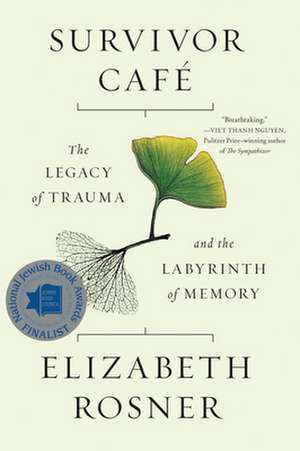
Survivor Cafe: The Legacy of Trauma and the Labyrinth of Memory
Autor Elizabeth Rosneren Limba Engleză Paperback – 4 sep 2018
Publicul țintă format din cercetători în domeniul memoriei colective, psihologi specializați în trauma intergenerațională și studenți ai științelor sociale va găsi în Survivor Cafe o analiză profundă a modului în care istoria personală se intersectează cu memoria națională. Putem afirma că lucrarea depășește granițele unui simplu volum de memorii, transformându-se într-o investigație riguroasă asupra modului în care atrocitățile secolului XX continuă să modeleze identitățile contemporane. Structura narativă este ancorată în trei vizite efectuate de Elizabeth Rosner împreună cu tatăl său la Buchenwald, oferind o perspectivă temporală unică asupra procesului de comemorare. Descoperim aici o sinteză între experiența trăită și datele științifice; Rosner integrează cercetări recente din neuroștiințe pentru a explica 'moștenirea' biologică a traumei. Această abordare oferă o alternativă la volumul Traumatic Memories of the Second World War and After de Peter Leese pentru cursurile de asistență socială sau istorie orală, cu avantajul că Survivor Cafe realizează conexiuni transversale între evenimente aparent disparate: de la Hiroshima la genocidul din Cambodgia și impactul atacurilor de la 11 septembrie. Reținem că, spre deosebire de Trauma de Selma Leydesdorff, care se concentrează pe interviuri și istorisiri de viață, Rosner analizează și 'labirintul' locurilor de memorie, de la muzee la proiecte de reconciliere națională. Cartea se poziționează ca o evoluție naturală în opera autoarei, rafinând temele explorate în The Speed of Light și Gravity, trecând de la ficțiune și poezie la o examinare documentară și sociologică a responsabilității colective.
Preț: 97.30 lei
Carte disponibilă
Livrare economică 07-21 noiembrie
Specificații
ISBN-10: 1640091076
Pagini: 288
Dimensiuni: 139 x 209 x 25 mm
Greutate: 0.3 kg
Editura: Penguin Random House Group
Colecția Counterpoint
Locul publicării:United States
V-ar putea interesa
-
 Piano Tide: A NovelKathleen Dean Moore-18%Preț: 87.05 lei105.53 lei
 -
 ManazuruHiromi KawakamiPreț: 94.11 lei
 -
 Here Let Us FeastM. F. K. FisherPreț: 123.37 lei
 -
 And Your Daughters Shall ProphesyAdrian ShirkPreț: 99.46 lei
 -
 -10%Preț: 94.63 lei105.58 lei
 -
 Sex, Economy, Freedom, & Community: Eight EssaysWendell Berry-20%Preț: 90.69 lei113.35 lei
 -
 Lake City: A NovelThomas Kohnstamm-11%Preț: 93.65 lei105.01 lei
 -
 -26%Preț: 94.97 lei128.48 lei
 -
 The Art of Loading Brush: New Agrarian WritingsWendell Berry-19%Preț: 92.66 lei114.52 lei
 -
 Think Little: EssaysWendell BerryPreț: 53.50 lei
 -
 Tawny Grammar: EssaysGary Snyder-21%Preț: 54.70 lei69.44 lei
 -
 -21%Preț: 136.01 lei173.00 lei
 -
 -10%Preț: 95.62 lei106.17 lei
 -
 Tomb of the Unknown Racist: A NovelBlanche Mccrary Boyd-20%Preț: 91.18 lei113.87 lei
 -
 White River Burning: A Dave Gurney Novel: Book 6John Verdon-18%Preț: 106.32 lei129.78 lei
 -
 Preț: 90.89 lei
 -
 Ghost Dance: A NovelCarole Maso-20%Preț: 87.46 lei109.78 lei
 -
 Silicon StatesLucie GreenePreț: 102.76 lei
 -
 Terrarium: New and Selected StoriesValerie Trueblood-19%Preț: 95.68 lei118.31 lei
 -
 The Big Book of the DeadMarion WinikPreț: 92.66 lei
 -
 -20%Preț: 93.41 lei116.94 lei
 -
 Lifting Belly: An Erotic PoemGertrude SteinPreț: 52.41 lei
De ce să citești această carte
Recomandăm Survivor Cafe oricărui cititor interesat de mecanismele prin care societățile procesează durerea istorică. Este o lectură esențială pentru a înțelege cum trauma nerezolvată a părinților influențează sănătatea mentală a descendenților. Câștigați o perspectivă globală asupra memoriei colective, învățând cum să păstrați vii lecțiile trecutului într-o eră în care ultimii martori direcți ai atrocităților secolului XX dispar.
Despre autor
Elizabeth Rosner este o scriitoare americană de prestigiu, absolventă a Universității Stanford și a programului de scriere creativă de la University of California, Irvine. Fiică a unor supraviețuitori ai Holocaustului, opera sa este marcată de explorarea tăcerii și a secretelor de familie, teme vizibile în romanele The Speed of Light și Gravity. Prin lucrarea Survivor Cafe, ea își consolidează poziția de voce importantă în literatura dedicată traumei, împletind rigoarea academică cu sensibilitatea poetică dezvoltată în publicații precum 'Poetry East'. În prezent, trăiește și scrie în Berkeley, California.
Descriere
A San Francisco Chronicle Best Book of the Year An 'impressive, highly readable' exploration of 'atrocity, trauma, and memory' that examines the legacies of the Holocaust, Hiroshima, and other mass trauma events - 'a powerful book' (Viet Thanh Nguyen, Pulitzer Prize-winning author of The Sympathizer). As firsthand survivors of many of the 20th century's most monumental events - the Holocaust, Hiroshima, the Killing Fields - begin to pass away, Survivor Cafe addresses urgent questions: How do we carry those stories forward? How do we collectively ensure that the horrors of the past are not forgotten? Elizabeth Rosner organizes her book around three trips with her father to Buchenwald concentration camp - in 1983, in 1995, and in 2015 - each journey an experience in which personal history confronts both commemoration and memorialization. She explores the echoes of similar legacies among descendants of African American slaves, descendants of Cambodian survivors of the Killing Fields, descendants of survivors of the bombing of Hiroshima and Nagasaki, and the effects of 9/11 on the general population. Examining current brain research, Rosner depicts the efforts to understand the intergenerational inheritance of trauma, as well as the intricacies of remembrance in the aftermath of atrocity. Survivor Cafe becomes a lens for numerous constructs of memory - from museums and commemorative sites to national reconciliation projects to small-group cross-cultural encounters. Beyond preserving the firsthand testimonies of participants and witnesses, individuals and societies must continually take responsibility for learning the painful lessons of the past in order to offer hope for the future. Survivor Cafe offers a clear-eyed sense of the enormity of our 21st-century-human inheritance - not only among direct descendants of the Holocaust but also in the shape of our collective responsibility to learn from tragedy, and to keep the ever-changing conversations alive between the past and the present. 'Each page is imbued with urgency, with sincerity, with heartache, with heart . . . [Rosner's] words, alongside the words of other survivors of atrocity and their descendants across the globe, can help us build a more humane world.' - San Francisco Chronicle