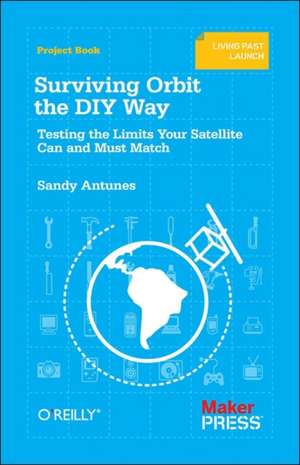
Surviving Orbit the DIY Way
Autor Sandy Antunesen Limba Engleză Paperback – 10 sep 2012
The perfect follow-up to DIY Satellite Platforms (our primer for designing and building a picosatellite), this book also provides an overview of what space is like and how orbits work, enabling you to set up the launch and orbit support you’ll need.
* Go deep into the numbers that describe conditions your satellite will face
* Learn how to mitigate the risks of radiation in the ionosphere
* Pick up enough formal systems engineering to understand what the tests are all about
* Build a thermal vacuum chamber for mimicking environment of space
* Simulate the rocket launch by building and running a vibration shake test
* Use a homebuilt centrifuge to conduct high G-force tests
* Get guidelines on scheduling tests and choosing an appropriate lab or clean room
Preț: 34.88 lei
Puncte Express: 52
Carte tipărită la comandă
Livrare economică 04-18 decembrie
Livrare prin curier în România Termenul estimat este afișat lângă disponibilitate.
Transport gratuit de la 400.00 lei Plată online sau ramburs, în funcție de opțiunile comenzii.
Retur gratuit în 14 zile Comandă securizată și suport în română.
Specificații
ISBN-13: 9781449310622
ISBN-10: 1449310621
Pagini: 90
Dimensiuni: 140 x 215 x 6 mm
Greutate: 0.12 kg
Editura: O'Reilly
ISBN-10: 1449310621
Pagini: 90
Dimensiuni: 140 x 215 x 6 mm
Greutate: 0.12 kg
Editura: O'Reilly
V-ar putea interesa
-
 Windows 7 AnnoyancesDavid A Karp-20%Preț: 219.08 lei273.85 lei
 -
 Mathematica CookbookSal Mangano-20%Preț: 415.66 lei519.58 lei
 -
 Cocoa and Objective-C: Up and RunningScott Stevenson-20%Preț: 184.34 lei230.42 lei
 -
 iPhone 3D ProgrammingPhilip Rideout-20%Preț: 209.25 lei261.56 lei
 -
 LPI Linux Certification in a NutshellAdam Haeder-20%Preț: 257.81 lei322.27 lei
 -
 DocBook 5: The Definitive GuideNorman Walsh-20%Preț: 316.88 lei396.10 lei
 -
 DIY Satellite PlatformsSandy AntunesPreț: 45.91 lei
 -
 DIY Instruments for Amateur SpaceSandy AntunesPreț: 37.77 lei
 -
 DIY Comms and Control for Amateur SpaceSandy AntunesPreț: 70.78 lei
 -
 Interactive Data Visualization for the WebScott Murray-20%Preț: 290.59 lei363.24 lei
 -
 Positioning in CSSEric Meyer-20%Preț: 47.01 lei58.76 lei
 -
 Xenserver Administration HandbookTim Mackey-20%Preț: 163.98 lei204.97 lei
 -
 Agile Application SecurityLaura Bell-20%Preț: 291.18 lei363.97 lei
 -
 Programming Beyond PracticesGregory T Brown-20%Preț: 170.06 lei212.58 lei
 -
 Design & Performance of Biometric SystemJohn T Elsworth-35%Preț: 724.65 lei1123.09 lei
 -
 SQL AntipatternsBill Karwin-20%Preț: 211.67 lei264.58 lei
 -
 Paralleles RechnenJosef Schüle-20%Preț: 301.05 lei376.32 lei
Notă biografică
Alexander "Sandy" Antunes (born 1967 in Baltimore, Maryland) is a Maryland-area astronomer, author, and role playing game designer. He graduated from Boston University in 1989 with a dual major in astronomy and physics, received a Masters in astronomy from Penn State in 1992, and received his PhD in computational astrophysics from George Mason University in 2005. He was the Maryland Science Center "Science Person of the Month" for May 2007.
Cuprins
Preface;
Conventions Used in This Book;
Using Code Examples;
Safari® Books Online;
How to Contact Us;
Chapter 1: Life as a Satellite;
1.1 Space Is...;
1.2 Launch Trouble;
1.3 How High Is Space?;
Chapter 2: The Measure of Space;
2.1 Outgassing;
2.2 Orbital Thermal Profiles;
2.3 Magnetic Fields;
2.4 Orbital Mechanics;
2.5 Orbital Debris;
Chapter 3: Space Radiation Environment;
3.1 Space Weather Events;
3.2 Shielding;
3.3 History of Damage;
3.4 Electronics Noise;
Chapter 4: Testing Formalism;
4.1 NASA CubeSat Requirements;
4.2 Sample Test Schedule;
4.3 Solving Problems;
4.4 Test Sequence;
4.5 Formal Risk Analysis;
Chapter 5: Thermal Vacuum Chamber;
5.1 Building and Using a Thermal Vacuum Chamber;
5.2 The $100 Thermal Vacuum Chamber;
5.3 Parts List;
5.4 Thermal/Vacuum Testing;
5.5 Heating Rates Due to Sunlight and Dark;
Chapter 6: Launch Tests;
6.1 Vibration Testing;
6.2 Vibration Spectra;
6.3 Shaker Design;
6.4 Acoustic Testing;
6.5 Drop Testing;
6.6 Static Loading;
Chapter 7: G-Force Testing;
7.1 G-Force Theory;
7.2 Hand-Powered G-force Rig;
7.3 The Drill-Powered G-force Rig;
Chapter 8: Good Test Procedures;
8.1 Flight Spares;
8.2 Test Scheduling and Isolated Testing;
8.3 Suggested Build-and-Test Schedule for a Typical Picosatellite;
8.4 Defects;
8.5 Frame Testing;
8.6 Clean Rooms;
8.7 DIY Clean Room/Box;
8.8 The Money Build;
8.9 When to Commit;
Colophon;
Conventions Used in This Book;
Using Code Examples;
Safari® Books Online;
How to Contact Us;
Chapter 1: Life as a Satellite;
1.1 Space Is...;
1.2 Launch Trouble;
1.3 How High Is Space?;
Chapter 2: The Measure of Space;
2.1 Outgassing;
2.2 Orbital Thermal Profiles;
2.3 Magnetic Fields;
2.4 Orbital Mechanics;
2.5 Orbital Debris;
Chapter 3: Space Radiation Environment;
3.1 Space Weather Events;
3.2 Shielding;
3.3 History of Damage;
3.4 Electronics Noise;
Chapter 4: Testing Formalism;
4.1 NASA CubeSat Requirements;
4.2 Sample Test Schedule;
4.3 Solving Problems;
4.4 Test Sequence;
4.5 Formal Risk Analysis;
Chapter 5: Thermal Vacuum Chamber;
5.1 Building and Using a Thermal Vacuum Chamber;
5.2 The $100 Thermal Vacuum Chamber;
5.3 Parts List;
5.4 Thermal/Vacuum Testing;
5.5 Heating Rates Due to Sunlight and Dark;
Chapter 6: Launch Tests;
6.1 Vibration Testing;
6.2 Vibration Spectra;
6.3 Shaker Design;
6.4 Acoustic Testing;
6.5 Drop Testing;
6.6 Static Loading;
Chapter 7: G-Force Testing;
7.1 G-Force Theory;
7.2 Hand-Powered G-force Rig;
7.3 The Drill-Powered G-force Rig;
Chapter 8: Good Test Procedures;
8.1 Flight Spares;
8.2 Test Scheduling and Isolated Testing;
8.3 Suggested Build-and-Test Schedule for a Typical Picosatellite;
8.4 Defects;
8.5 Frame Testing;
8.6 Clean Rooms;
8.7 DIY Clean Room/Box;
8.8 The Money Build;
8.9 When to Commit;
Colophon;
Descriere
Just how harsh is the space environment into which you thrust your DIY satellite? We look at what conditions your satellite must endure, how to test your satellite, and what launch, ground and orbit support you will need.