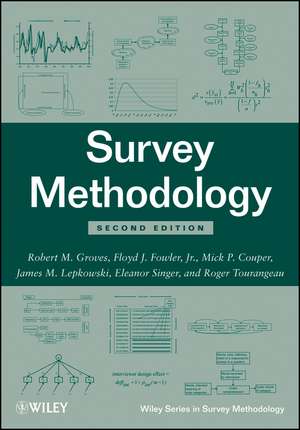
Survey Methodology 2e: Wiley Series in Survey Methodology
Autor Eleanor Singer, Floyd J. Fowler, James M. Lepkowski, Mick P. Couper, Robert M. Groves, Roger Tourangeauen Limba Engleză Paperback – 14 iul 2009
Considerăm Survey Methodology o resursă academică fundamentală pentru nivelul de licență avansat și masterat, fiind structurată special pentru a servi drept manual în departamentele de sociologie și centrele de cercetare. Această a doua ediție, publicată de John Wiley & Sons, Inc., reprezintă o actualizare necesară în contextul evoluției tehnologice, abordând direct provocările eșantionării pentru dispozitive mobile și mediul online. Remarcăm rigoarea cu care cei șase autori — experți recunoscuți la nivel mondial — tratează întregul proces de cercetare, de la evaluarea cadrelor de eșantionare până la procesarea datelor post-colectare. Textul extinde cadrul propus de Survey Research Methods de Fowler Floyd J Jr cu date noi din sfera tehnologiilor emergente și o analiză aprofundată a integrității științifice. În comparație cu International Handbook of Survey Methodology, care oferă o perspectivă globală și statistică vastă, Survey Methodology se concentrează pe mecanismele decizionale din spatele designului de sondaj, oferind o structură pedagogică superioară prin suplimentarea cu 50% a exercițiilor practice. Apreciem în mod deosebit modul în care Eleanor Singer și echipa sa integrează cercetările recente despre etică și confidențialitate, teme care devin tot mai complexe în era digitală. Lucrarea continuă direcția metodologică stabilită de Eleanor Singer în Methods for Testing and Evaluating Survey Questionnaires, rafinând tehnicile de evaluare a chestionarelor și oferind soluții concrete pentru reducerea erorilor de non-răspuns. Este un volum echilibrat, unde rigoarea statistică întâlnește aplicabilitatea practică, fiind indispensabil pentru orice profesionist care utilizează metode de cercetare socială.

Preț: 586.47 lei
Preț vechi: 724.03 lei
-19%
Carte disponibilă
Livrare economică 04-18 decembrie
Livrare express 20-26 noiembrie pentru 50.16 lei
Specificații
ISBN-10: 0470465468
Pagini: 496
Dimensiuni: 178 x 252 x 25 mm
Greutate: 0.86 kg
Ediția:2. Auflage
Editura: John Wiley & Sons, Inc.
Colecția Wiley Series in Survey Methodology
Seria Wiley Series in Survey Methodology
Locul publicării:Hoboken, United States
V-ar putea interesa
-
 The Science of Web SurveysRoger Tourangeau-34%Preț: 667.30 lei1006.67 lei
-
 Cross-Cultural Survey MethodsJanet A Harkness-9%Preț: 1101.44 lei1210.38 lei
-
 Survey Errors Survey Cost PRobert M Groves-9%Preț: 902.27 lei991.51 lei
-
 The Psychology of Survey ResponseRoger Tourangeau-19%Preț: 466.08 lei575.40 lei
-
 Time Series Analysis for the Social SciencesJanet M. Box-SteffensmeierPreț: 292.42 lei
-
 Preț: 410.99 lei
-
 -23%Preț: 497.75 lei646.42 lei
-
 -11%Preț: 463.91 lei521.24 lei
-
 -27%Preț: 833.97 lei1142.42 lei
-
 Understanding and Applying Research DesignMartin Lee Abbott-9%Preț: 834.01 lei916.49 lei
-
 Social Media, Sociality, and Survey ResearchCraig A Hill-8%Preț: 503.07 lei546.82 lei
-
 Designing and Conducting Survey ResearchLouis M Rea-8%Preț: 513.55 lei558.21 lei
-
 Bayesian Inference in the Social SciencesIvan Jeliazkov-9%Preț: 840.48 lei923.61 lei
-
 Preț: 273.24 lei
-
 -18%Preț: 2428.55 lei2961.65 lei
-
 Doing Optimality TheoryJohn J MccarthyPreț: 418.08 lei
-
 Preț: 571.32 lei
-
 The SAGE Handbook of Innovation in Social Research MethodsMalcolm WilliamsPreț: 353.05 lei
-
 The Nonresponse Challenge to Surveys and StatisticsDouglas S Massey-15%Preț: 454.63 lei534.86 lei
-
 FragebogenRolf PorstPreț: 280.53 lei
Public țintă
Advanced–undergraduate and beginning–graduate level courses in survey research methods in departments of sociology or survey research centers; practicing survey methodologists;government employees; corporate and academic libraries.De ce să citești această carte
Recomandăm această carte studenților la sociologie și profesioniștilor care doresc să stăpânească designul de sondaje moderne. Cititorul câștigă o înțelegere clară a modului în care tehnologia web și mobilă influențează eșantionarea, beneficiind totodată de exerciții practice care consolidează conceptele teoretice. Este instrumentul ideal pentru a minimiza erorile de cercetare și pentru a asigura integritatea datelor colectate.
Despre autor
Eleanor Singer a fost cercetător principal la Centrul de Cercetare a Sondajelor din cadrul Universității din Michigan, fiind una dintre cele mai respectate voci în metodologia cercetării sociale. Activitatea sa s-a concentrat pe etica sondajelor, protecția confidențialității și motivația respondenților. Alături de co-autori precum Robert M. Groves și Floyd J. Fowler, a contribuit decisiv la standardizarea metodelor de colectare a datelor. Expertiza sa în testarea și evaluarea chestionarelor, reflectată și în lucrarea „Methods for Testing and Evaluating Survey Questionnaires”, se regăsește în acuratețea și profunzimea analizei prezentate în acest volum de referință din Wiley Series in Survey Methodology.
Notă biografică
Descriere scurtă
Cuprins
ACKNOWLEDGEMENTS xxi
CHAPTER 1. AN INTRODUCTION TO SURVEY METHODOLOGY
1.1 Introduction 2
1.2 A Brief History of Survey Research 3
1.3 Some Examples of Ongoing Surveys 7
1.4 What is Survey Methodology? 30
1.5 The Challenge of Survey Methodology 32
1.6 About this Book 34
CHAPTER 2. INFERENCE AND ERROR IN SURVEYS
2.1 Introduction 39
2.2 The Lifecycle of a Survey From a Design Perspective 41
2.3 The Lifecycle of a Survey from A Quality Perspective 49
2.4 Putting It All Together 60
2.5 Error Notions in Different Kinds of Statistics 61
2.6 Nonstatistical Notions of Survey Quality 62
2.7 Summary 63
CHAPTER 3. TARGET POPULATIONS, SAMPLING FRAMES, AND COVERAGE ERROR
3.1 Introduction 69
3.2 Populations and Frames 69
3.3 Coverage Properties of Sampling Frames 72
3.4 Alternative Frames for the Target Population of Households or Persons 81
3.5 Frame Issues for Other Common Target Populations 84
3.6 Coverage Error 87
3.7 Reducing Undercoverage 88
3.8 Summary 94
CHAPTER 4. SAMPLE DESIGN AND SAMPLING ERROR
4.1 Introduction 97
4.2 Samples and Estimates 99
4.3 Simple Random Sampling 103
4.4 Cluster Sampling 106
4.5 Stratification and Stratified Sampling 113
4.6 Systematic Selection 123
4.7 Complications in Practice 125
4.8 Sampling US Telephone Households 133
4.9 Selecting Persons Within Households 136
4.10 Summary 138
CHAPTER 5. METHODS OF DATA COLLECTION
5.1 Alternative Methods of Data Collection 150
5.2 Choosing the Appropriate Method 159
5.3 Effects of Different Data Collection Methods on Survey Errors 160
5.4 Using Multiple Modes of Data Collection 175
5.5 Summary 177
CHAPTER 6. NONRESPONSE IN SAMPLE SURVEYS
6.1 Introduction 183
6.2 Response Rates 183
6.3 Impact of Nonresponse on the Quality of Survey Estimates 189
6.4 Thinking Causally About Survey Nonresponse Error 191
6.5 Dissecting the Nonresponse Phenomenon 192
6.6 Design Features to Reduce Unit Nonresponse 201
6.7 Item Nonresponse 208
6.8 Are Nonresponse Propensities Related to Other Error Sources? 210
6.9 Summary 210
CHAPTER 7. QUESTIONS AND ANSWERS IN SURVEYS
7.1 Alternatives Methods of Survey Measurement 217
7.2 Cognitive Processes in Answering Questions 218
7.3 Problems in Answering Survey Questions 225
7.4 Guidelines for Writing Good Questions 242
7.5 Summary 252
CHAPTER 8. EVALUATING SURVEY QUESTIONS
8.1 Introduction 259
8.2 Expert Reviews 260
8.3 Focus Groups 261
8.4 Cognitive Interviews 263
8.5 Field Pretests and Behavior Coding 265
8.6 Randomized or Split-Ballot Experiments 267
8.7 Applying Question Standards 268
8.8 Summary of Question Evaluation Tools 269
8.9 Linking Concepts of Measurement Quality to Statistical Estimates 274
8.10 Summary 286
CHAPTER 9. SURVEY INTERVIEWING
9.1 The Role of the Interviewer 291
9.2 Interviewer Bias 292
9.3 Interviewer Variance 295
9.4 Strategies for Reducing Interviewer Bias 300
9.5 Strategies for Reducing Interviewer-Related Variance 302
9.6 The Controversy About Standardized Interviewing 312
9.7 Interviewer Management 315
9.8 Validating the Work of Interviewers 319
9.9 The Use of Recorded Voices (and Faces) in Data Collection 322
9.10 Summary 323
CHAPTER 10. POSTCOLLECTION PROCESSING OF SURVEY DATA
10.1 Introduction 329
10.2 Coding 331
10.3 Entering Numeric Data into Files 344
10.4 Editing 345
10.5 Weighting 347
10.6 Imputation for Item-missing data 354
10.7 Sampling Variance Estimation for Complex Samples 359
10.8 Survey Data Documentation and Metadata 363
10.9 Summary 365
CHAPTER 11. PRINCIPLES AND PRACTICES RELATED TO ETHICAL RESEARCH
11.1 Introduction 371
11.2 Standards for the Conduct of Research 371
11.3 Standards for Dealing with Clients 374
11.4 Standards for Dealing with the Public 375
11.5 Standards for Dealing with Respondents 376
11.6 Emerging Ethical Issues 384
11.7 Research About Ethical Issues in Surveys 384
11.8 Administrative and Technical Procedures for Safe-Guarding Confidentiality 392
11.9 Summary and Conclusions 398
Keywords
For More In-Depth Reading
Exercises
CHAPTER 12. FAQS ABOUT SURVEY METHODOLOGY
12.1 Introduction 405
12.2 The Questions and Their Answers 405
REFERENCES 421
INDEX 451