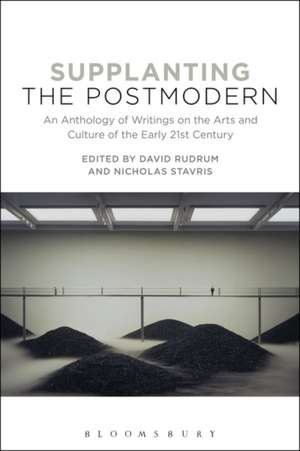
Supplanting the Postmodern: An Anthology of Writings on the Arts and Culture of the Early 21st Century
Editat de Dr. David Rudrum, Nicholas Stavrisen Limba Engleză Paperback – 5 noi 2015
The book is divided into two parts: the first, 'The Sense of an Ending', presents a range of positions in the debate around the demise of the postmodern; the second, 'Coming to Terms with the New', presents representative writings from the new '-isms' mentioned above. Each of the entries is prefaced by a brief introduction by the editors, in which they outline its central ideas, point out the similarities and/or differences from other positions found in the anthology, and suggest possible strengths and limitations to the insights presented in each piece.
Preț: 212.54 lei
Preț vechi: 266.51 lei
-20%
Carte tipărită la comandă
Livrare economică 09-23 decembrie
Specificații
ISBN-10: 1501306863
Pagini: 400
Dimensiuni: 150 x 228 x 26 mm
Greutate: 0.61 kg
Editura: Bloomsbury Publishing
Colecția Bloomsbury Academic
Locul publicării:New York, United States
V-ar putea interesa
-
 -19%Preț: 98.59 lei121.76 lei
 -
 The Poisonous Pen of Agatha ChristieMichael C. GeraldPreț: 223.74 lei
 -
 DiaryWitold GombrowiczPreț: 120.01 lei
 -
 Joyce and the Invention of Irish HistoryThomas HofheinzPreț: 297.70 lei
 -
 Simone de Beauvoir and the Limits of CommitmentAnne WhitmarshPreț: 288.73 lei
 -
 The Cambridge History of the American NovelLeonard Cassuto-14%Preț: 1661.19 lei1931.62 lei
 -
 The Contemporary Spanish-American Novel: Bolano and AfterProfessor Will H. CorralPreț: 285.61 lei
 -
 The Science Fiction HandbookDr Nick Hubble-21%Preț: 206.52 lei259.85 lei
 -
 The Romanticism HandbookDr Sue Chaplin-22%Preț: 252.61 lei323.50 lei
 -
 The OdysseyHomer-20%Preț: 126.94 lei159.07 lei
 -
 -24%Preț: 211.84 lei279.96 lei
 -
 Henry DunbarMary Elizabeth BraddonPreț: 135.61 lei
 -
 Dame Agatha's ShortsElena SantangeloPreț: 72.71 lei
Descriere
For more than a decade now a steadily growing chorus of voices has announced that the 'postmodern' literature, art, thought and culture of the late 20th century have come to an end. At the same time as this, the early years of the 21st century have seen a stream of critical formulations proclaiming a successor to postmodernism. Intriguing and exciting new terms such as 'remodernism', 'performatism', 'hypermodernism', 'automodernism+?, 'renewalism', 'altermodernism', 'digimodernism' and 'metamodernism' have been coined, proposed and debated as terms for what comes after the postmodern. Supplanting the Postmodern is the first anthology to collect the key writings in these debates in one place.
The book is divided into two parts: the first, 'The Sense of an Ending', presents a range of positions in the debate around the demise of the postmodern; the second, 'Coming to Terms with the New', presents representative writings from the new '-isms' mentioned above. Each of the entries is prefaced by a brief introduction by the editors, in which they outline its central ideas, point out the similarities and/or differences from other positions found in the anthology, and suggest possible strengths and limitations to the insights presented in each piece.
Cuprins
Part One: The Sense of an Ending
"Epilogue: The Postmodern - In Retrospect"
"Gone Forever But Here To Stay: The Legacy of the Postmodern"
Linda Hutcheon
"Beyond Postmodernism: Toward an Aesthetic of Trust"
Ihab Hassan
"Postmodernism Grown Old"
Steven Connor
"The Death of Postmodernism and Beyond"
Alan Kirby
"They Might Have Been Giants"
John McGowan
From Post-Postmodernism, or, The Cultural Logic of Just-in-Time Capitalism
Jeffrey Nealon
Part Two: Coming to Terms with the New
Remodernism
Billy Childish and Charles Thomson, "The Stuckist Manifesto"
Billy Childish and Charles Thomson, "Remodernism"
Performatism
Raoul Eshelman, "Introduction"
Raoul Eshelman, "Performatism, or the End of Postmodernism (American Beauty)"
Hypermodernism
Gilles Lipovetsky, from "Time Against Time, or The Hypermodern Society"
Automodernism
Robert Samuels, "Auto-modernity after Postmodernism: Autonomy and Automation in Culture, Technology, and Education"
Renewalism
Neil Brooks and Josh Toth, "Introduction: A Wake and Renewed?"
Josh Toth, from The Passing of Postmodernism: A Spectroanalysis of the Contemporary
Altermodernism
Nicolas Bourriaud, The Altermodern Manifesto
Nicolas Bourriaud, "Altermodern"
Digimodernism
Alan Kirby, from Digimodernism: How New Technologies Dismantle the Postmodern and Reconfigure our Culture
Metamodernism
Timotheus Vermeulen and Robin van den Akker, "Notes on Metamodernism"
Conclusions
"Note on the Supplanting of 'Post-'"
David Rudrum
"The Anxieties of the Present"
Nicholas Stavris
Bibliography
Index
Recenzii
Rudrum and Stavris have put together a fascinating collection of speculations, arguments, and manifestos that engage in very different ways with the question of postmodernism's demise. That this question is shown to involve asking whether there actually is or was a single cultural tendency that can be labelled "postmodernism", or whether its aftermath can be similarly labelled by a single term, is a sign of the editors' own open-minded (postmodern?) approach.
It may well be, as the editors suggest, that postmodernism was the last time we looked coherent enough to oppose ourselves. If so, then Supplanting the Postmodern provides the dual service of recalling, as postmodernism becomes forgettable, its inescapability, while doing away with all efforts to prolong it. I have difficulty imagining serious aesthetic discussion apart from the background this book provides.
A useful collection of writings, helpfully designed to make students think about contemporary cultural dynamics.