
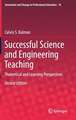
Successful Science and Engineering Teaching: Theoretical and Learning Perspectives: Innovation and Change in Professional Education, cartea 16
Autor Calvin S. Kalmanen Limba Engleză Paperback – 29 aug 2018
Din seria Innovation and Change in Professional Education
- 18%
 Preț: 1278.08 lei
 - 15%
 Preț: 656.33 lei
 - 5%
 Preț: 1350.04 lei
 - 28%
 Preț: 737.86 lei
 - 18%
 Preț: 929.44 lei
 - 18%
 Preț: 1052.15 lei
 - 18%
 Preț: 982.31 lei
 - 5%
 Preț: 383.84 lei
 - 15%
 Preț: 669.40 lei
 - 15%
 Preț: 409.32 lei
 - 15%
 Preț: 636.41 lei
 - 5%
 Preț: 1290.63 lei
 - 15%
 Preț: 612.98 lei
 - 15%
 Preț: 632.74 lei
 - 18%
 Preț: 748.01 lei
 - 15%
 Preț: 644.60 lei
 - 15%
 Preț: 642.81 lei
 - 59%
 Preț: 343.39 lei
Preț: 624.49 lei
Preț vechi: 780.61 lei
-20%
Puncte Express: 937
Carte tipărită la comandă
Livrare economică 04-10 decembrie
Livrare prin curier în România Termenul estimat este afișat lângă disponibilitate.
Transport gratuit pentru acest produs Plată online sau ramburs, în funcție de opțiunile comenzii.
Retur gratuit în 14 zile Comandă securizată și suport în română.
Specificații
ISBN-13: 9783319881867
ISBN-10: 3319881868
Pagini: 271
Ilustrații: XIX, 271 p. 51 illus.
Dimensiuni: 155 x 235 mm
Ediția:Softcover reprint of the original 2nd ed. 2018
Editura: Springer International Publishing
Colecția Springer
Seria Innovation and Change in Professional Education
Locul publicării:Cham, Switzerland
ISBN-10: 3319881868
Pagini: 271
Ilustrații: XIX, 271 p. 51 illus.
Dimensiuni: 155 x 235 mm
Ediția:Softcover reprint of the original 2nd ed. 2018
Editura: Springer International Publishing
Colecția Springer
Seria Innovation and Change in Professional Education
Locul publicării:Cham, Switzerland
V-ar putea interesa
-
 The Institutional Development of Business SchoolsAndrew M. Pettigrew-31%Preț: 794.80 lei1144.68 lei
 -
 -19%Preț: 264.28 lei326.81 lei
 -
 The Research Student's Guide to SuccessPat Cryer-28%Preț: 158.36 lei219.21 lei
 -
 The Push Guide to Which UniversityJonathan RichPreț: 214.21 lei
 -
 Preț: 323.63 lei
 -
 Critical Reading and Writing for PostgraduatesMike WallacePreț: 320.41 lei
 -
 One LScott Turow-23%Preț: 82.33 lei107.45 lei
 -
 The Researching, Teaching, and Learning TriangleMiguel A. R. B. CastanhoPreț: 364.57 lei
 -
 -18%Preț: 47.03 lei57.39 lei
Cuprins
Part I: How Students Learn Science.- 1. Introduction.- 2. Intellectual Development and Psychological Types.- 3. Students Alternative Scientific Conceptions.- 4. Writing to Learn: Reflective Writing.- 5. What is the students’ Worldview?.- Part II: Theoretical and Learning Perspectives.- 6. Educational Models Based upon Philosophy of Science.- 7. Critical Thinking.- 8. Constructing an Epistemology.- 9. Changing How Students Learn.- Part III: Final Thoughts.- 10. Courses for Non-science Students.- 11. Computer Assisted Instruction. – 12. Summing Up.
Textul de pe ultima copertă
This second edition goes beyond the question of whether or not a pedagogical technique is effective, towards more of a focus on answering the question of why a particular technique or class of techniques is effective. In particular it is shown that students’ epistemological beliefs could become more expert-like with a combination of appropriate instructional activities. The debate in the science education community between those who believe that students come in to the classroom with a theory about the subject which is different from that described by the teacher and their textbooks and those who feel that students’ knowledge consists of isolated structures is elaborated especially in the light of the work by M.J. Lattery. Discussion of the stages in epistemic development in students beginning with the Perry model and continuing through later developments is now included. In this edition there is a discussion of how an instructor can enable the student to resolve cognitive dissonance in the difficulties students have in transcending their misconceptions. The second edition includes research comparing Peer Instruction with the Conceptual Conflict Collaborative Group Activity that had been described in the first edition. Much better instructions are available for students on how to use Reflective Writing including a rubric that simplifies the marking of Reflective Writing.
Caracteristici
Shows how students can resolve cognitive dissonance to transcend their misconceptions Shows how a student can use Reflective Writing to begin to analyze material in the manner of the modern theory of hermeneutics Offers ways of getting students to view science in terms of a coherent scientific framework and how we can get students to change the way they learn science
Descriere
Descriere de la o altă ediție sau format:
The intent of this book is to describe how a professor can provide a learning en vironment that assists students to come to grips with the nature of science and engineering, to understand science and engineering concepts, and to solve problems in science and engineering courses. As such, this book is intended to be useful for any science or engineering professor, who wants to change their course to include more effective teaching methods, to instructors at post-secondary institutions, who are beginning their careers, and as a handbook for TA’s. Since the book is based upon articles that I have had published in Science Educational Research and which are grounded in educational research that I have performed (both quantitative and qualitative) over many years, it will also be of interest to anyone engaged in research into teaching science and engineering at the post-secondary level. I have also tried to include enough background so that the book could be used as a te- book for a course in educational practice in science and engineering. The book has two main axes of development. Firstly, how do we get students to change their epistemology so that their outlook on the course material is not that it consists of a tool kit of assorted practices, classified according to problem type, but rather that the subject comprises a connected structure of concepts. Secondly, he- ing students to have a deeper understanding of science and engineering.
The intent of this book is to describe how a professor can provide a learning en vironment that assists students to come to grips with the nature of science and engineering, to understand science and engineering concepts, and to solve problems in science and engineering courses. As such, this book is intended to be useful for any science or engineering professor, who wants to change their course to include more effective teaching methods, to instructors at post-secondary institutions, who are beginning their careers, and as a handbook for TA’s. Since the book is based upon articles that I have had published in Science Educational Research and which are grounded in educational research that I have performed (both quantitative and qualitative) over many years, it will also be of interest to anyone engaged in research into teaching science and engineering at the post-secondary level. I have also tried to include enough background so that the book could be used as a te- book for a course in educational practice in science and engineering. The book has two main axes of development. Firstly, how do we get students to change their epistemology so that their outlook on the course material is not that it consists of a tool kit of assorted practices, classified according to problem type, but rather that the subject comprises a connected structure of concepts. Secondly, he- ing students to have a deeper understanding of science and engineering.