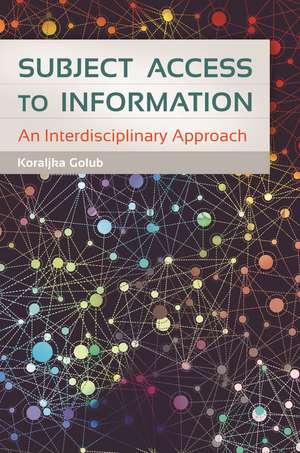
Subject Access to Information: An Interdisciplinary Approach
Autor Koraljka Goluben Limba Engleză Paperback – 21 noi 2014
A much-needed analysis of the intersection of information organization and technology, this interdisciplinary work encompasses both current and potential methods of organizing information by subject. It examines traditional approaches as they are used in the online environment and explores computer science approaches, such as ontologies and automated tools for subject information organization. Entries review the advantages and disadvantages of the two approaches, showcase their applications today, and project what those applications may be in the future.
Content ranges from background on the importance of information organization in general to the importance of information organization by subject in particular. Traditional and modern knowledge-organization systems are covered, as are technological standards, selected topics in automated tools, and interdisciplinary research and cooperation. By tackling varied approaches, the work provides you with an appreciation of the tools-and an understanding of common aims.
Preț: 361.99 lei
Preț vechi: 518.86 lei
-30%
Puncte Express: 543
Carte tipărită la comandă
Livrare economică 20 noiembrie-04 decembrie
Livrare prin curier în România Termenul estimat este afișat lângă disponibilitate.
Transport gratuit de la 400.00 lei Plată online sau ramburs, în funcție de opțiunile comenzii.
Retur gratuit în 14 zile Comandă securizată și suport în română.
Specificații
ISBN-13: 9781610695770
ISBN-10: 1610695771
Pagini: 180
Dimensiuni: 156 x 235 x 13 mm
Greutate: 0.3 kg
Editura: Bloomsbury Publishing
Colecția Libraries Unlimited
Locul publicării:New York, United States
ISBN-10: 1610695771
Pagini: 180
Dimensiuni: 156 x 235 x 13 mm
Greutate: 0.3 kg
Editura: Bloomsbury Publishing
Colecția Libraries Unlimited
Locul publicării:New York, United States
V-ar putea interesa
-
 Preț: 388.86 lei
 -
 Extensible Processing for Archives and Special CollectionsDaniel a. Santamaria-23%Preț: 424.21 lei550.93 lei
 -
 Crash Course in Basic Cataloging with RDAHeather Lea Moulaison-20%Preț: 287.37 lei359.72 lei
 -
 -29%Preț: 459.54 lei643.67 lei
 -
 Subject Analysis: Blitz Cataloging WorkbookBobby Ferguson-24%Preț: 229.75 lei301.92 lei
 -
 -25%Preț: 269.22 lei360.11 lei
 -
 -27%Preț: 491.06 lei671.98 lei
 -
 -15%Preț: 325.04 lei381.87 lei
 -
 -24%Preț: 297.57 lei391.33 lei
 -
 -25%Preț: 278.30 lei369.67 lei
 -
 -21%Preț: 330.50 lei417.57 lei
 -
 -15%Preț: 342.30 lei401.10 lei
 -
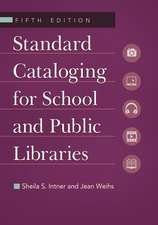 Standard Cataloging for School and Public LibrariesSheila S. Intner-28%Preț: 362.95 lei506.48 lei
 -
 -19%Preț: 595.52 lei735.20 lei
 -
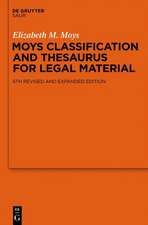 Moys Classification and Thesaurus for Legal MaterialsElizabeth M. Moys-23%Preț: 2261.24 lei2936.67 lei
Cuprins
CONTENTS
Preface
Acknowledgments
Chapter 1: Organizing Information by Subject
Chapter 2: Knowledge Organization Systems
Claudio Gnoli
Chapter 3: Technological Standards
Chapter 4: Automated Tools for Subject Information Organization: Selected Topics
Chapter 5: Perspectives for the Future
Index
Preface
Acknowledgments
Chapter 1: Organizing Information by Subject
Chapter 2: Knowledge Organization Systems
Claudio Gnoli
Chapter 3: Technological Standards
Chapter 4: Automated Tools for Subject Information Organization: Selected Topics
Chapter 5: Perspectives for the Future
Index
Recenzii
Exceptionally well written, organized and presented . . . Subject Access to Information: An Interdisciplinary Approach is a valuable instructional guide. . . . Very highly recommended for Library Science reference collections and supplemental studies reading lists.
This book would be worthwhile for cataloging/metadata librarians and systems/technology librarians who are interested in subject-based access to information and how discovery systems work. It would probably be of most use to academic librarians and library schools, but public and special librarians (and others) who are interested in the discovery of resources based on subjects would benefit from this book as well.
Subject Access to Information: An Interdisciplinary Approach succeeds in conveying, from an interdisciplinary perspective, the breadth and complexity of issues associated with providing subject access to information. The pedagogical features of the book (review questions, glossaries, and lists of references) are excellent. Beyond its targeted student audience, practicing catalogers and metadata librarians, as well as those involved in the development of library resource discovery tools, may benefit from reading this book.
This book would be worthwhile for cataloging/metadata librarians and systems/technology librarians who are interested in subject-based access to information and how discovery systems work. It would probably be of most use to academic librarians and library schools, but public and special librarians (and others) who are interested in the discovery of resources based on subjects would benefit from this book as well.
Subject Access to Information: An Interdisciplinary Approach succeeds in conveying, from an interdisciplinary perspective, the breadth and complexity of issues associated with providing subject access to information. The pedagogical features of the book (review questions, glossaries, and lists of references) are excellent. Beyond its targeted student audience, practicing catalogers and metadata librarians, as well as those involved in the development of library resource discovery tools, may benefit from reading this book.