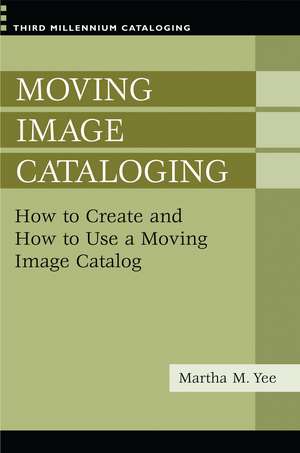
Moving Image Cataloging: How to Create and How to Use a Moving Image Catalog: Third Millennium Cataloging
Autor Martha M. Yeeen Limba Engleză Paperback – 30 oct 2007
Preț: 297.57 lei
Preț vechi: 391.33 lei
-24%
Puncte Express: 446
Carte tipărită la comandă
Livrare economică 08-22 decembrie
Livrare prin curier în România Termenul estimat este afișat lângă disponibilitate.
Transport gratuit de la 400.00 lei Plată online sau ramburs, în funcție de opțiunile comenzii.
Retur gratuit în 14 zile Comandă securizată și suport în română.
Specificații
ISBN-13: 9781591584384
ISBN-10: 1591584388
Pagini: 288
Dimensiuni: 178 x 254 x 18 mm
Greutate: 0.6 kg
Editura: Bloomsbury Publishing
Colecția Libraries Unlimited
Seria Third Millennium Cataloging
Locul publicării:New York, United States
ISBN-10: 1591584388
Pagini: 288
Dimensiuni: 178 x 254 x 18 mm
Greutate: 0.6 kg
Editura: Bloomsbury Publishing
Colecția Libraries Unlimited
Seria Third Millennium Cataloging
Locul publicării:New York, United States
V-ar putea interesa
-
 The Intellectual Foundation of Information OrganizationElaine Svenonius-20%Preț: 213.68 lei267.10 lei
 -
 Preț: 380.40 lei
 -
 Preț: 467.81 lei
 -
 -19%Preț: 606.02 lei748.17 lei
 -
 Moys Classification and Thesaurus for Legal MaterialsElizabeth M. Moys-23%Preț: 2336.99 lei3035.06 lei
Cuprins
Illustrations
Introduction
Chapter 1: Introduction to Moving Image Cataloging
Chapter 2: Introduction to A Data Structure Standard; How to Create a Cataloging Record; Automation Complexities and OPAC Searching
Chapter 3: Moving Image Works, Expressions and Manifestations; Introduction to Uniform Titles; Relationships; Represented and Presented Works
Chapter 4: Work Identification and Authorship; Authority Control
Chapter 5: Complications with Names of Persons and Corporate Bodies; Location of FRBR Entities; OPAC Searching Complications
Chapter 6: Introduction to Subject Analysis
Chapter 7: More on Subject Analysis
Chapter 8: Newsfilm access; OPAC searching
Chapter 9: Subject Access to Fiction; Genre/Form Access
Chapter 10: Digitization and the Future of Cataloging
Exercise Answers
Glossary
Bibliography of Works Consulted
Cataloging Standards Bibliography
Index
Introduction
Chapter 1: Introduction to Moving Image Cataloging
Chapter 2: Introduction to A Data Structure Standard; How to Create a Cataloging Record; Automation Complexities and OPAC Searching
Chapter 3: Moving Image Works, Expressions and Manifestations; Introduction to Uniform Titles; Relationships; Represented and Presented Works
Chapter 4: Work Identification and Authorship; Authority Control
Chapter 5: Complications with Names of Persons and Corporate Bodies; Location of FRBR Entities; OPAC Searching Complications
Chapter 6: Introduction to Subject Analysis
Chapter 7: More on Subject Analysis
Chapter 8: Newsfilm access; OPAC searching
Chapter 9: Subject Access to Fiction; Genre/Form Access
Chapter 10: Digitization and the Future of Cataloging
Exercise Answers
Glossary
Bibliography of Works Consulted
Cataloging Standards Bibliography
Index
Recenzii
Encouraging the reader to think critically and be prepared to make decisions in ambiguous situations where the solutions might not always be obvious or clearly dictated by rules, Moving Image Cataloging stimulates critical thinking with exercises at the end of each chapter, providing suggested (but not absolute) answers at the end of the book. Primarily geared for catalogers of moving images, the work also teaches how to make decisions that impact the catalog and, more generally, how to search a catalog.
This is a book which will become a standard work on the subject of cataloguing the moving image, and it needs to be read by those involved in cataloguing in film libraries, archives, and museums, as well as library schools and the more advanced cataloguing courses. Finally, I cannot resist quoting the marvellous dedication at the beginning of the book: 'This book is dedicated to all of the cataloguers who have laboured in the vineyards of bibliographic control for hundreds of years, largely unthanked and unappreciated because, when we do our work well, it is invisible to the catalogue user.'
How true!
.this is an excellent overview of the challenges, principles, and practices of cataloging moving image materials. It would be a useful textbook for courses on this topic, as well as for in-library training programs.
Martha Yee is a well-known exponent of moving image cataloguing, and this book is correspondingly authoritative.
This is a book which will become a standard work on the subject of cataloguing the moving image, and it needs to be read by those involved in cataloguing in film libraries, archives, and museums, as well as library schools and the more advanced cataloguing courses. Finally, I cannot resist quoting the marvellous dedication at the beginning of the book: 'This book is dedicated to all of the cataloguers who have laboured in the vineyards of bibliographic control for hundreds of years, largely unthanked and unappreciated because, when we do our work well, it is invisible to the catalogue user.'
How true!
.this is an excellent overview of the challenges, principles, and practices of cataloging moving image materials. It would be a useful textbook for courses on this topic, as well as for in-library training programs.
Martha Yee is a well-known exponent of moving image cataloguing, and this book is correspondingly authoritative.