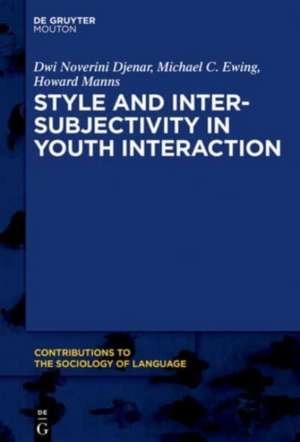
Style and Intersubjectivity in Youth Interaction
Autor Dwi Noverini Djenar, Howard Manns, Michael Ewingen Limba Engleză Hardback – 19 feb 2018
Indonesia provides a rich context for the study of style and intersubjectivity among youth. In constructing style, Indonesian urban youth have been moving away from conventions which emphasized hierarchy and uniformity toward new ways of connecting in intersubjective space. This book analyzes how these new ways are realized in different text types.
This book makes a valuable addition to sociolinguistic literature on youth and language and an essential reading for those interested in Austronesian sociolinguistics.
Preț: 818.60 lei
Preț vechi: 1063.12 lei
-23%
Puncte Express: 1228
Carte tipărită la comandă
Livrare economică 08-22 iunie
Specificații
ISBN-13: 9781614517559
ISBN-10: 161451755X
Pagini: 274
Dimensiuni: 160 x 236 x 21 mm
Greutate: 0.57 kg
Ediția:1. Auflage
Editura: De Gruyter Mouton
Locul publicării:Berlin/Boston
ISBN-10: 161451755X
Pagini: 274
Dimensiuni: 160 x 236 x 21 mm
Greutate: 0.57 kg
Ediția:1. Auflage
Editura: De Gruyter Mouton
Locul publicării:Berlin/Boston
V-ar putea interesa
-
 Metaphor: A Practical IntroductionZoltan Kövescses-14%Preț: 250.82 lei291.83 lei
 -
 -18%Preț: 383.15 lei468.68 lei
 -
 Rhetoric: A Very Short IntroductionRichard Toye-21%Preț: 53.16 lei67.60 lei
 -
 The Code BookSimon SinghPreț: 109.61 lei
 -
 Toward a History of American LinguisticsE.F.K. KoernerPreț: 445.24 lei
 -
 Indonesian: A Comprehensive GrammarJames Neil Sneddon-15%Preț: 652.38 lei767.51 lei
 -
 On DialogueDavid BohmPreț: 211.59 lei
 -
 What the Doctor OrdersHoward MannsPreț: 59.34 lei
 -
 Success & Lunacy- What's the Connection?Howard MannsPreț: 58.71 lei
 -
 -19%Preț: 417.25 lei515.12 lei
 -
 Indonesian: A Comprehensive GrammarJames Neil Sneddon-18%Preț: 1297.63 lei1582.48 lei
 -
 Multilingualism OnlineCarmen LeePreț: 385.68 lei
 -
 -25%Preț: 267.55 lei359.12 lei
 -
 Understanding SemanticsSebastian LoebnerPreț: 420.19 lei
 -
 Language and Identity across Modes of CommunicationDwi Noverini Djenar-23%Preț: 822.87 lei1068.65 lei
 -
 Ellipsis in ComparativesWinfried Lechner-23%Preț: 1785.95 lei2319.41 lei
 -
 Brücken schlagenHardarik Blühdorn-23%Preț: 1799.85 lei2337.47 lei
 -
 Factivity: Its Nature and AcquisitionPetra Schulz-23%Preț: 823.41 lei1069.36 lei
 -
 -23%Preț: 1120.68 lei1455.42 lei
 -
 Medium und Reflexiv: Eine Studie zur VerbsemantikIngrid Kaufmann-23%Preț: 1112.11 lei1444.30 lei
 -
 Gender Differences in English SyntaxBritta Mondorf-23%Preț: 821.42 lei1066.79 lei
 -
 -23%Preț: 824.59 lei1070.89 lei
 -
 -23%Preț: 1045.79 lei1358.16 lei
 -
 Deutsch-französische Übersetzungsübungen für das GrundstudiumCatherine RampfPreț: 137.07 lei
Notă biografică
Dwi Noverini Djenar, University of Sydney; Michael C. Ewing, University of Melbourne, Howard Manns, Monash University, Australia.
Descriere
Descriere de la o altă ediție sau format:
This book examines how style and intersubjective meanings emerge through language use. It is innovative in theoretical scope and empirical focus. It brings together insights from discourse-functional linguistics, stylistics, and conversation analysis to understand how language resources are used to enact stances in intersubjective space. While there are numerous studies devoted to youth language, the focus has been mainly on face-to-face interaction. Other types of youth interaction, particularly in mediated forms, have received little attention. This book draws on data from four different text types - conversation, e-forums, comics, and teen fiction - to highlight the multidirectional nature of style construction.
Indonesia provides a rich context for the study of style and intersubjectivity among youth. In constructing style, Indonesian urban youth have been moving away from conventions which emphasized hierarchy and uniformity toward new ways of connecting in intersubjective space. This book analyzes how these new ways are realized in different text types.
This book makes a valuable addition to sociolinguistic literature on youth and language and an essential reading for those interested in Austronesian sociolinguistics.
This book examines how style and intersubjective meanings emerge through language use. It is innovative in theoretical scope and empirical focus. It brings together insights from discourse-functional linguistics, stylistics, and conversation analysis to understand how language resources are used to enact stances in intersubjective space. While there are numerous studies devoted to youth language, the focus has been mainly on face-to-face interaction. Other types of youth interaction, particularly in mediated forms, have received little attention. This book draws on data from four different text types - conversation, e-forums, comics, and teen fiction - to highlight the multidirectional nature of style construction.
Indonesia provides a rich context for the study of style and intersubjectivity among youth. In constructing style, Indonesian urban youth have been moving away from conventions which emphasized hierarchy and uniformity toward new ways of connecting in intersubjective space. This book analyzes how these new ways are realized in different text types.
This book makes a valuable addition to sociolinguistic literature on youth and language and an essential reading for those interested in Austronesian sociolinguistics.