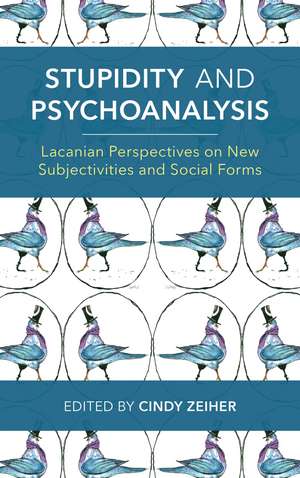
Stupidity and Psychoanalysis: Lacanian Perspectives on New Subjectivities and Social Forms
Editat de Cindy Zeiheren Limba Engleză Hardback – 29 ian 2025
In Stupidity and Psychoanalysis, chapters by internationally respected Lacanian analysts and theoreticians think about how we can understand stupidity as a specific psychoanalytic encounter. This collection draws critical Lacanian attention to considering new ways to approach stupidity and stupor as new contemporary subjective and social forms. Contributors provide various insights into how stupidity might be rethought as contemporary signifiers whose importance lies (for better or worse) more in producing effect than in transmitting meaning.
Contributors: Giole P. Cima, Christian Ingo Lenz Dunker, David Ferraro, Luis Izcovich, Adrian Johnston, James Martell, Jean-Michel Rabate, Samo Tomsic, Antonio Viselli, and Cindy Zeiher.
Preț: 597.00 lei
Preț vechi: 883.65 lei
-32%
Puncte Express: 896
Carte tipărită la comandă
Livrare economică 28 noiembrie-12 decembrie
Livrare prin curier în România Termenul estimat este afișat lângă disponibilitate.
Transport gratuit pentru acest produs Plată online sau ramburs, în funcție de opțiunile comenzii.
Retur gratuit în 14 zile Comandă securizată și suport în română.
Specificații
ISBN-13: 9781786616203
ISBN-10: 1786616203
Pagini: 280
Ilustrații: 2 BW Illustrations, 5 BW Photos
Dimensiuni: 150 x 230 x 24 mm
Greutate: 0.56 kg
Editura: Bloomsbury Publishing
Colecția Rowman & Littlefield
Locul publicării:New York, United States
ISBN-10: 1786616203
Pagini: 280
Ilustrații: 2 BW Illustrations, 5 BW Photos
Dimensiuni: 150 x 230 x 24 mm
Greutate: 0.56 kg
Editura: Bloomsbury Publishing
Colecția Rowman & Littlefield
Locul publicării:New York, United States
Cuprins
Acknowledgements
Introduction: Why We Should Listen to Stupidity's Bad Reputation
Cindy Zeiher
Chapter 1. Stupid Jokes
Jean-Michel Rabate´
Chapter 2. Natural Born Dupes: A Lacanian Theory of Stupidity
Gioele P. Cima
Chapter 3. "For to Begin Yet Again": Re-Rising the Ground(s) of Stupidity in Deleuze-Schelling-Lacan
James Martell
Chapter 4. Stupidity of the Signifier
Samo Tomsic
Chapter 5. Lacan and Pigeons
Antonio Viselli
Chapter 6. Errare Humanum Est. On Psychoanalysis as Morosophy
Dany Nobus
Chapter 7. Responses to the Sexual Void: Capitalism, Paranoia and Disavowal
David Ferraro
Chapter 8. A Mass of Fools and Knaves': Psychoanalysis and the World's Many Asininities
Adrian Johnston
Chapter 9. Can One be Less Stupid?
Luis Izcovich, Translated by Ed Pluth
Chapter 10. A Paradigmatic Case of Brazilian National Stupidity: Olavo de Carvalho
Christian Ingo Lenz Dunker
Chapter 11. Seriously! That is Fucking Stupid! The Importance of Being Stupid, Earnestly
Cindy Zeiher
Index
About the Contributors
Introduction: Why We Should Listen to Stupidity's Bad Reputation
Cindy Zeiher
Chapter 1. Stupid Jokes
Jean-Michel Rabate´
Chapter 2. Natural Born Dupes: A Lacanian Theory of Stupidity
Gioele P. Cima
Chapter 3. "For to Begin Yet Again": Re-Rising the Ground(s) of Stupidity in Deleuze-Schelling-Lacan
James Martell
Chapter 4. Stupidity of the Signifier
Samo Tomsic
Chapter 5. Lacan and Pigeons
Antonio Viselli
Chapter 6. Errare Humanum Est. On Psychoanalysis as Morosophy
Dany Nobus
Chapter 7. Responses to the Sexual Void: Capitalism, Paranoia and Disavowal
David Ferraro
Chapter 8. A Mass of Fools and Knaves': Psychoanalysis and the World's Many Asininities
Adrian Johnston
Chapter 9. Can One be Less Stupid?
Luis Izcovich, Translated by Ed Pluth
Chapter 10. A Paradigmatic Case of Brazilian National Stupidity: Olavo de Carvalho
Christian Ingo Lenz Dunker
Chapter 11. Seriously! That is Fucking Stupid! The Importance of Being Stupid, Earnestly
Cindy Zeiher
Index
About the Contributors
Recenzii
Cindy Zeiher has provided us here with an erudite collection of irreverent reflections on a topic of no small importance! In these pages, the reader will find Freud glowingly characterized as the world's first Professor of Stupidity, and psychoanalysis as at times a foolosophical enterprise that takes human stupidity as its main object of study. Thought by some to be excessively cerebral, Lacan nevertheless invites us-analysands and analysts alike-to dwell and even revel in stupidity. In this collection, the contributors evince studied stupidity by allowing themselves to remain dupes of the unconscious.
Lacan contends that the human animal as the "animal that supposes to know" remains structurally if not biologically afflicted by stupidity. In this broad sense, we are all not sapiens but folie-sophers. Famously, he also claims that the alleged non-stupid err the most. Dumb or dumber, it would seem. Is psychoanalysis then a question of fatalistically accepting this false choice and opt for ready-at-hand dumbness, trying not to know too much? Or is it instead a renewed Socratic method that turns such generic dumbness into wise ignorance, as a pacifying sublation achieved by the few who, erring the most, still somehow manage to know best? Problematising such clichéd alternative, in Psychoanalysis and Stupidity,Cindy Zeiher sapiently brings together a wide-ranging and entertaining collection of pungent essays whose provisional endpoint might be: Dumb and dumber, dialectically, or both are worse!
A wonderful collection of essays that highlights the central role that stupidity has played in psychoanalytic theory and practice-from the nature and function of such psychoanalytic concepts as the signifier, the symptom, the death drive, and jouissance, to the psychoanalytic understanding of humor, knowledge, being, and sexuality. While reading the essays collected herein, one will marvel at just how stupid we have been not to have realized stupidity's significance for psychoanalysis sooner. A truly critical intervention.
Can stupidity be avoided? Should it be? Can and should psychoanalysis make the subject less stupid? In attempting to answer these questions the present volume is anything but naïve or indifferent. Rather contributors maintain that psychoanalysis renews stupidity within moral and political contemporary debates. Stupidity has a long record of being dismissed and overlooked especially since the function of western philosophy is born out of the desire to eradicate it. Here the mastery of the philosopher is to signify truth. However, this book very originally argues that stupidity is not mere intellectual disability.
In this collection internationally renowned psychoanalysts, philosophers, literary critics all put to work "the importance of being stupid" as not in praise of a position that can turn out to be tragic but rather as an acknowledgement of an experience constitutive of our very being- our être parlant which requires to be critically addressed.
Lacan contends that the human animal as the "animal that supposes to know" remains structurally if not biologically afflicted by stupidity. In this broad sense, we are all not sapiens but folie-sophers. Famously, he also claims that the alleged non-stupid err the most. Dumb or dumber, it would seem. Is psychoanalysis then a question of fatalistically accepting this false choice and opt for ready-at-hand dumbness, trying not to know too much? Or is it instead a renewed Socratic method that turns such generic dumbness into wise ignorance, as a pacifying sublation achieved by the few who, erring the most, still somehow manage to know best? Problematising such clichéd alternative, in Psychoanalysis and Stupidity,Cindy Zeiher sapiently brings together a wide-ranging and entertaining collection of pungent essays whose provisional endpoint might be: Dumb and dumber, dialectically, or both are worse!
A wonderful collection of essays that highlights the central role that stupidity has played in psychoanalytic theory and practice-from the nature and function of such psychoanalytic concepts as the signifier, the symptom, the death drive, and jouissance, to the psychoanalytic understanding of humor, knowledge, being, and sexuality. While reading the essays collected herein, one will marvel at just how stupid we have been not to have realized stupidity's significance for psychoanalysis sooner. A truly critical intervention.
Can stupidity be avoided? Should it be? Can and should psychoanalysis make the subject less stupid? In attempting to answer these questions the present volume is anything but naïve or indifferent. Rather contributors maintain that psychoanalysis renews stupidity within moral and political contemporary debates. Stupidity has a long record of being dismissed and overlooked especially since the function of western philosophy is born out of the desire to eradicate it. Here the mastery of the philosopher is to signify truth. However, this book very originally argues that stupidity is not mere intellectual disability.
In this collection internationally renowned psychoanalysts, philosophers, literary critics all put to work "the importance of being stupid" as not in praise of a position that can turn out to be tragic but rather as an acknowledgement of an experience constitutive of our very being- our être parlant which requires to be critically addressed.