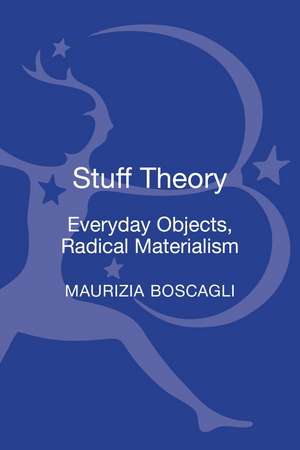
Stuff Theory: Everyday Objects, Radical Materialism
Autor Professor Maurizia Boscaglien Limba Engleză Hardback – 22 mai 2014
Stuff Theory's five chapters illustrate the intermittent flashes of modern 'minor' materiality in twentieth-century modernity as fashion, memory object, clutter, home décor, and waste in a wide range of texts: Benjamin's essays, Virginia Woolf's and Elfriede Jelinek's fiction, Rem Koolhaas' criticism, 1920s German photography and the cinema of Tati, Bertolucci, and Mendes. To call the commodified, ebullient materiality the book tracks stuff, is to foreground its plastic and transformative power, its fluidity and its capacity to generate events. Stuff Theory interrogates the political value of stuff's instability. It investigates the potential of stuff to revitalize the oppositional power of the object.
Stuff Theory traces a genealogy of materiality: flashpoints of one kind of minor matter in a succession of cultural moments. It asserts that in culture, stuff becomes a rallying point for a new critique of capital, which always works to reassign stuff to a subaltern position. Stuff is not merely unruly: it becomes the terrain on which a new relation between people and matter might be built.
Preț: 614.57 lei
Preț vechi: 914.27 lei
-33%
Puncte Express: 922
Carte tipărită la comandă
Livrare economică 07-21 decembrie
Livrare prin curier în România Termenul estimat este afișat lângă disponibilitate.
Transport gratuit pentru acest produs Plată online sau ramburs, în funcție de opțiunile comenzii.
Retur gratuit în 14 zile Comandă securizată și suport în română.
Specificații
ISBN-13: 9781623562687
ISBN-10: 1623562686
Pagini: 288
Dimensiuni: 140 x 216 x 19 mm
Greutate: 0.51 kg
Ediția:New.
Editura: Bloomsbury Publishing
Colecția Bloomsbury Academic
Locul publicării:New York, United States
ISBN-10: 1623562686
Pagini: 288
Dimensiuni: 140 x 216 x 19 mm
Greutate: 0.51 kg
Ediția:New.
Editura: Bloomsbury Publishing
Colecția Bloomsbury Academic
Locul publicării:New York, United States
V-ar putea interesa
-
 -31%Preț: 966.71 lei1403.45 lei
 -
 A History of the World in 100 ObjectsNeil MacGregor-25%Preț: 103.43 lei137.91 lei
 -
 -18%Preț: 1125.82 lei1372.95 lei
 -
 Urban ConsumptionPeter Newton-19%Preț: 462.57 lei571.07 lei
 -
 Consumer CultureCelia LuryPreț: 156.98 lei
 -
 -18%Preț: 1304.26 lei1590.56 lei
 -
 -18%Preț: 1252.71 lei1527.70 lei
 -
 The Appearances of MemoryAbidin KusnoPreț: 297.80 lei
 -
 Art, Anthropology and the GiftRoger SansiPreț: 317.52 lei
 -
 -18%Preț: 1046.10 lei1275.73 lei
 -
 The Material Culture of Tableware: Staffordshire Pottery and American ValuesJeanne Morgan Zarucchi-39%Preț: 735.86 lei1204.21 lei
 -
 -32%Preț: 666.65 lei976.12 lei
 -
 Space, Place and Religious Landscapes: Living MountainsDarrelyn Gunzburg-34%Preț: 617.13 lei929.88 lei
 -
 -25%Preț: 257.93 lei341.78 lei
 -
 A Return to the Object: Alfred Gell, Art, and Social TheorySusanne KüchlerPreț: 402.59 lei
 -
 -24%Preț: 257.25 lei337.51 lei
 -
 -18%Preț: 1296.62 lei1581.25 lei
 -
 Intercultural Transmission in the Medieval MediterraneanDr Stephanie L. Hathaway-25%Preț: 285.29 lei379.09 lei
 -
 Ethics After PoststructuralismLee OlsenPreț: 262.93 lei
 -
 -18%Preț: 923.70 lei1126.46 lei
 -
 -9%Preț: 1329.23 lei1460.68 lei
 -
 The Multivoices of Kenyan Primary School Children Learning to Read and WriteEsther Mukewa LisanzaPreț: 398.13 lei
 -
 -15%Preț: 254.46 lei299.17 lei
 -
 DancehallSonjah Stanley NiaahPreț: 381.12 lei
Cuprins
Introduction: Of Jena Glassware and Potatoes-Matter in the Moment
1. Homeopathic Benjamin: A Flexible Poetics of Matter
2. For the Unnatural Use of Clothes: Fashion as Cultural Assault
3. Paris Circa 1968: Cool Spaces, Decoration, Revolution
4. "You Must Remember this:" Memory Objects in the Age of Erasable Memory
5. Garbage in Theory: Waste Aesthetics
Envoi: What Should We Do With Our Stuff?
Notes
Index
1. Homeopathic Benjamin: A Flexible Poetics of Matter
2. For the Unnatural Use of Clothes: Fashion as Cultural Assault
3. Paris Circa 1968: Cool Spaces, Decoration, Revolution
4. "You Must Remember this:" Memory Objects in the Age of Erasable Memory
5. Garbage in Theory: Waste Aesthetics
Envoi: What Should We Do With Our Stuff?
Notes
Index
Recenzii
Boscagli's readings of objects are genuinely exciting ... For anyone interested in consumer capitalism, mediation, the cultural transition from modernity to postmodernity, or objects in art, however, Stuff Theory is a necessary read. Boscagli's writing throughout has verve, and the analyses are sharp, incisive, and often surprising.
The hinge between [modernist and new materialism] is supplied by the endlessly suggestive writing of Walter Benjamin who acts as the richest example of what can be gleaned when these two worlds are entangled ... Boscagli both follows Benjamin and pushes his work into new arenas ... Stuff Theory's engagement with 'new materialism' is wide ranging.
New materialism meets historical materialism, to the expansion and improvement of both. With enviable nuance and sophistication, imaginative verve and critical acuity, Maurizia Boscagli explores the complex, dynamic life of the stuff of capitalism, producing an innovative and original materialism for the twenty-first century. Essential reading.
At one point in David Fincher's 1999 cult film Fight Club, Brad Pitt's rascally Tyler Durden mocks a minor character who states vaguely that in college he studied "stuff." Maurizia Boscagli's dazzling Stuff Theory: Everyday Objects, Radical Materialism shows how Tyler might have taken this utterance seriously: "stuff" is indeed worthy of study. Each page brimming with fresh examples drawn from literature, art, and culture, and carefully informed by intellectual precursors from Marx to the new materialists, Boscagli's theory ultimately illuminates the practice of stuff, and suggests that this practice may be due for revision.
Matter is desire. Whether conceived as an object that can be represented and appropriated or as force whose unpredictability and vitality throws life wide open, matter never leaves us in peace. In this wonderful book Maurizia Boscagli explores how the everyday is shaped by these tantalizing movements of matter. Beyond the capitalocentricism of historical materialism and the detached hype of new materialism Stuff Theory proposes an experimental materialist practice that works with matter to remake the stuff that power and politics are made of.
Boscagli offers an exhilarating genealogy of the commodity in order to open up a questions that neither presuppose the old distinction between subject and object nor revel in the sheer plasticity of things. I especially admire the case that Stuff Theory makes for dialectic as the necessary means of thinking our way through and beyond the 19th-century opposition of materialism (which now includes cyborgian hybrids) to idealism (which has always included aesthetic expression). Bocagli's "radical materialism" shows that only a critique of post-commodity things can tell us how to read them as transformations of "stuff" that expresses the people and selves to which neo-liberalism denies subjectivity.
The hinge between [modernist and new materialism] is supplied by the endlessly suggestive writing of Walter Benjamin who acts as the richest example of what can be gleaned when these two worlds are entangled ... Boscagli both follows Benjamin and pushes his work into new arenas ... Stuff Theory's engagement with 'new materialism' is wide ranging.
New materialism meets historical materialism, to the expansion and improvement of both. With enviable nuance and sophistication, imaginative verve and critical acuity, Maurizia Boscagli explores the complex, dynamic life of the stuff of capitalism, producing an innovative and original materialism for the twenty-first century. Essential reading.
At one point in David Fincher's 1999 cult film Fight Club, Brad Pitt's rascally Tyler Durden mocks a minor character who states vaguely that in college he studied "stuff." Maurizia Boscagli's dazzling Stuff Theory: Everyday Objects, Radical Materialism shows how Tyler might have taken this utterance seriously: "stuff" is indeed worthy of study. Each page brimming with fresh examples drawn from literature, art, and culture, and carefully informed by intellectual precursors from Marx to the new materialists, Boscagli's theory ultimately illuminates the practice of stuff, and suggests that this practice may be due for revision.
Matter is desire. Whether conceived as an object that can be represented and appropriated or as force whose unpredictability and vitality throws life wide open, matter never leaves us in peace. In this wonderful book Maurizia Boscagli explores how the everyday is shaped by these tantalizing movements of matter. Beyond the capitalocentricism of historical materialism and the detached hype of new materialism Stuff Theory proposes an experimental materialist practice that works with matter to remake the stuff that power and politics are made of.
Boscagli offers an exhilarating genealogy of the commodity in order to open up a questions that neither presuppose the old distinction between subject and object nor revel in the sheer plasticity of things. I especially admire the case that Stuff Theory makes for dialectic as the necessary means of thinking our way through and beyond the 19th-century opposition of materialism (which now includes cyborgian hybrids) to idealism (which has always included aesthetic expression). Bocagli's "radical materialism" shows that only a critique of post-commodity things can tell us how to read them as transformations of "stuff" that expresses the people and selves to which neo-liberalism denies subjectivity.