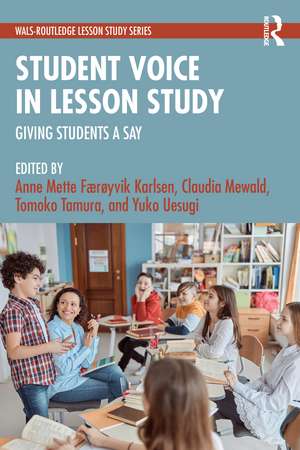
Student Voice in Lesson Study: Giving Students a Say: WALS-Routledge Lesson Study Series
Editat de Anne Mette Færøyvik Karlsen, Claudia Mewald, Tomoko Tamura, Yuko Uesugien Limba Engleză Paperback – 28 aug 2026
The book provides a comprehensive up-to-date compilation of important issues around SVLS. Chapters guide readers to understand the rich contextual nature of student voice in education and Lesson Study. It includes teachers, their learners, and researchers offering practice-oriented insights into their Lesson Study experience. The book explores and discusses theoretical foundations, social functions, roles, aims and purposes, the impact of attending to student voice, an emerging SVLS-methodology including issues of planning, coordinating, conducting, and reporting about student voice, dialogic teaching and learning, as well as democratic citizenship in Lesson Study.
It is a useful guide for practitioners and student educators interested in the benefits of Lesson Study in the classroom.


Preț: 358.53 lei
Nou
Puncte Express: 538
Carte tipărită la comandă
Livrare economică 02-16 decembrie
Livrare prin curier în România Termenul estimat este afișat lângă disponibilitate.
Transport gratuit de la 400.00 lei Plată online sau ramburs, în funcție de opțiunile comenzii.
Retur gratuit în 14 zile Comandă securizată și suport în română.
Specificații
ISBN-13: 9781041041122
ISBN-10: 1041041128
Pagini: 278
Ilustrații: 72
Dimensiuni: 156 x 234 mm
Greutate: 0.51 kg
Ediția:1
Editura: Taylor & Francis
Colecția Routledge
Seria WALS-Routledge Lesson Study Series
Locul publicării:Oxford, United Kingdom
ISBN-10: 1041041128
Pagini: 278
Ilustrații: 72
Dimensiuni: 156 x 234 mm
Greutate: 0.51 kg
Ediția:1
Editura: Taylor & Francis
Colecția Routledge
Seria WALS-Routledge Lesson Study Series
Locul publicării:Oxford, United Kingdom
Public țintă
Postgraduate, Professional Practice & Development, and Professional ReferenceCuprins
Introduction
Anne Mette Færøyvik Karlsen, Claudia Mewald, Tomoko Tamura, Yuko Uesugi
Part I
Student Voice in Lesson Study: from theory to practice
1. Student Voice in Lesson Study - an overview
Anne Mette Færøyvik Karlsen
2. Pedagogical implications of attending to student voice
Claudia Mewald
Part II
Student Voice in Lesson Study with social impact
3. Exploring student voice in Lesson Study at a Norwegian lower secondary school
Anne Mette Færøyvik Karlsen, Nina Helgevold
4. Student voice in foreign language education: the role of feedback
Claudia Mewald
5. Collaborating with students within Lesson Study groups: improving outcomes of Lesson Study at a senior school in Scotland
Andrew Kirkwood, John Paul Mynott
6. Student voice in teacher education in Hungary
Agnes Klein
Part III
Student-led Lesson Study
7. Can the perspectives and agency of students enhance Lesson Studies and what encourages and discourages teachers from actively involving students in Lesson Studies?
Tomoko Tamura, Peter Dudley
8. Active learning in the context of Japanese culture
Yuko Uesugi
9. Students as partners in Lesson Study: towards meaningful participation and educational co-agency
Daisuke Suzuki, Tomoko Tamura
10. A new type of Lesson Study through student voice: understanding learning through the eyes of students and teachers
Yasuhiro Shibata
Part IV
Case stories
11. Student voice as a means of developing inclusive learning environments: A Lesson Study on optimising learning for the visually impaired
Michael Krebs
12. ‘Now that I think about it!’
Eliciting student voice through discussion groups in Lesson Study
Andrew Kirkwood
13. Exploring students’ latent voices through lesson analysis: off-topic utterances and teacher prompts in fostering deep thinking
Yu Zhu, Masanobu Sakamoto
14. The motivation of Japanese high school students to participate in physics classes
Yuichi Hirano
Part V
Student Voice in Lesson Study with educational impact
15. The elevation of student voice in teacher education
Joanna C. Weaver, Emily Mueller
16. Student voice in action: Lesson Study as democratic and critical teacher education
Encarna Soto Gómez, María J. Serván Núñez, Ángel I. Pérez Gómez
17. What can be learned about students’ learning of subtraction from repeated task-based student interviews?
Hoda Ashjari, Éva Fülöp, Angelika Kullberg
18. Empowering pupils’ voices: transforming lessons through pupil-led planning in Japan
Miho Yamaguchi
Part VI
New approaches of Student Voice in Lesson Study
19. Towards a dialogic research-practice partnership model for Student Voice in Lesson Study and citizenship character education
Andrew J. Pereira, Yanping Fang, Pamela Costes-Onishi
20. Giving children a voice through pedagogical documentation in Lesson Study
Gonzalo Maldonado-Ruiz , Encarna Soto Gómez
21. Making the invisible learning visible: a phenomenological inquiry into student voice of unforgettable classroom moment
Shuying Li
Part VII
The next steps
22. Towards a model of Student Voice in Lesson Study
Claudia Mewald, Anne Mette Færøyvik Karlsen, Tomoko Tamura, Yuko Uesugi
Anne Mette Færøyvik Karlsen, Claudia Mewald, Tomoko Tamura, Yuko Uesugi
Part I
Student Voice in Lesson Study: from theory to practice
1. Student Voice in Lesson Study - an overview
Anne Mette Færøyvik Karlsen
2. Pedagogical implications of attending to student voice
Claudia Mewald
Part II
Student Voice in Lesson Study with social impact
3. Exploring student voice in Lesson Study at a Norwegian lower secondary school
Anne Mette Færøyvik Karlsen, Nina Helgevold
4. Student voice in foreign language education: the role of feedback
Claudia Mewald
5. Collaborating with students within Lesson Study groups: improving outcomes of Lesson Study at a senior school in Scotland
Andrew Kirkwood, John Paul Mynott
6. Student voice in teacher education in Hungary
Agnes Klein
Part III
Student-led Lesson Study
7. Can the perspectives and agency of students enhance Lesson Studies and what encourages and discourages teachers from actively involving students in Lesson Studies?
Tomoko Tamura, Peter Dudley
8. Active learning in the context of Japanese culture
Yuko Uesugi
9. Students as partners in Lesson Study: towards meaningful participation and educational co-agency
Daisuke Suzuki, Tomoko Tamura
10. A new type of Lesson Study through student voice: understanding learning through the eyes of students and teachers
Yasuhiro Shibata
Part IV
Case stories
11. Student voice as a means of developing inclusive learning environments: A Lesson Study on optimising learning for the visually impaired
Michael Krebs
12. ‘Now that I think about it!’
Eliciting student voice through discussion groups in Lesson Study
Andrew Kirkwood
13. Exploring students’ latent voices through lesson analysis: off-topic utterances and teacher prompts in fostering deep thinking
Yu Zhu, Masanobu Sakamoto
14. The motivation of Japanese high school students to participate in physics classes
Yuichi Hirano
Part V
Student Voice in Lesson Study with educational impact
15. The elevation of student voice in teacher education
Joanna C. Weaver, Emily Mueller
16. Student voice in action: Lesson Study as democratic and critical teacher education
Encarna Soto Gómez, María J. Serván Núñez, Ángel I. Pérez Gómez
17. What can be learned about students’ learning of subtraction from repeated task-based student interviews?
Hoda Ashjari, Éva Fülöp, Angelika Kullberg
18. Empowering pupils’ voices: transforming lessons through pupil-led planning in Japan
Miho Yamaguchi
Part VI
New approaches of Student Voice in Lesson Study
19. Towards a dialogic research-practice partnership model for Student Voice in Lesson Study and citizenship character education
Andrew J. Pereira, Yanping Fang, Pamela Costes-Onishi
20. Giving children a voice through pedagogical documentation in Lesson Study
Gonzalo Maldonado-Ruiz , Encarna Soto Gómez
21. Making the invisible learning visible: a phenomenological inquiry into student voice of unforgettable classroom moment
Shuying Li
Part VII
The next steps
22. Towards a model of Student Voice in Lesson Study
Claudia Mewald, Anne Mette Færøyvik Karlsen, Tomoko Tamura, Yuko Uesugi
Recenzii
‘Student Voice in Lesson Study: Giving Students a Say is a compelling and timely contribution to international Lesson Study research and practice. This outstanding volume demonstrates how students’ perspectives enrich teachers’ professional inquiry and deepen understanding of learning as a shared, dialogic process. The contributors show that Lesson Study can foster genuine pedagogic partnership, strengthening professional knowledge and educational improvement. Combining conceptual clarity with rich empirical insight, this book will be essential reading for educators, leaders, policymakers, and researchers committed to student-centred professional learning and school improvement’.
- David Pedder, Academic Dean, Emirates College for Advanced Education, Abu Dhabi, UAE
‘At its essence, Lesson Study is systemic collaborative professional learning among teachers, researchers, school administrators, textbook authors… and the focus of Lesson Study is students’ learning. But the students’ voice is often not explicitly present in the process. This book, by unequivocally “giving students a say” and considering them as “partners who have a voice within a learning partnership with educators, peers, school, and society,” brings to Lesson Study a new “driving force for innovation in teaching”’.
– Stéphane Clivaz, Lausanne University of Teacher Education, WALS president
‘This book captivates from its opening pages by challenging an assumption: that Lesson Study begins with the teacher. Instead, the authors invite us to see how it can begin with the student — with their questions, experiences, and ways of making meaning. In doing so, they offer a bold and refreshing reimagining of Lesson Study, positioning students not as observers but as authentic partners in shaping learning. The book inspires you to take a chance, reconsider the distribution of power in the classroom and see learning through the eyes of those for whom it exists. This is not just a collection of case studies, but a manifesto of a new approach — dialogical, ethical and truly transformative’.
– Tavilya Akimova, Zhubanov University, Department of Academic Quality, Vice director, Aktobe, Kazakhstan
- David Pedder, Academic Dean, Emirates College for Advanced Education, Abu Dhabi, UAE
‘At its essence, Lesson Study is systemic collaborative professional learning among teachers, researchers, school administrators, textbook authors… and the focus of Lesson Study is students’ learning. But the students’ voice is often not explicitly present in the process. This book, by unequivocally “giving students a say” and considering them as “partners who have a voice within a learning partnership with educators, peers, school, and society,” brings to Lesson Study a new “driving force for innovation in teaching”’.
– Stéphane Clivaz, Lausanne University of Teacher Education, WALS president
‘This book captivates from its opening pages by challenging an assumption: that Lesson Study begins with the teacher. Instead, the authors invite us to see how it can begin with the student — with their questions, experiences, and ways of making meaning. In doing so, they offer a bold and refreshing reimagining of Lesson Study, positioning students not as observers but as authentic partners in shaping learning. The book inspires you to take a chance, reconsider the distribution of power in the classroom and see learning through the eyes of those for whom it exists. This is not just a collection of case studies, but a manifesto of a new approach — dialogical, ethical and truly transformative’.
– Tavilya Akimova, Zhubanov University, Department of Academic Quality, Vice director, Aktobe, Kazakhstan
Notă biografică
Anne Mette Færøyvik Karlsen is an associate professor at Western Norway University of Applied Sciences, Norway, where she is responsible for courses that are part of the Master program of Educational Leadership. Her research focuses specifically on student voice and teachers’ professional learning in Lesson Study.
Claudia Mewald is an independent Lesson Study researcher and freelance teacher educator. She is a retired Professor of TESOL, having previously taught and conducted qualitative research in foreign language methodology, testing, and assessment at Austrian and international universities and schools.
Tomoko Tamura is a professor at Waseda University, Japan. Her work focuses on school-based curriculum development and management, student agency, Lesson Study, and teachers’ professional learning, and she has contributed to national-level educational policy discussions.
Yuko Uesugi is a professor at the prefectural Eikei University of Hiroshima, Japan, specialising in American literature and English education, focusing on Sylvia Plath, CLIL, and innovative pedagogy. She leads national and international projects on global competency, BEVI-based assessment, and developing new models linking intercultural competency with English proficiency.
Claudia Mewald is an independent Lesson Study researcher and freelance teacher educator. She is a retired Professor of TESOL, having previously taught and conducted qualitative research in foreign language methodology, testing, and assessment at Austrian and international universities and schools.
Tomoko Tamura is a professor at Waseda University, Japan. Her work focuses on school-based curriculum development and management, student agency, Lesson Study, and teachers’ professional learning, and she has contributed to national-level educational policy discussions.
Yuko Uesugi is a professor at the prefectural Eikei University of Hiroshima, Japan, specialising in American literature and English education, focusing on Sylvia Plath, CLIL, and innovative pedagogy. She leads national and international projects on global competency, BEVI-based assessment, and developing new models linking intercultural competency with English proficiency.
Descriere
This publication brings together top-quality contributions by distinguished authors from research and practice as well as students from around the world to flesh out the role of Student Voice in Lesson Study (SVLS). It is a useful guide for practitioners and student educators interested in the benefits of Lesson Study in the classroom.