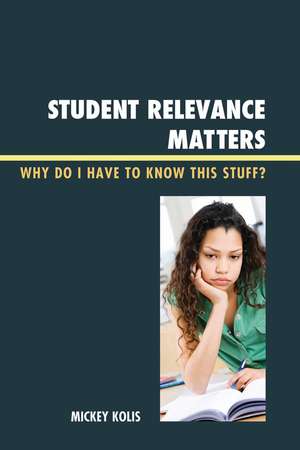
Student Relevance Matters: Why Do I Have to Know This Stuff?
Autor Mickey Kolisen Limba Engleză Hardback – 16 mar 2011
Student Relevance Matters: Why Do I Have to Know this Stuff? aims to clarify the most intrinsic reasons to learn, thereby bridging the gap between content and meeting student needs. This allows for compelling visions, and visions are the seed of learning.
This book describes current classrooms, students, and the relationships between them through systems viewpoints-one positive and the other skeptical that they are working as effectively as they might. Each content area is viewed through a lens of deep purpose and how that meets students' needs in timeframes that work best for students.
Using those purposes as lenses, knowledge areas are redefined and skills provided to help make those purposes a reality in classrooms today.
| Toate formatele și edițiile | Preț | Express |
|---|---|---|
| Paperback (1) | 207.89 lei 6-8 săpt. | |
| Bloomsbury Publishing – 16 mar 2011 | 207.89 lei 6-8 săpt. | |
| Hardback (1) | 378.95 lei 6-8 săpt. | |
| Bloomsbury Publishing – 16 mar 2011 | 378.95 lei 6-8 săpt. |
Preț: 378.95 lei
Preț vechi: 551.29 lei
-31%
Puncte Express: 568
Preț estimativ în valută:
67.07€ • 78.38$ • 58.23£
67.07€ • 78.38$ • 58.23£
Carte tipărită la comandă
Livrare economică 20 februarie-06 martie
Preluare comenzi: 021 569.72.76
Specificații
ISBN-13: 9781607099154
ISBN-10: 1607099152
Pagini: 124
Dimensiuni: 164 x 240 x 17 mm
Greutate: 0.41 kg
Ediția:New.
Editura: Bloomsbury Publishing
Colecția R&L Education
Locul publicării:New York, United States
ISBN-10: 1607099152
Pagini: 124
Dimensiuni: 164 x 240 x 17 mm
Greutate: 0.41 kg
Ediția:New.
Editura: Bloomsbury Publishing
Colecția R&L Education
Locul publicării:New York, United States
V-ar putea interesa
-
 -26%Preț: 336.45 lei457.70 lei
 -
 -20%Preț: 226.81 lei282.46 lei
 -
 Tools for Dossier Success: A Guide for Promotion and TenureJoy J. Burnham-21%Preț: 218.06 lei277.68 lei
 -
 Leading for Instructional ImprovementStephen FinkPreț: 229.18 lei
 -
 Preț: 202.81 lei
 -
 Teacher: Mastering the Art and Craft of TeachingTom Bennett-47%Preț: 118.36 lei221.71 lei
 -
 Supporting and Supervising your Teaching AssistantDr Jill Morgan-43%Preț: 103.85 lei182.69 lei
 -
 Preț: 230.48 lei
Cuprins
Foreword
Preface
Acknowledgements
Section 1And the point of schooling is? A systems perspective
Chapter 1Facts-based instruction - Why it seems to work
Chapter 2Generally accepted patterns and outcomes of facts-based instruction
Chapter 3A skeptics' view of facts-based instruction
Chapter 4Generally ignored patterns and outcomes of facts-based instruction
Section 2Purposes defined
Chapter 5Why purpose is important
Chapter 6The Purpose of Language Arts
Chapter 7The Purpose of Social Studies
Chapter 8The Purpose of Science
Chapter 9The Purpose of Mathematics
Chapter 10The Purpose of Health and Physical Education
Chapter 11The Purpose of Art
Chapter 12The Purpose of Music
Chapter 13The Purpose of Vocational Education
Chapter 14The Purpose of Foreign Language
Chapter 15All together
Section 3Purposes in the classroom
Chapter 16Knowledge needed
Chapter 17Roles
Chapter 18Compelling why
Section 4Conclusion
Preface
Acknowledgements
Section 1And the point of schooling is? A systems perspective
Chapter 1Facts-based instruction - Why it seems to work
Chapter 2Generally accepted patterns and outcomes of facts-based instruction
Chapter 3A skeptics' view of facts-based instruction
Chapter 4Generally ignored patterns and outcomes of facts-based instruction
Section 2Purposes defined
Chapter 5Why purpose is important
Chapter 6The Purpose of Language Arts
Chapter 7The Purpose of Social Studies
Chapter 8The Purpose of Science
Chapter 9The Purpose of Mathematics
Chapter 10The Purpose of Health and Physical Education
Chapter 11The Purpose of Art
Chapter 12The Purpose of Music
Chapter 13The Purpose of Vocational Education
Chapter 14The Purpose of Foreign Language
Chapter 15All together
Section 3Purposes in the classroom
Chapter 16Knowledge needed
Chapter 17Roles
Chapter 18Compelling why
Section 4Conclusion
Recenzii
A must-read for EVERY teacher, principal, and administrator, at all levels. Times have changed, and our educational systems need to change to keep up with providing a quality education for all students. Dr. Kolis' book gives some great insight on how to do this. This book is timely in addressing accountability and cultural responsiveness. You will want to redesign your lessons in the future. Dr. Kolis' love for learning and passion for the success of all students is evident.
I have been extremely fortunate to be part of the many discussions and applications that are the basis for Dr. Kolis' book. The theories and practical application of what is contained in this book changed my teaching from a teacher-centered, facts-based system to a student-centered inquiry system. The results have been an increase in student learning and understanding, students who are acting like scientists, and a teacher who is excited to be 'doing science' with his students!
Dr. Kolis challenges the existing approach to education in this timely text. Following a detailed description of the status quo, Dr. Kolis reframes educational practice in a student-centered useable format that builds upon big ideas as the driving force in teaching. This refreshing presentation breathes new life into the understanding and practice of teaching. I was left with a clear picture of what to do and, as importantly, why these practices should be done. This book is a must-read for educators who are interested in looking more deeply at meaningful change.
Kolis (Univ. of Wisconsin, Eau Claire) has written an enlightening, thought-provoking book for educators who believe in student-centered teaching. He presents ideas about how to develop discipline-specific lessons that connect the classroom to the "real world." Many of today's secondary students are interested only in the actual purpose of education; they want to know how this knowledge will help them in college and in the professional world. Kolis inspires teachers to create lessons that challenge young learners to think critically and to look beyond the classroom. Teachers who are advocates for inquiry-based learning, backward design, and teacher collaboration will appreciate all this book has to offer. Kolis even makes reference to "twenty first century learning" and The Partnership for 21st Century Skills, an organization that promotes collaboration between education and the community.
I have been extremely fortunate to be part of the many discussions and applications that are the basis for Dr. Kolis' book. The theories and practical application of what is contained in this book changed my teaching from a teacher-centered, facts-based system to a student-centered inquiry system. The results have been an increase in student learning and understanding, students who are acting like scientists, and a teacher who is excited to be 'doing science' with his students!
Dr. Kolis challenges the existing approach to education in this timely text. Following a detailed description of the status quo, Dr. Kolis reframes educational practice in a student-centered useable format that builds upon big ideas as the driving force in teaching. This refreshing presentation breathes new life into the understanding and practice of teaching. I was left with a clear picture of what to do and, as importantly, why these practices should be done. This book is a must-read for educators who are interested in looking more deeply at meaningful change.
Kolis (Univ. of Wisconsin, Eau Claire) has written an enlightening, thought-provoking book for educators who believe in student-centered teaching. He presents ideas about how to develop discipline-specific lessons that connect the classroom to the "real world." Many of today's secondary students are interested only in the actual purpose of education; they want to know how this knowledge will help them in college and in the professional world. Kolis inspires teachers to create lessons that challenge young learners to think critically and to look beyond the classroom. Teachers who are advocates for inquiry-based learning, backward design, and teacher collaboration will appreciate all this book has to offer. Kolis even makes reference to "twenty first century learning" and The Partnership for 21st Century Skills, an organization that promotes collaboration between education and the community.