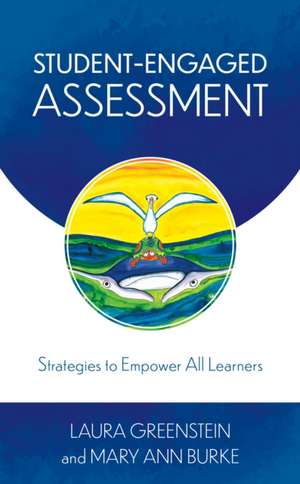
Student-Engaged Assessment: Strategies to Empower All Learners
Autor Laura Greenstein, Mary Ann Burkeen Limba Engleză Paperback – 30 iun 2020
This book is intended to be a hands-on guide for educators and students on the best and most effective practices for supporting students in their role as self-assessors. It develops sequentially from ensuring that students are assessment ready, to engaging students in assessment, and ultimately empowering students as assessors. Readers can also rely on the book to help them improve specific aspects of self-assessment that are most important in their setting and for their students.
Preț: 218.85 lei
Preț vechi: 291.90 lei
-25%
Puncte Express: 328
Carte tipărită la comandă
Livrare economică 08-22 decembrie
Livrare prin curier în România Termenul estimat este afișat lângă disponibilitate.
Transport gratuit de la 400.00 lei Plată online sau ramburs, în funcție de opțiunile comenzii.
Retur gratuit în 14 zile Comandă securizată și suport în română.
Specificații
ISBN-13: 9781475857825
ISBN-10: 1475857829
Pagini: 140
Ilustrații: 1 b/w illustration; 14 b/w photos; 29 tables; 7 textboxes
Dimensiuni: 154 x 222 x 12 mm
Greutate: 0.25 kg
Editura: Bloomsbury Publishing
Colecția Rowman & Littlefield
Locul publicării:New York, United States
ISBN-10: 1475857829
Pagini: 140
Ilustrații: 1 b/w illustration; 14 b/w photos; 29 tables; 7 textboxes
Dimensiuni: 154 x 222 x 12 mm
Greutate: 0.25 kg
Editura: Bloomsbury Publishing
Colecția Rowman & Littlefield
Locul publicării:New York, United States
Cuprins
Foreword
Preface
Acknowledgments
Introduction
Part 1
Chapter 1: Foundations of success
Chapter 2: The soar model
Chapter 3: Touchstones of effective assessment
Part 2
Chapter 4: Assessment ready learners
Chapter 5: Engaging students in assessment
Chapter 6: Developing students as owners of assessment
Chapter 7: When students become agents of assessment
Part 3
Chapter 8: partnering with parents
Chapter 9: Conclusions and next steps
References
About the authors
Preface
Acknowledgments
Introduction
Part 1
Chapter 1: Foundations of success
Chapter 2: The soar model
Chapter 3: Touchstones of effective assessment
Part 2
Chapter 4: Assessment ready learners
Chapter 5: Engaging students in assessment
Chapter 6: Developing students as owners of assessment
Chapter 7: When students become agents of assessment
Part 3
Chapter 8: partnering with parents
Chapter 9: Conclusions and next steps
References
About the authors
Recenzii
Laura Greenstein and Mary Ann Burke provide educators with an excellent resource to engage and empower students in the assessment process. Student-Engaged Assessment focuses on keeping the student at the center of engagement and showing educators the methods and means to make this a reality. The authors reinforce the idea that student engagement is key to not only personalizing learning goals, but also developing a meaningful, cogent action plan.
This book centers students in the assessment process by not only asking learners what they think should be measured, but also incorporating them in the design of assessment tools and practices.
Greenstein and Burke also build educator self-efficacy in this model by embedding self-reflection and documentation of mindsets across the text. The book builds the skillset of readers as they ask readers to think about and document learning process, products, and outcomes. The ability to document the reader's thinking creates an ongoing dialogue with the authors and points made in the text.
I work with students who rely on reading interventions to make progress towards grade level expectations. Being involved in learning and assessing is essential for these learners, as it is for all students. The book makes it easy for teachers to recognize the fundamental ideas of engagement and at the same time, it supports the reader in going as deeply as they need or want into the concepts and practices. The SOAR model provides an indispensable format for engaging all students in a sequential process towards agency.
As a believer in the power of self-directed learning, this book will guide and support teachers in taking student engagement to the next level. It does a powerful job of translating research and theory into an actionable and sequential plan for empowering students as self-assessors. It is a must-have resource for teachers and school leaders and will be a valuable asset for professional development in that teachers can customize and apply the models and templates for their own setting.
The practical ideas and strategies are immediately usable not only in our classrooms, but throughout our system, in both short cycle assessments as well as in support of national standards. When students are invested in their learning outcomes, whether they are in traditional schools or alternative settings, the practices described in this book are relevant, adaptable, and immediately useful. They are especially significant for our most vulnerable learners.
This book centers students in the assessment process by not only asking learners what they think should be measured, but also incorporating them in the design of assessment tools and practices.
Greenstein and Burke also build educator self-efficacy in this model by embedding self-reflection and documentation of mindsets across the text. The book builds the skillset of readers as they ask readers to think about and document learning process, products, and outcomes. The ability to document the reader's thinking creates an ongoing dialogue with the authors and points made in the text.
I work with students who rely on reading interventions to make progress towards grade level expectations. Being involved in learning and assessing is essential for these learners, as it is for all students. The book makes it easy for teachers to recognize the fundamental ideas of engagement and at the same time, it supports the reader in going as deeply as they need or want into the concepts and practices. The SOAR model provides an indispensable format for engaging all students in a sequential process towards agency.
As a believer in the power of self-directed learning, this book will guide and support teachers in taking student engagement to the next level. It does a powerful job of translating research and theory into an actionable and sequential plan for empowering students as self-assessors. It is a must-have resource for teachers and school leaders and will be a valuable asset for professional development in that teachers can customize and apply the models and templates for their own setting.
The practical ideas and strategies are immediately usable not only in our classrooms, but throughout our system, in both short cycle assessments as well as in support of national standards. When students are invested in their learning outcomes, whether they are in traditional schools or alternative settings, the practices described in this book are relevant, adaptable, and immediately useful. They are especially significant for our most vulnerable learners.