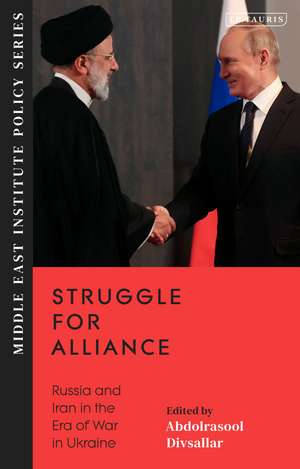
Struggle for Alliance: Russia and Iran in the Era of War in Ukraine: Middle East Institute Policy Series
Editat de Abdolrasool Divsallaren Limba Engleză Hardback – 19 sep 2024
The book analyzes various debates about the impact of the war on Russo-Iranian relations. From the perspective of the emerging literature on authoritarian regionalism, the book explores how domestic politics and common threat perceptions play a role in these states' decisions to adjust to the systemic changes caused by the war. Chapters address how changes in the strategic environment are affecting Moscow and Tehran's perception of each other, what factors contribute the most to both states' decision to pursue greater cooperation and how they manage the new conflicts of interest raised by the war. The book also queries whether relations continue to be based on tactical partnership, or whether a stronger alliance between Moscow and Tehran is unfolding, and what the consequences of such a struggle for alliance will be for the wider region.

Preț: 451.87 lei
Preț vechi: 656.08 lei
-31%
Puncte Express: 678
Carte tipărită la comandă
Livrare economică 30 noiembrie-14 decembrie
Livrare prin curier în România Termenul estimat este afișat lângă disponibilitate.
Transport gratuit pentru acest produs Plată online sau ramburs, în funcție de opțiunile comenzii.
Retur gratuit în 14 zile Comandă securizată și suport în română.
Specificații
ISBN-13: 9780755653515
ISBN-10: 0755653513
Pagini: 272
Dimensiuni: 142 x 220 x 26 mm
Greutate: 0.58 kg
Editura: Bloomsbury Publishing
Colecția I.B.Tauris
Seria Middle East Institute Policy Series
Locul publicării:London, United Kingdom
ISBN-10: 0755653513
Pagini: 272
Dimensiuni: 142 x 220 x 26 mm
Greutate: 0.58 kg
Editura: Bloomsbury Publishing
Colecția I.B.Tauris
Seria Middle East Institute Policy Series
Locul publicării:London, United Kingdom
Cuprins
Introduction: What Makes a New Study Needed?
Abdolrasool Divsallar
Part 1 - Domestic Debates: Between State enthusiasm and public uncertainty
Chapter 1. Iran's Ascent in Russian Foreign Policy Thinking: The Emergence of a New Paradigm
Nicole Grajewski, Postdoctoral Fellow with the Belfer Center at Harvard's Kennedy School
Chapter 2. The Ukraine War and Internal Debates in Iran
Mahmood Shoori, Deputy Director of the Institute for Iran & Eurasia Studies
Chapter 3. Identity, Statehood, and Strategic Sympathy
Dianna Galeeva, Visiting Fellow at Oxford Centre for Islamic Studies
Part 2 - Systemic Constraints
Chapter 4. Russian Policy in the MENA and Mediterranean Regions: Implications for Iran
Mark N. Katz, Professor of Government and Politics at the George Mason University Schar School of Policy and Government
Chapter 5. The Principle of Strategic Stability: Russia's Nuclear Policy Towards Iran
Anastasia Malygina, Associate Professor at the School of International Relations at St. Petersburg State University
Part 3 - A Hybrid Status: Competition amid Cooperation
Chapter 6. Anti-Americanism and a Dream of Non-Western Order
Jeffrey Mankoff, Distinguished Research Fellow at the U.S. National Defense University's Institute for National Strategic Studies
Mahsa Rouhi, Research Fellow at the U.S. National Defense University's Institute for National Strategic Studies
Chapter 7. Countering Sanctions: New Economic and Trade Prospects
Esfandyar Batmanghelidj, Founder and CEO, the Bourse & Bazaar Foundation
Chapter 8. Why Russian Energy Interests Cannot Match Iranian Ones
Jakub M. Godzimirski, Research Professor at the Norwegian Institute of International Affairs
Chapter 9. How the War in Ukraine Changes Russia and Iran's Posture in Syria and the Eastern Mediterranean
Hamidreza Azizi, Visiting Fellow at the German Institute for International and Security Affairs (SWP)
Part 4 - The Future of relations
Chapter 10. Is An Authoritarian Alliance Emerging?
Abdolrasool Divsallar
Conclusion
Abdolrasool Divsallar
Abdolrasool Divsallar
Part 1 - Domestic Debates: Between State enthusiasm and public uncertainty
Chapter 1. Iran's Ascent in Russian Foreign Policy Thinking: The Emergence of a New Paradigm
Nicole Grajewski, Postdoctoral Fellow with the Belfer Center at Harvard's Kennedy School
Chapter 2. The Ukraine War and Internal Debates in Iran
Mahmood Shoori, Deputy Director of the Institute for Iran & Eurasia Studies
Chapter 3. Identity, Statehood, and Strategic Sympathy
Dianna Galeeva, Visiting Fellow at Oxford Centre for Islamic Studies
Part 2 - Systemic Constraints
Chapter 4. Russian Policy in the MENA and Mediterranean Regions: Implications for Iran
Mark N. Katz, Professor of Government and Politics at the George Mason University Schar School of Policy and Government
Chapter 5. The Principle of Strategic Stability: Russia's Nuclear Policy Towards Iran
Anastasia Malygina, Associate Professor at the School of International Relations at St. Petersburg State University
Part 3 - A Hybrid Status: Competition amid Cooperation
Chapter 6. Anti-Americanism and a Dream of Non-Western Order
Jeffrey Mankoff, Distinguished Research Fellow at the U.S. National Defense University's Institute for National Strategic Studies
Mahsa Rouhi, Research Fellow at the U.S. National Defense University's Institute for National Strategic Studies
Chapter 7. Countering Sanctions: New Economic and Trade Prospects
Esfandyar Batmanghelidj, Founder and CEO, the Bourse & Bazaar Foundation
Chapter 8. Why Russian Energy Interests Cannot Match Iranian Ones
Jakub M. Godzimirski, Research Professor at the Norwegian Institute of International Affairs
Chapter 9. How the War in Ukraine Changes Russia and Iran's Posture in Syria and the Eastern Mediterranean
Hamidreza Azizi, Visiting Fellow at the German Institute for International and Security Affairs (SWP)
Part 4 - The Future of relations
Chapter 10. Is An Authoritarian Alliance Emerging?
Abdolrasool Divsallar
Conclusion
Abdolrasool Divsallar
Recenzii
This volume offers not only original and timely research on Russo-Iranian relations in the context of the war in Ukraine, but also a carefully structured and genuinely multidimensional analysis of the subject ... The chapters collectively demonstrate a high level of empirical rigour and conceptual clarity, making the book a valuable contribution to the existing literature.