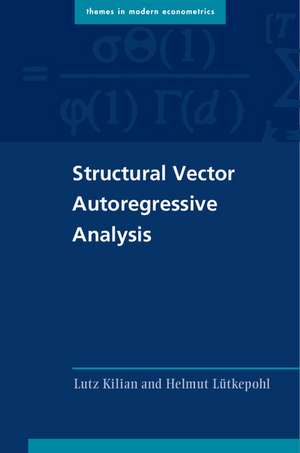
Structural Vector Autoregressive Analysis
Autor Lutz Kilian, Helmut Lütkepohlen Limba Engleză Paperback – 6 mar 2019
Pe linia practică a volumului Applied Macroeconometrics, dar cu un focus exhaustiv pe modelele autoregresive vectoriale structurale, Structural Vector Autoregressive Analysis se impune ca resursa definitivă pentru cercetătorul modern. Suntem de părere că această lucrare depășește abordările fragmentate din New Developments in Time Series Econometrics, oferind o sinteză unitară a unei literaturi care a evoluat rapid în ultimele decenii. Găsim în acest volum o rigoare metodologică dublată de o orientare clară spre rezultate, autorii prioritizând înțelegerea ipotezelor de lucru în detrimentul demonstrațiilor pur teoretice. Lutz Kilian și Helmut Lütkepohl construiesc aici o continuare firească a explorărilor din Var Models in Macroeconomics – New Developments – Essays in Honor of Christopher A. Sims, rafinând conceptele de inferență cauzală în macroeconometrie. Structura cărții este remarcabil de logică: după o introducere solidă în modelele VAR și VEC, autorii ghidează cititorul prin diverse strategii de identificare — de la restricții pe termen scurt și lung, până la metode moderne bazate pe semne, date externe sau medii bogate în date (Factor-Augmented VAR). Merită menționat modul în care textul tratează controversele metodologice, comparând sistematic SVAR cu modelele DSGE (Dynamic Stochastic General Equilibrium). Capitolele finale adresează provocări practice esențiale, precum nelinearitatea, șocurile non-fundamentale și schimbările structurale, oferind soluții concrete pentru modelarea seriilor de timp financiare și macroeconomice. Este o resursă care transformă teoria econometrică abstractă într-un set de instrumente de analiză aplicabilă, esențială pentru orice specialist în domeniu.
Preț: 519.37 lei
Preț vechi: 564.53 lei
-8%
Carte tipărită la comandă
Livrare economică 17 noiembrie-01 decembrie
Specificații
ISBN-10: 1316647331
Pagini: 756
Ilustrații: 40 b/w illus.
Dimensiuni: 152 x 229 x 45 mm
Greutate: 1 kg
Editura: Cambridge University Press
Locul publicării:New York, United States
V-ar putea interesa
-
 A Practical Guide to Price Index and Hedonic TechniquesAna M. Aizcorbe-29%Preț: 535.13 lei750.67 lei
 -
 The Index Number Problem: Construction TheoremsSydney Afriat-31%Preț: 898.74 lei1307.94 lei
 -
 Essays in Nonlinear Time Series EconometricsNiels Haldrup-31%Preț: 776.92 lei1125.45 lei
 -
 Introduction to Estimating Economic ModelsAtsushi Maki-18%Preț: 709.86 lei865.68 lei
 -
 Hdbk of MatricesLutkepohl-9%Preț: 1210.29 lei1329.99 lei
 -
 An Introduction to Mathematics for EconomicsAkihito AsanoPreț: 373.59 lei
 -
 Applied Time Series EconometricsHelmut LuetkepohlPreț: 399.03 lei
 -
 Handbook of Computational Social ChoiceFelix Brandt-20%Preț: 438.81 lei548.51 lei
 -
 Revealed Preference TheoryChristopher P. Chambers-14%Preț: 728.98 lei847.65 lei
 -
 Dynamic Economic AnalysisGerhard SorgerPreț: 422.69 lei
 -
 Revealed Preference TheoryChristopher P. ChambersPreț: 277.50 lei
 -
 Applied Choice AnalysisDavid A. Hensher-8%Preț: 636.14 lei691.45 lei
 -
 A Practitioner's Guide to Stochastic Frontier Analysis Using StataSubal C. KumbhakarPreț: 453.77 lei
 -
 Analysis of Economic DataG KoopPreț: 462.02 lei
 -
 Preț: 117.58 lei
 -
 British Economic StatisticsC. F. CarterPreț: 274.36 lei
 -
 A Guide to EconometricsPeter KennedyPreț: 249.47 lei
 -
 Ensemble Methods: Foundations and AlgorithmsZhi-Hua Zhou-20%Preț: 679.85 lei849.82 lei
 -
 Forecasting Aggregated Vector ARMA ProcessesHelmut LütkepohlPreț: 399.02 lei
 -
 New Introduction to Multiple Time Series AnalysisHelmut Lütkepohl-18%Preț: 878.32 lei1071.12 lei
 -
 Introduction to Multiple Time Series AnalysisHelmut LütkepohlPreț: 412.55 lei
De ce să citești această carte
Această carte este indispensabilă economiștilor și cercetătorilor care doresc să stăpânească analiza macroeconomică empirică. Veți învăța cum să alegeți corect metodele de estimare și cum să evaluați critic modelele SVAR în contextul datelor reale. Câștigați o înțelegere profundă a mecanismelor de identificare a șocurilor, trecând de la teorie la execuție practică prin exemplele ilustrative oferite de doi dintre cei mai reputați experți în econometrie.
Descriere scurtă
Cuprins
Recenzii
'Structural vector autoregressions (SVARs) are an essential tool in empirical macroeconomics. This book provides a thorough and long-overdue digest of a literature that has been thriving for over 35 years and seen a lot of exciting developments in the past decade. The authors masterfully blend theoretical foundations, guidance for practitioners, and detailed empirical applications. This is a must-read for anyone working with SVARs.' Frank Schorfheide, University of Pennsylvania